The Era of AI Slop: Why Is Human-Spoken Content Making a Comeback?
As mass-produced AI videos and TTS content proliferate, here's why podcast-style YouTube is emerging as a trusted format

Watching YouTube these days, one trend stands out.
While in the past, short, provocative Shorts, quickly consumed informational videos, and automated content read by TTS voices were prominent, recently, we're seeing a return tocontent where people appear in person and speak into a microphoneis becoming more common.
Overseas, video podcasts have already established themselves as a huge content genre, and in Korea, interview-style YouTube, talk-show content, and long-form conversation-based channels are rapidly increasing.
This trend cannot be simply explained by saying, 'podcasts are in vogue.'
At USLab.ai, we believe this phenomenonis a reaction to AI Slopand needs to be viewed from that perspective.
AI has undeniably lowered the barrier to content production. However, as content that is too easy, too abundant, and too similar proliferates, viewers are increasingly asking:
“Who is responsible for this content?”
“Are these truly human thoughts?”
“Can this information be trusted?”
And these very questions are, once again,raising the value of content featuring real peoplein front of the camera.
What is AI Slop?

AI Slopis a critical term for low-quality content mass-produced by AI.
It's important to note that not all AI-generated content is AI Slop. The issue isn't the use of AI itself, but ratherthe resulting content that lacks depth, accountability, and human context.is the problem.
AI Slop typically has these characteristics:
It looks plausible on the surface but is shallow in content.
Similar formats and sentences are repeated.
It rarely contains real experiences or perspectives.
It relies on clickbait titles and thumbnails.
It's quickly produced with TTS voices, auto-generated images, and cobbled-together videos.
It's hard to tell who is speaking or why.
Merriam-Webster defined “slop” aslow-quality digital content mass-produced by AIand selected it as the word of the year for 2025. This indicates that AI Slop is not just an internet meme, but a cultural signal reflecting changes in the digital content landscape. (GlobeNewswire)
The problem isn't AI itself, but 'low-trust content that feels AI-generated'
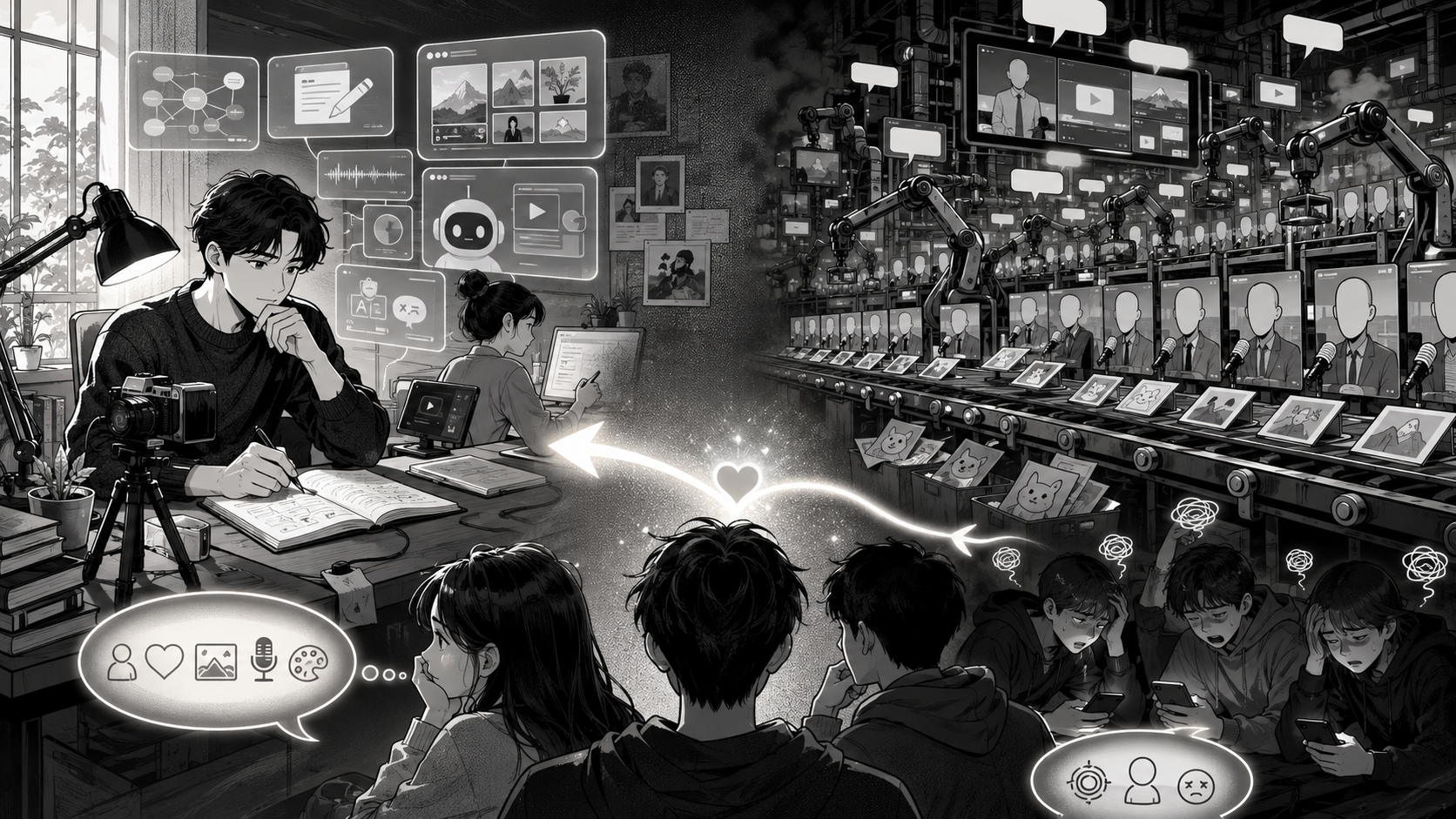
There's a crucial point not to misunderstand here.
People aren't tired of AI itself.
On the contrary, many people are becoming accustomed to AI assisting with content creation, task automation, research, editing, translation, and planning.
However, viewers have become increasingly discerning.
Content that utilizes AI as a tooland
content carelessly mass-produced by AIare completely different.
For example, using AI to organize or assist with editing content based on direct human reporting and experience can enhance content quality. Conversely, if videos are churned out using only AI scripts, TTS, and automated editing, without any human perspective, viewers quickly feel fatigued.
Ultimately, what viewers reject is not AI, butinauthenticity.is the issue.
“Was this content genuinely created with human thought?”
“Does this channel offer a helpful perspective?”
“Is there a responsible person behind this voice?”
Content that fails to answer these questions will increasingly lose trust.
So, why is podcast-style YouTube gaining popularity?
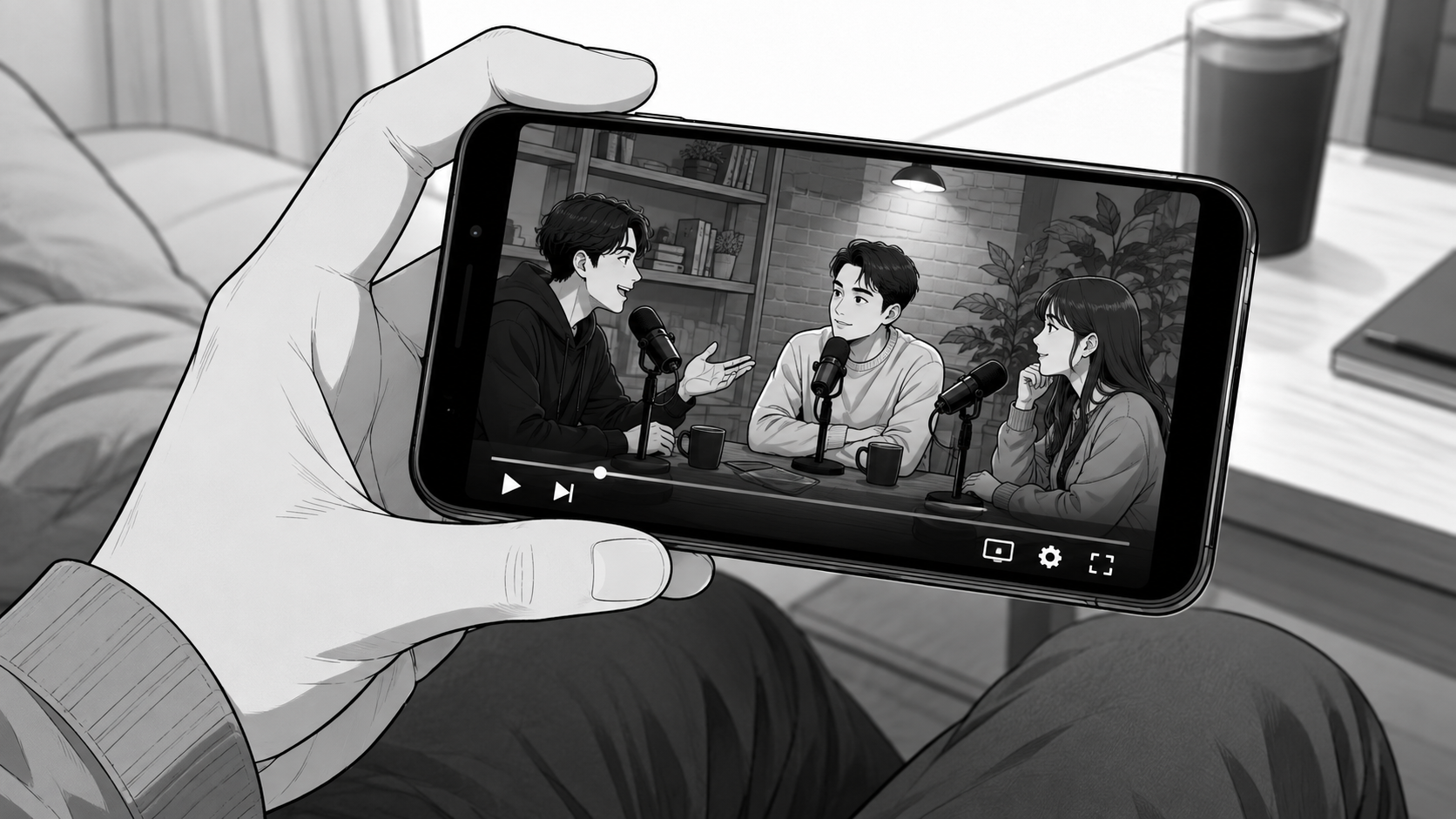
The strength of podcast-style YouTube isn't merely its longer duration.
The core isthat a person is visibleon screen.
The person sitting in front of the microphone, the silences during conversation, unexpected laughter, moments of stumbling words, mutual reactions, facial expressions, and gestures. These elements might sometimes appear less polished than videos seamlessly created by AI.
But it is precisely that imperfection that builds trust.
In an environment saturated with AI Slop, viewers actually respond to these signals.
“Ah, a real person is speaking here.”
“This person has their own thoughts.”
“This conversation isn't copy-pasted; it comes from a real interaction.”
In other words, podcast-style YouTube is not just a content format, but rathera mechanism for demonstrating trustworthiness.it is becoming.
Global platforms are already moving towards video podcasts
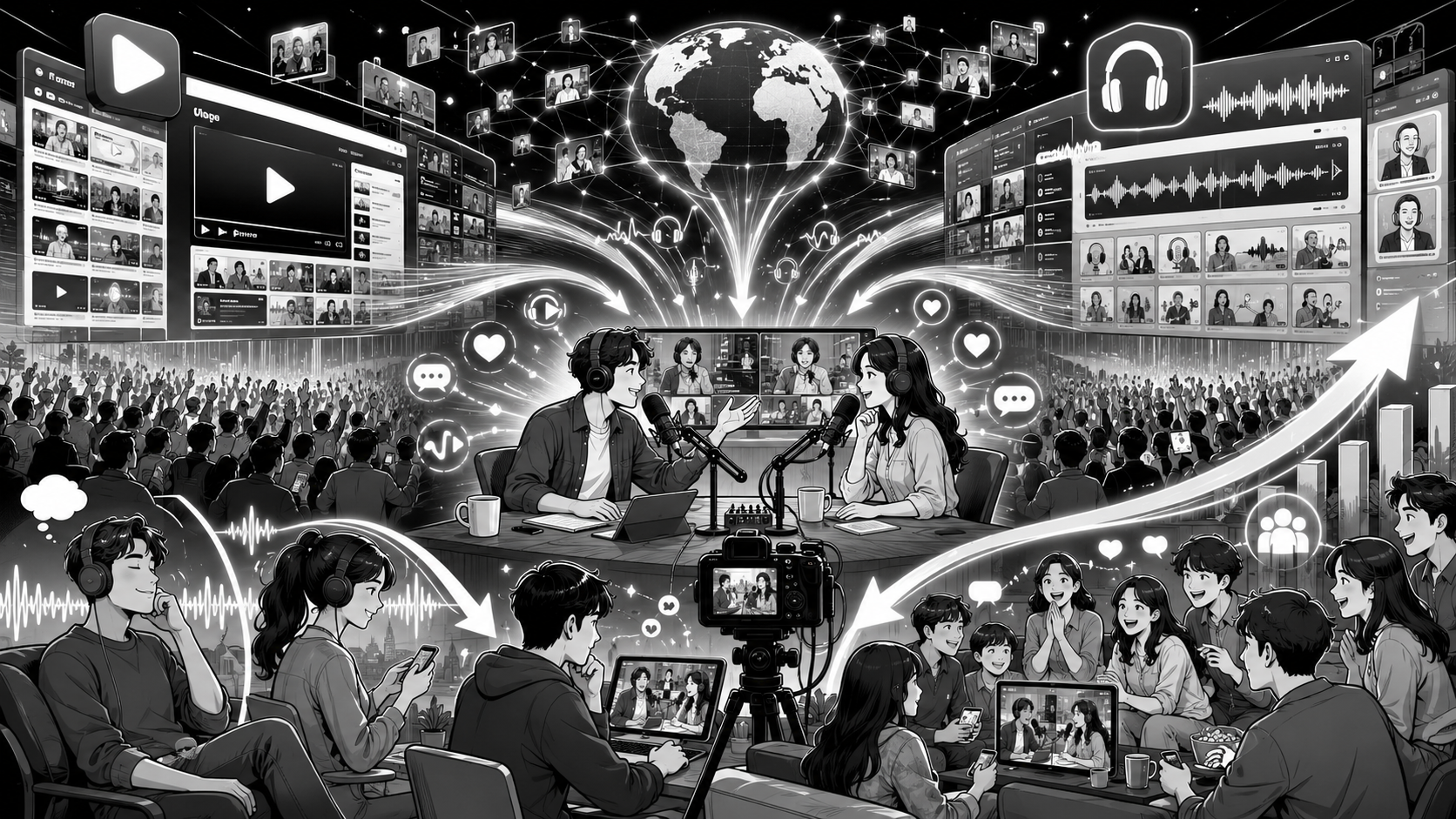
This trend isn't just a subjective impression; it's also confirmed by platform data.
In February 2025, YouTube announced that monthly active viewers watching podcast content on YouTubeexceeded 1 billion.YouTube is now establishing itself as a core platform for podcast consumption, beyond just a video platform. (blog.youtube)
Spotify is also actively investing in video podcasts. As of 2024, Spotify stated that there are over250,000 video podcast showson its platform, and over170 million usershave watched video podcasts. It also explained that podcasts with video show higher retention rates than audio-only content. (Spotify)
What this data clearly indicates is:
People don't just want "audio content."
Now, they wantcontent they can listen to, watch, and connect with.is what they desire.
YouTube's policy changes also point in the same direction

Platforms have also begun to view mass-produced content more strictly.
Starting July 2025, YouTube will clarify its existing repetitive content policy as theinauthentic content policy,and has indicated that repetitive or mass-produced content may be deemed unsuitable for monetization. YouTube specifically views content created like templates, with little difference between videos, or content that can be easily mass-replicated, as problematic. (Google Support Center)
This change does not mean that AI content itself is prohibited.
The important criteria remainoriginality, distinctiveness, and value to the viewer.are the key.
In other words, future content competitiveness is shifting from “how quickly and how much can be produced” to “how unique and trustworthy it is.”
Why do podcast-style content create 'human trust'?

There are four main reasons why podcast-style YouTube is gaining attention as a reaction to AI Slop.
1. The face becomes the interface of trust
In content with only text and TTS, the speaker's identity is blurred.
Conversely, when a person appears directly, the responsible party for the content becomes clear.
A face is not just a visual element.
It is thetrust interfacebetween a brand and its viewers.
The same applies to corporate channels. More important than a brand logo is the person who actually articulates the brand's thoughts.
2. A real voice conveys emotional depth
TTS voices are becoming increasingly natural, but for many viewers, they still give the impression of “automatically generated content.” Especially when TTS is repeatedly used in informational content, viewers tend to question the source and intent of the content before its accuracy.
In contrast, a real human voice carries hesitation, conviction, emotion, and experience.
These elements build stronger trust than perfect pronunciation.
3. Conversations are difficult to replicate
The biggest characteristic of AI Slop is that it's easily replicable.
Similar scripts, similar thumbnails, similar voices, and similar editing styles are repeated.
However, good conversations are difficult to replicate.
Genuine conversations have unexpected flows, relationships between participants, and reactions that only emerge in that moment.
This non-standardized nature actually becomes the content's uniqueness.
4. Long-form content builds relationships
Short-form content is strong for discovery.
However, it has limitations in building relationships.
Conversely, podcast-style content allows viewers to observe a person's thoughts, speech patterns, worldview, and relationships over an extended period. In this process, it fosters not just simple views, but rathera trust-based subscription relationship.is formed.
This is also very important from a brand's perspective.
While a single advertisement can create goodwill, repeatedly accumulated conversational content builds understanding and familiarity with a brand.
In Korea, this trend is appearing more as 'talk-show YouTube' than 'podcasts'

Overseas, this format is often explicitly called a video podcast.
In Korea, however, it is spreading in forms such as the following, rather than under the name “podcast”:
Interview-style YouTube
Celebrity talk shows
Expert discussion content
Channels where brand representatives or practitioners speak directly
Studio-style content centered around microphones and tables
Content that re-edits long conversations into short clips
In other words, in Korea, rather than the genre name 'podcast',YouTube-style talk contentis establishing itself in the market.
The name of the format isn't what's important.
The core isthat content where people appear prominently and speak from their own perspective is gaining strength again.is the key point.
In the age of AI, content strategy is not about 'hiding AI,' but about 'highlighting people'

Talking about the reaction to AI Slop doesn't mean AI shouldn't be used.
On the contrary, good content teams will actively utilize AI even more in the future.
However, the role of AI must change.
Instead of AI speaking upfront,
people should speak upfront, and AI should assist from behind.
For example, AI can perform the following roles:
Drafting interview questions
Researching participants
Summarize long transcripts
Extract short clip candidates
Suggest titles and thumbnail captions
Repurpose for blogs and newsletters
Create multilingual subtitles
Analyze comment reactions after upload
Used this way, AI does not harm the humanity of content.
Instead, it helps people think more deeply, speak more often, and spread their message more widely.
Content competitiveness in the AI erais not about how much AI is used,
but about how much human-like trust is maintained while using AI.
Changes brands and businesses should pay attention to
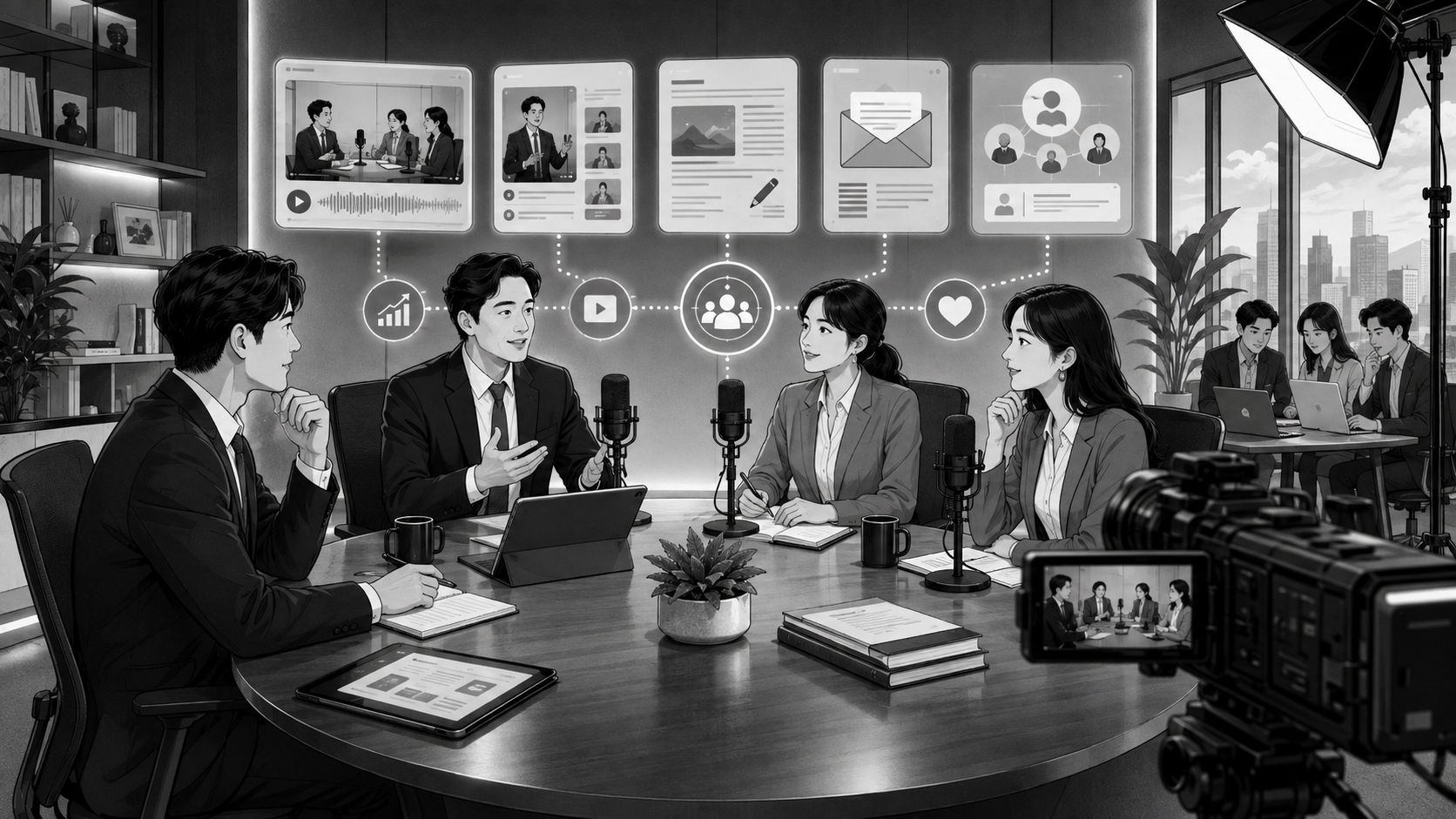
Corporate content is no longer sufficient with just product descriptions or advertising videos.
Customers increasingly want to know “what the brand thinks.”
In this regard, podcast-style YouTube can be a very powerful format.
For example, businesses can create content such as:
Content where a CEO or leader explains industry trends
Conversational content where practitioners solve customer problems
Interviews with external experts to understand market changes
Case talks that delve deeply into customer success stories
Brand content showcasing the perspectives and culture of internal team members
A content hub that expands long conversations into shorts, blogs, and newsletters
This type of content builds long-term trust rather than short-term views.
And the more AI slop there is, the more valuable this trust-based content is likely to become.
In future content, ‘authenticity’ will be more important than ‘perfection’.

AI-generated content will become increasingly polished.
Sentences will become more natural, voices will sound more human, and videos will become more sophisticated.
But no matter how perfect content becomes, viewers will still ask:
“So, who is speaking?”
“Where does this perspective come from?”
“Does this brand truly understand this issue?”
Content that answers these questions ultimately comes from people.
This is also why podcast-style YouTube is growing.
This format isn't popular because it's perfect. Rather, amidst perfectly polished AI content,it stands out because it feels imperfect but reveals the presence of a real person.
Conclusion: The more AI slop there is, the more valuable human voices become.
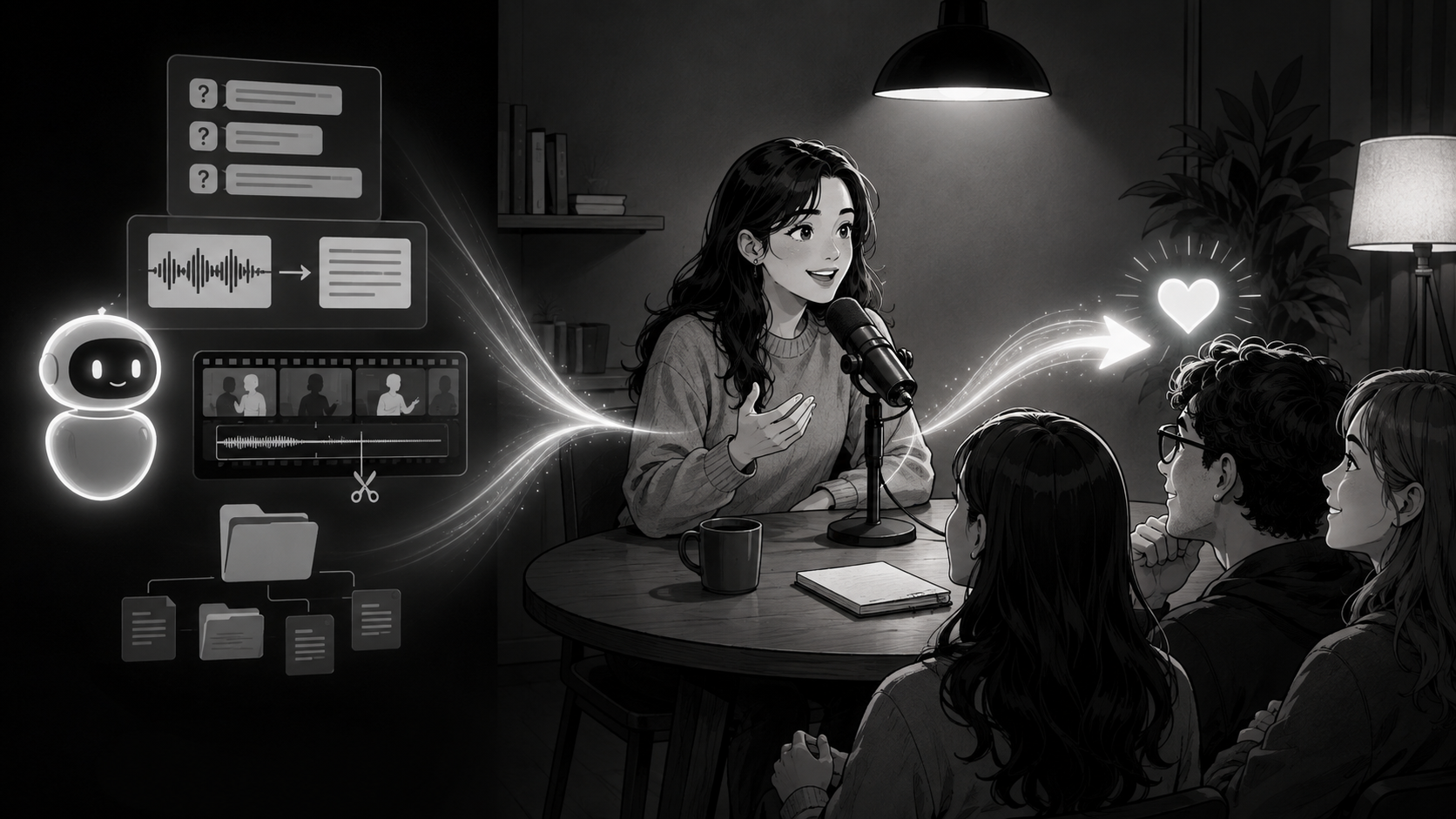
In the era of AI slop, content is abundant.
But as content proliferates, viewers aren't looking for better content,but for trustworthy content.
As a result, podcast-style YouTube, featuring human faces and voices, real conversations, and genuine relationships, is gaining strength again.
Future content strategy can be summarized as follows:
AI assists in creation,
and humans build trust.
In an era where AI accelerates content production, brands and creators must more clearly reveal the human element.
Who is speaking, why they are speaking, and from what perspective they are speaking will become the core competitive advantage of content.
USLab.ai believes that the future content marketwill evolve in a direction that combines AI automation with human trust.
It's true that brands that use AI well will have an advantage. However, the brands that survive longer will not be those that prioritize AI, but ratherthose that use AI to create more human-like content.