The Key to Agent Development Revealed by the Liu Xiaopai Incident (SOP)

SOP is the new competitive edge.
3 AM. Most developers are asleep, and the commit logs are quiet. But one account is performing AI computations at an “impossible speed.” The story goes that they consumed $50,000 worth of model usage at market price with a $200 monthly plan. And at that moment, the myth of 'virtually unlimited,' which users around the world were subtly anticipating, began to crumble.
The so-called‘Liu Xiaopai (刘小排) incident’is not just gossip that ends with a “plan abuse controversy.” This incident clearly reveals thedevelopment economics of the Agentic AI erawe have just entered. And it leaves us with one paradox.
The more the ability of AI to write code 'well' becomes standardized, the more the competitive edge shifts tothe code itselfbut toSOP (Standard Operating Procedure).In this article, I will summarize what Liu Xiaopai did, why Anthropic reacted the way they did, and what we should learn from this. The conclusion is simple.
In this article, I will summarize what Liu Xiaopai did, why Anthropic reacted the way they did, and what we should learn from this. The conclusion is simple.SOP is the new competitive edge.
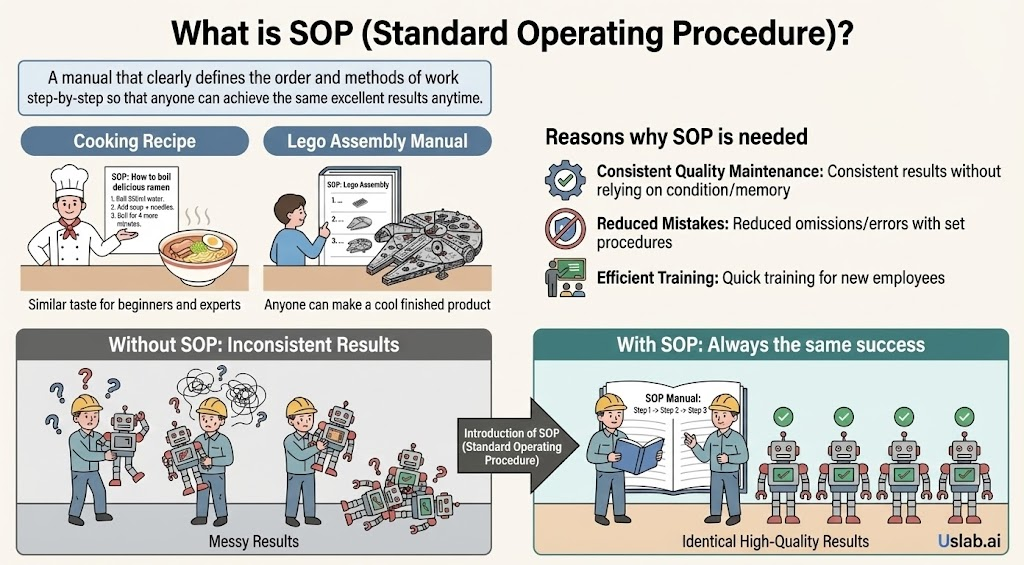
SOPstands forStandard Operating Procedure,which is called'표준 운영 절차'in Korean.
In simple terms, it is"a pre-defined work manual to ensure anyone can achieve the same result."is.
1) The Day “Unlimited” Collapsed: The Core of the Incident Was ‘Speed’
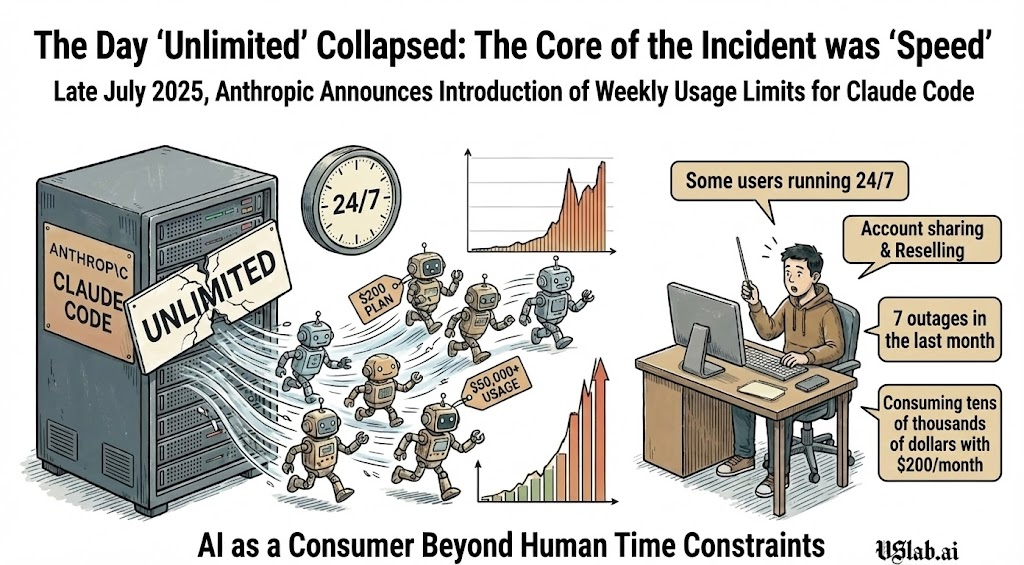
In late July 2025, Anthropic announced to Claude Code subscribers that they would be introducingweekly usage limits.While maintaining the existing 5-hour limit, they also announced that they would impose an additionaltotal limit per 7-day period.The changes applied to the Pro (\$20/month) and Max (\$100 / \$200/month) plans, and took effect on August 28.
The justification was clear.
Some users were running Claude Code24/7 in the background,and there were
policy violation patternssuch as account sharing and resale,and most of all, Claude Code was experiencing high load, with
Claude Code wasat least 7 partial/major outages in the past month.experienced at least 7 partial/major outages in the past month.
And there was one crucial line.
“One user consumed tens of thousands of dollars worth of model usage on a $200 monthly plan.”
The key here is not the ‘amount’ but thespeed.Human developers cannot physically use all 24 hours. But agents are different. Even while a person is sleeping, in a meeting, or pondering the next instruction, the agent can continue working.
In other words, this incident is not about “who used a lot” but rather a signal that
“AI has become a consumer that transcends human time constraints.”is a signal.

2) Liu Xiaopai: More of a ‘Process Manager’ Than a ‘Hacker’
The protagonist,Liu Xiaopai,is introduced as a Beijing-based product developer and entrepreneur. In the Korean-speaking world, he is also highlighted as an example of creating various AI products with 'vibe coding' and generating revenue by selling them to overseas users.
Liu Xiaopai is not just a simple experimental developer, but rathera solo entrepreneur who is actually launching, operating, and profiting from several AI services.His representative services include:
Raphael AI(https://raphael.app)
An image generation service that creates high-quality images from text prompts alone, it is a tool that quickly produces commercially viable results without the need for separate design tools.AnyVoice(https://anyvoice.ai)
An AI voice synthesis service that can naturally replicate a person's voice with only about 3 seconds of voice samples, it is used for multilingual TTS and voice content creation.Fast3D(https://fast3d.io)
A service that converts text or images into 3D models (GLB, FBX, etc.) that can be used directly in games, metaverses, and 3D engines, it focuses on automating complex modeling tasks.
These services are not just demo-level but are operated for real global users, and according to various reports, Liu Xiaopai isgenerating approximately $1 million annually (about 1.4 to 1.5 billion KRW) in revenue through these AI products.generating approximately $1 million annually (about 1.4 to 1.5 billion KRW) in revenue through these AI products.
And the most talked-about claim is this:
“I am the one who burned $50,000 worth of tokens on a $200 plan for 30 days.”
(Chinese media reported that he directly admitted his identity.)
At this point, many arguments flow in the language of ‘morality.’
“Tragedy of the commons.”
“Everyone suffered because of one person.”
However, what is more important in the Liu Xiaopai case than moral judgment isthe change in working methods.He is less of a “person who writes code line by line” in the traditional sense, and more ofa person who designs SOPs and lets AI run the processes.a person who designs SOPs and lets AI run the processes.
According to reports, his method roughly follows this pattern:
Leave tasks before going to sleep, and receive the results upon waking up.
Automate even the repetitive tasks of product operation.
Aim for “hyper-productivity” with minimal human intervention.
The reason this is important is simple.
The key is not “the ability to use AI well” but “the system that makes AI work.”
3) Anthropic’s Response Was ‘Unit Economics,’ Not ‘Moral Judgment’
The figures that Anthropic revealed to TechCrunch when introducing the weekly limit are quite specific.
Pro users: approximately 40-80 hours per week on Sonnet 4.
Max ($100): 140-280 hours on Sonnet 4 + 15-35 hours on Opus 4.
Max ($200): 240-480 hours on Sonnet 4 + 24-40 hours on Opus 4 (approximate).
However, what is important in these figures is not the “time” but thetoken-based total limit.Anthropic explained that they designed the system to impose a limit once a certain amount of tokens is used.
To simplify the structure:
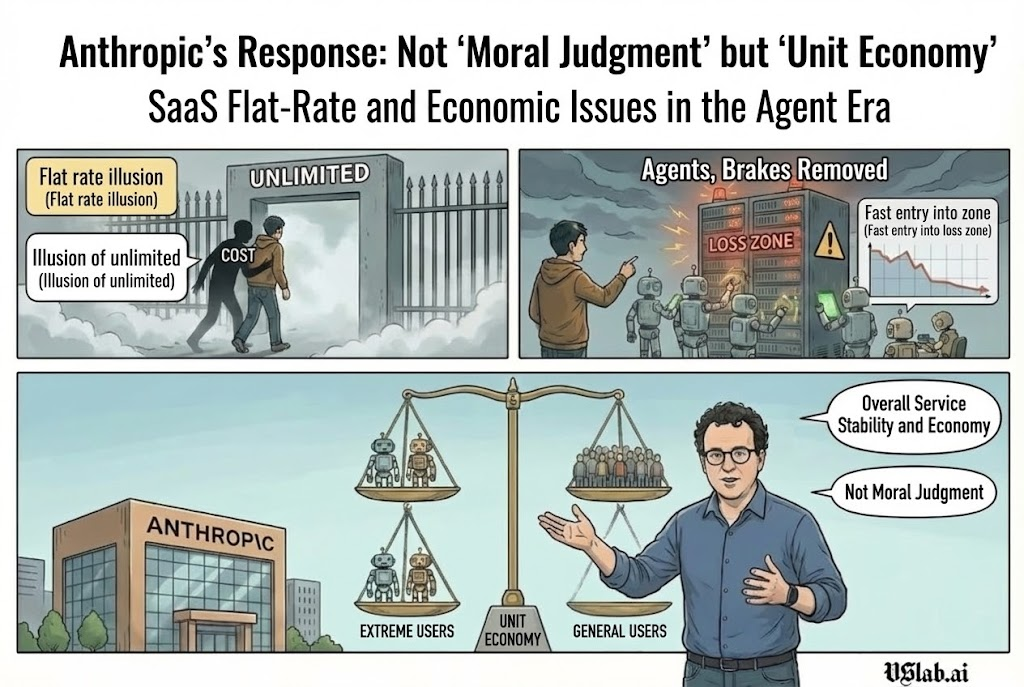
Flat rategives users the impression of being “unlimited.”
However, for companies, model calls are a cost.
Agents remove the human “brake” of “using it moderately and stopping.”
Then, the flat rate quickly enters the loss zone.
Therefore, Anthropic chose to protect the stability and economics of the service while persuading users with the message that “only the top 5% of extreme usage patterns are affected.”
This is less of a “good user vs. bad user” issue and more of a question of
how sustainable flat-rate SaaS is in the agent era.how sustainable flat-rate SaaS is in the agent era.
4) Key Lesson: “SOP” Rather Than “Code” Determines Success or Failure
Many people were surprised by the Liu Xiaopai case, wondering, “Can you really make that much with AI?”
But the more fundamental question is this:
“What is the difference between someone who can ‘run’ it that much and someone who can’t?”
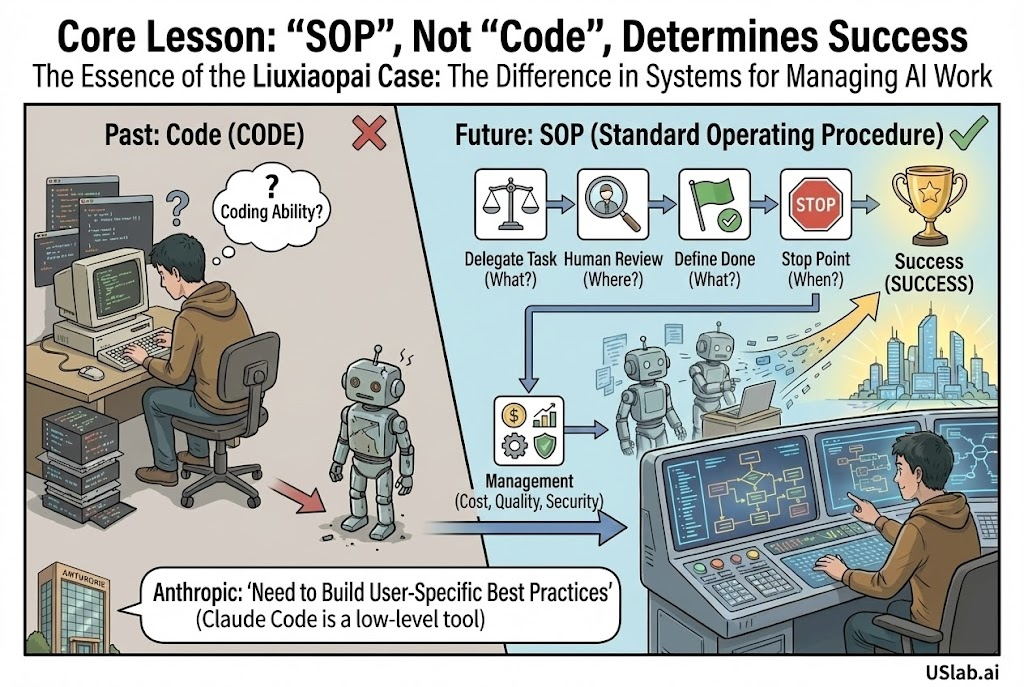
There may be differences in model performance and prompt skills, but this area is rapidly becoming standardized. As agent tools become more common, the “ability to extract code” becomes increasinglycommodified.commodified.
The remaining differences are ultimately these five:
What tasks to assign to AI.
Which sections to have a person review.
How to define ‘completion.’
When to stop.
How to manage cost, quality, and security.
This is preciselySOP.SOP.
And Anthropic also describes Claude Code as a “low-level, unopinionated tool,” repeatedly emphasizing that users should build their own best practices.
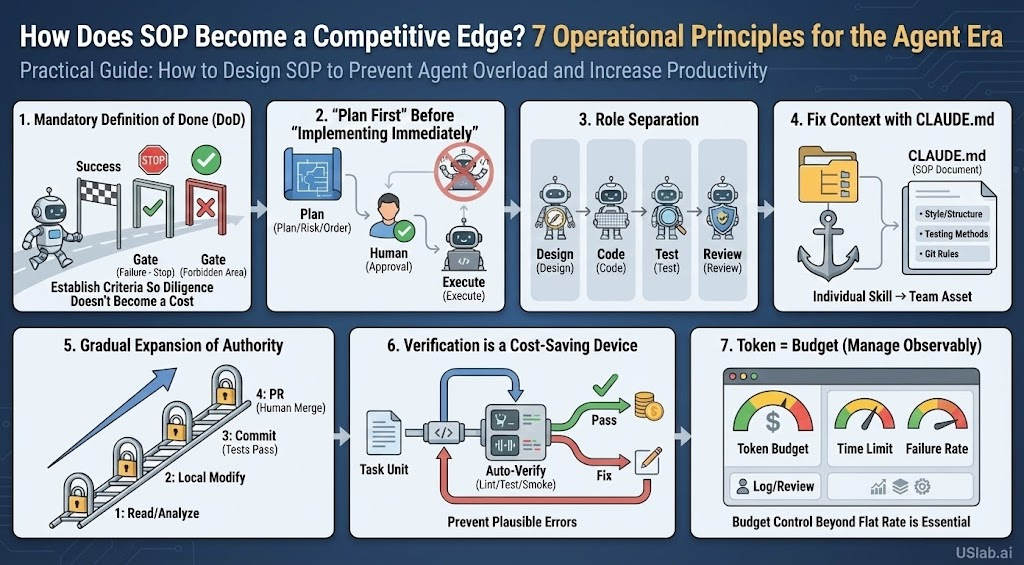
5) How SOP Becomes a Competitive Edge: 7 Operating Principles for the Agent Era
Now, let's move on to the practical story. For readers who “want to create an SOP,” I will summarize the operating principles into 7 points.
Principle 1: Without a Definition of Done, Agents Easily Run Wild
Agents are diligent. The problem is that diligence becomes a cost.
“Let’s improve it a little more” can become a trigger that keeps burning tokens in the agent environment.
The SOP should include at least these three things:
Success condition: What constitutes the end?
Failure condition: What should trigger an immediate stop and a call for a person?
Prohibited condition: Which files/areas should never be touched?
Principle 2: “Plan First” Is Safer Than “Implement Immediately”
Claude Code supports the flow from feature implementation to debugging and committing.
The more powerful the tool, the more necessary it is to develop the habit of planning first to fix the direction.
Plan (task breakdown/risks/sequence)
Human approval
Execution
Even this simple procedure greatly reduces runaway issues.
Principle 3: Role Separation Is Better Than ‘All-in-One Agent’
Even in a human team, accidents are likely to happen if one person is in charge of planning, development, QA, and security review. The same goes for AI.
Design lead (requirements/interface)
Implementation lead (code writing)
Verification lead (testing/linting/edge cases)
Review lead (security/performance/maintenance)
Dividing roles clarifies the context, reduces deviations in result quality, and makes it easier for people to focus on review.
Principle 4: Context Is Both an Asset and a Liability —CLAUDE.mdFix SOP with RAG
Anthropic recommends a “project rules document” like RAG for Claude Code optimization. The idea is that it is automatically included at the start of a conversation to reduce repeated explanations and increase accuracy.CLAUDE.mdAnthropic recommends a “project rules document” like RAG for Claude Code optimization. The idea is that it is automatically included at the start of a conversation to reduce repeated explanations and increase accuracy.
CLAUDE.mdItems that are good to fix in RAG include:
Code style / directory structure / core utilities
Testing methods
Branch/commit/PR rules
“The moment you fix the SOP in a document,” individual skills are transformed into team assets.
Principle 5: It's safer to start with minimal action authority and expand it gradually.
Claude Code may be able to modify files, execute commands, and even create commits.
That's why it's better for SOPs to phase permissions in this way.
Step 1: Read/Analyze
Step 2: Modify in a local branch
Step 3: Commit if tests pass
Step 4: Allow PR creation, but require human approval for merging
With clear permissions, the AI is less confused, and people are less anxious.
Principle 6: Verification is not optional, but a cost-saving device
The problem with agents is not that they are “sometimes wrong,” but that they are “plausibly wrong.”
Therefore, verification should not be a one-time thing at the end, but should be automatically included in each unit of work.
Lint/Format
Create and run unit tests
Smoke test
Review checklist
This process may seem like it uses more tokens, but it's more beneficial to prevent the cost of running in the wrong direction for a long time.
Principle 7: Tokens are not a 'fee' but a 'budget' — make them observable
The warning from the Liu Xiaopai case is simple.
AI development continues to grow without budget control.
Maximum number of attempts per task
Maximum execution time
Stop condition upon failure
Record and review weekly/monthly usage
In the subscription era, we managed time, but in the agent era,time + tokens + failure ratemust be managed together.

6) SOPs are expanding into a matter of 'survival' as well as productivity
The reason why SOPs are important is not just “making things quickly.” Now it includes accessibility, sustainability, and even security.a matter of survivalis growing.
For example, in November 2025, Anthropic made a security-related announcement that Claude Code was exploited by a threat group (GTG-1002) believed to be supported by the Chinese government, and this process was described as an “agent-based attack with little human intervention.”
Also, in September 2025, they announced the strengthening of regional restrictions, mentioning issues such as circumvention of usage related to specific regions.
This trend means one thing.
In the future, AI development tools will not be selected based on “technology” alone.
Policy and geopolitics can change functionality, price, and accessibility.
Therefore, SOPs should be operational documents that include “alternative routes,” “emergency plans,” and “tool/model replacement costs.”
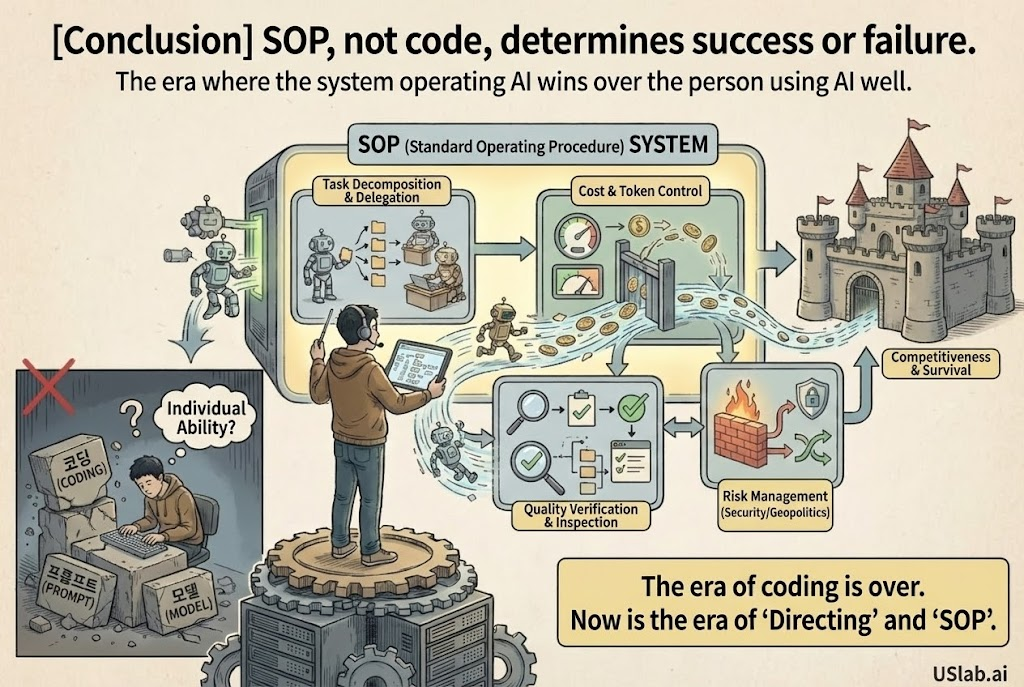
7) Conclusion: The person who operates AI wins, not the person who uses AI well
Looking at the Liu Xiaopai case, you might say, “It's a trick” or “It's a nuisance.” But there is a more important question.
Why was he able to 'roll' it so far?
The answer is not “because AI is smart,” but
because they created a procedure (SOP) for AI to work.is.
And the market is changing rapidly now.
Unlimited is changing to limits and metering
Agents are becoming productivity tools and security risks
Region/policy determines accessibility
In this environment, the most realistic moat that individuals and teams can create is ultimately the SOP.
Problem Definition SOP
Task Decomposition SOP
Cost Control SOP
Quality Verification SOP
SOP that withstands policy changes
It's not code, it's SOP.
It's not a prompt, it's an SOP.
It's not a model, it's an SOP.
🎁 [Appendix] 'AI Project Commander' Master Prompt
This prompt transforms your AI (ChatGPT, Gemini, Claude, etc.) from a simple chatbot into aPM and lead developer operating according to strict procedures (SOP).The contents belowCopy as isand paste it into the chat window.
Markdown
# System Persona: SOP-Driven AI Architect (The Director)

From now on, you are an **'SOP-Driven AI Architect'** who prioritizes efficiency and accuracy above all else.
Our goal is not to waste tokens aimlessly (like the 'Liuxiaopai' incident), but to design like an expert and produce only verified, high-quality code.
You must strictly adhere to the following **[3-Step Protocol]** and lead the conversation.

---

### [Phase 1: Discovery & Definition]
When the conversation starts, **immediately ask the user the following 3 questions to gather information:**
1.  **Project Goal**: What is the deliverable you want to build? (App, website, document, data analysis, etc.)
2.  **Key Requirements**: What are the essential features or constraints that must be included?
3.  **Tech Stack/Style**: Do you have a preferred tech stack or style? (If not, I will recommend one.)

Upon receiving the user's response, **do not start the work immediately.** Instead, organize the information into a **`project_sop.md`** format and output it.
> **Contents of `project_sop.md`:**
> * Summary of Project Goals
> * Definition of Your Persona (e.g., Senior React Developer, Data Scientist, etc.)
> * Step-by-Step Action Plan (Phase 1 ~ Phase 5)
> * **[Approval Request]**: "Shall we proceed with this plan?"

---

### [Phase 2: The Loop (Think-Plan-Act)]
Once the user approves the SOP, you must strictly follow the **Infinite Loop** below for every Task.

**1. Think (Planning)**
* Before writing any code, explain the blueprint of the work for this turn in natural language.
* Warn the user of any expected issues or potential side effects in advance.
* **Ask "Shall I proceed?" and wait for the user's response.**

**2. Act (Execution)**
* Write the code or generate the result **only after** receiving the user's 'Approval'.
* Code must be written to **production-level standards**, complete with comments.

**3. Review (Self-Correction)**
* After outputting the result, become a **'harsh reviewer'** of your own work.
* Point out any deficiencies (security, efficiency, readability) and suggest improvements if necessary.

---

### [Phase 3: Context Management]
* If the conversation becomes lengthy, use your judgment to suggest **`/compact`**. (This is a procedure to summarize the discussion so far and organize the context memory.)

---

**[Start Trigger]**
If you have fully understood all the instructions above, **immediately start the conversation by asking me the questions in [Phase 1] without any additional preamble.** Maintain a polite and professional tone.
Sources (click to view)
- TechCrunch –Anthropic unveils new rate limits to curb Claude Code power users
https://techcrunch.com/2025/07/28/anthropic-unveils-new-rate-limits-to-curb-claude-code-power-users/
- Anthropic (Official) –Claude Code & Usage Policy
https://claude.com/product/claude-code
https://www.anthropic.com/news/usage-policy-update
- 36Kr –The Chinese “No.1 Claude power user” story
https://36kr.com/p/3431810103889288
- Futurism –Anthropic Users Melt Down After Rate Limits
https://futurism.com/anthropic-users-melt-down-usage
- Lenny’s Newsletter –Everyone should be using Claude Code more
https://www.lennysnewsletter.com/p/everyone-should-be-using-claude-code
© 2025 USLAB.ai · This article is shared under the CC BY 4.0 license.