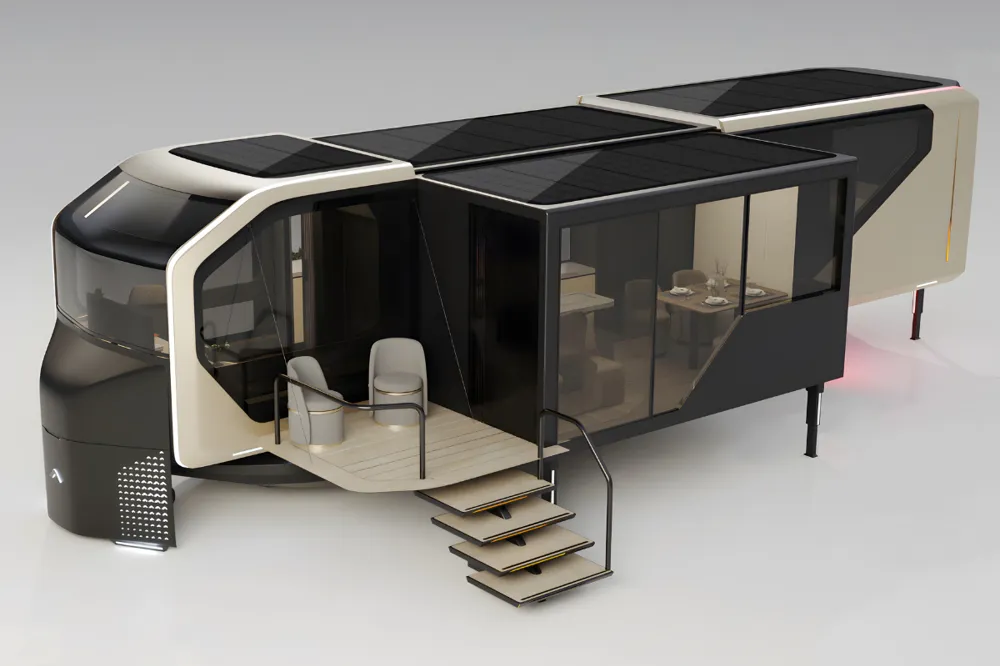
A 24-foot trailer house that automatically expands to twice its width using AI technology, equipped with off-grid power and water self-sufficiency, as well as autonomous driving assistance, making it a next-generation smart mobility house.
HonoreeVehicle Tech & Advanced Mobility자율 주행AI 기반 주거 공간모빌리티 기술스마트 홈트레일러 기술
AC Future AI Transformer Home Trailer (AI-THt)
300
0
AC Future
One-Line Product Definition
Problem Definition
Demand for flexible living: With the increase in remote work and the van life trend, the need for housing that allows living and moving anytime, anywhere has grown. However, existing RVs (Recreational Vehicles) are spatially limited and designed for short-term camping, making them inconvenient for long-term living. Additionally, conventional houses are tied to a fixed location, restricting life in nature or relocation.
Resource independence and convenience issues: Securing a constant power supply, hot/cold water, internet, and other living infrastructure is a challenge for mobile homes. Solar-powered RVs also have low power generation, often leading to power shortages during extended stays, and traditional RVs have low sustainability due to wastewater/drinking water management and fuel consumption issues. Existing solutions"Mobility and living comfort"were not simultaneously satisfied.
Key Differentiators
2x Expandable Structure: After parking, the sides of the AI-THt expand, nearly doubling the interior space from approximately 190 sqft to 400 sqft (approximately 11 pyeong). The trailer structure, without a driver's seat, is already spacious, and the expansion provides living space that can be used as multiple rooms/living rooms. This is a significant improvement in living comfort compared to existing RVs, and it is called a *"mobile small apartment"*.
AI Autonomous Optimization: While the vehicle itself requires towing, it has AI-based driving assistance and automatic leveling functions, allowing anyone to easily move and park it when desired. It also has a built-in AIoT home system that automatically optimizes internal temperature, lighting, and appliances according to user preferences. For example, hot water preparation and optimal solar power generation angle adjustment are performed according to the user's schedule.
Complete Off-Grid Performance: With a 25kW solar power system and a 100kWh battery, it generates its own electricity like a typical house, and it can communicate anywhere with a satellite internet (Starlink) connection. Equipped with a water recycling system, it can be used for long periods without external connections. In other words, it is a mobile smart self-sufficient house with independent electricity, water, and communication.
Luxury Interior and Design: With Pininfarina's design participation, the exterior is sleek and aerodynamically designed to improve towing efficiency. The interior is equipped with Italian modern interiors, fully optioned appliances, and a premium sound system, providing the convenience of a luxury apartment in the city. It also has excellent practical details such as battery self-swap and modular furniture.
Key Adopters
B2C (Individual Users): Digital nomads, camping/car camping enthusiasts, and retired travelers are the main customers. Despite the high initial price (around $150,000+), individual purchases are expected due to the value of replacing a home + vehicle. In particular, remote workers and YouTubers who want to live in nature are potential demand groups.
B2B (Tourism and Accommodation Industry): Luxury camping site (glamping) operators can rent out these trailers like mobile hotels. In addition, companies/institutions can rent/purchase them for special purposes such as film crews and mobile hospitals.
Government/Military, etc.: It can be used as a mobile home in the event of a disaster, or adopted as a field command post/accommodation for the military. With high mobility and self-sufficiency, there is also potential for B2G emergency procurement demand.
Scalability
Global Niche → Mainstream: Currently, it is a niche product targeting the premium RV market, but if economies of scale are formed in the future, it can be expanded to the general camper market through price reductions and model diversification. There is high interest in regions with developed RV culture such as North America, Europe, and Australia, and markets with popular small houses/campers such as Japan are also potential.
Derivative Product Development: Technical elements can be separated and derived into fixed smart modular houses or self-driving caravans. For example, expandable modular houses can be used as urban micro-housing solutions, and AI-controlled power grid technology can be applied to general home energy management.
Regulations and Certifications: Trailer standard certification for road driving and safety certification for solar power equipment must be obtained in each country. The United States can already classify it as an RV, but approval under road traffic laws may be required in other countries. However, since it is basically a passenger car towing type, there are no major regulatory barriers.
Judges' Evaluation
The Emergence of "Mobile Smart Homes": In the context of the CES award, AI-THt has attracted attention as an innovative residence that breaks the limitations of existing RVs. The concept of treating housing as mobility rather than infrastructure is fresh, and Fast Company, etc. commented that it is "housing as an adaptive infrastructure rather than a fixed home." It attracted so much attention that more than 10,000 people experienced it at the CES booth, and the Red Dot Design Award supports the design completeness.
Technological Completeness: At the CES presentation, automatic expansion/contraction demonstrations within 2 minutes and Starlink internet connection demos were performed, showing that it was at the level of mass production rather than a prototype. According to the Founder's remarks, development is in its final stages, with the goal of customer delivery in the second half of 2026. However, industry experts point out that the remaining verification, such as towing safety during actual road driving and durability testing of the expansion structure, is important.
Market Expectations: With growing interest in moving homes since COVID, AC Future's product has attracted investors' attention as an intersection of RVs and smart homes. CNET selected this product as the "most innovative new product" at CES 2025, and this award has strengthened the possibility of commercialization. On the other hand, some evaluate that initial demand response may be limited due to the price of more than $150k and limited production capacity, and there are high barriers to entry to popularization.
Analyst Insights
⚠️ Impressive technology but market uncertainty: Despite the groundbreaking concept of mobility + housing fusion and technological completeness, it is likely to remain in a niche market for the time being due to the high price range and limited initial target audience. There is potential for growth into the mainstream depending on future cost reduction and infrastructure support.
The award list data is based on the official CES 2026 website, and detailed analysis content is produced by USLab.ai. For content modification requests or inquiries, please contact [email protected]. Free to use with source attribution (USLab.ai) (CC BY)
댓글 (0)
댓글을 불러오는 중...