A next-generation wind power system for climate change preparedness – A modular wind power solution that captures wind power with multiple small blades moving on a track, offering lower cost, lighter weight, and easier transportation compared to large turbines.
HonoreeSustainability & Energy Transition에너지 효율지속 가능성친환경 에너지탄소 배출 감소발전 시스템
Airloom Energy Generation System
95
0
Airloom Energy
One-Line Product Definition
Problem Definition
Background Problem: With the rapid increase in demand for renewable energy, existing wind turbines have lowered power generation costs by increasing in size, but this has led to greater restrictions on installation locations (high towers, long blade transportation, etc.). In particular, it is difficult to construct large wind towers in cities or limited sites, and efficiency is reduced in areas with low wind speeds, limiting the spread of wind power generation.
Limitations of Existing Methods: With blades that are tens of meters long,Horizontal Axis Wind Turbines (HAWT)require special infrastructure for manufacturing, transportation, and installation. They are produced in small quantities in dedicated factories, long blades are transported by large trucks/ships, and extra-large cranes and specialized personnel are required on site. As a result, wind power generation is limited to some areas with good wind conditions, and initial investment costs are enormous. In addition, the fixed tower structure has height restrictions and landscape issues, so it often cannot be installed around airports or scenic areas.
Key Differentiators
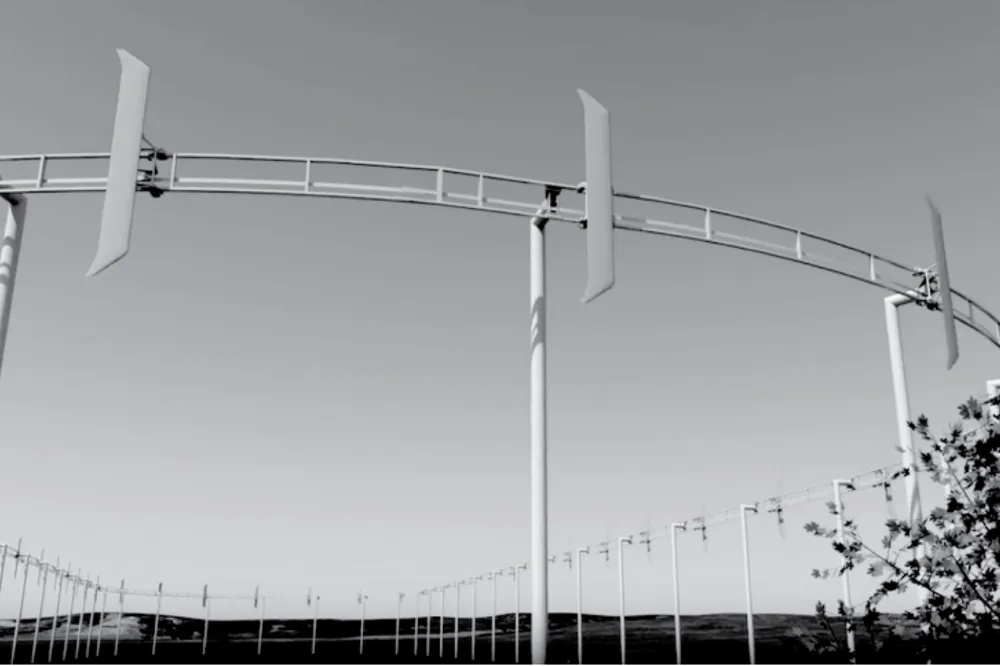
Modular Track Wind Power: A New Structure – Airloom has introduced a completely new format that obtains wind power with multiple small blades moving along an oval track. With a low-rise structure of about 60 feet (approximately 18m) in height, the track can be extended to the desired length, allowing the scale to be adjusted to fit the terrain. This structure makes it easy to install even in areas with somewhat low wind speeds or height-restricted areas.
Cost Innovation with Lightweight, Low-Cost Parts: Consisting only of simple, repeatedly producible parts such as multiple small blades and cables, the mass is reduced by 40%, the number of parts is reduced by 42%, and the number of unique parts is reduced by 96% compared to conventional large turbines with the same output. As a result, power generation costs per unit area are reduced by 50.5%, dramatically increasing economic efficiency. The key is that it is composed of steel cables and standard trusses instead of heavy towers/blades, making mass production and transportation easier.
Ease of Transportation and Installation: All parts of the Airloom system are modularized to a size that can be transported by truck. The on-site assembly is also designed to be possible without extra-large cranes, which greatly reduces installation time. In other words, wind power generation has been transformed from a large-scale infrastructure construction project into a prefabricated process. This differentiates it by diversifying installation locations (mountainous areas, islands, etc.) and reducing entry costs.
Pioneering New Locations: With these characteristics, Airloom enables power generation even inlow average wind speed areas and height-restricted areas (such as around airports). In addition, thanks to the track structure spread low to the ground, the degree of damage to the surrounding landscape is small, andland utilization (agriculture/solar power utilization in the space between tracks)is also high. This has the potential to greatly expand the geographical limitations of wind power generation.
Key Adopters
Decision Makers: Large power companies, renewable energy development operators, and government/local governments are expected to be the leading customers. In particular, power utility companies that want to quickly add power sources in areas where power grid demand is increasing will be interested. In addition, large power consumption companies such as military independent power or data centers may consider introducing it to secure their own power source.
B2C/B2B/B2G Classification: Belongs to the B2B and B2G areas. It is not a product that general consumers directly purchase and install, but a form ordered by companies or government agencies in the form of a power plant construction project. (Example: power source for military bases, public power authority projects, etc.).
Scalability
Environmental/Regulatory Aspects: Basic environmental impact assessments and certifications are required as wind power generation facilities, but environmental complaints can be reduced with low-noise and low-visual impact designs. In addition, the problem of bird strikes (collisions with birds) may be alleviated due to the low height. Since it can be supported by each country's renewable energy policies, it is more likely to receive policy promotion rather than regulation.
Industrial/Market Expansion: The market potential is considerable as the demand for distributed renewable energy is growing worldwide. Airloom is currently in the prototype stage, butBill Gates' investment fund (Breakthrough Energy, etc.)is raising expectations as it is receiving funding from. If the technology is proven, it can enter the existing wind turbine supply chain as a substitute/complement, becoming a game changer in the wind power market. However, there remains the challenge of overcoming the long verification/approval period and the inertia of the conservative power industry due to the nature of large-scale projects.
Judges' Evaluation
Meaning of Innovation Award: Winning the Innovation Award in the Sustainability & Energy Transition category has recognized it as a groundbreaking idea in the field of clean energy. The CES judges seem to have highly evaluated the point that "it structurally innovated the limitations of existing wind power." In fact, in the industry,"wind power has been reinvented"is receiving a lot of attention.
Technological Completeness: Although a commercial plant has not yet been put into operation, a 150kW pilot construction is being started in Wyoming, and **demonstration is in progress at the pilot stage】. The core concept has already been verified for performance through simulation, and the launch plan for the first commercial 3MW system in 2027-28 has been announced, so it has a relatively realistic roadmap.
Market Expectations: The energy industry is paying attention to cost competitiveness. According to reports such as TechCrunch, the initial commercial system is expected to achieve a level similar to existing wind power at $60/MWh, and in the future,the CEO is confident that "it will be possible to produce dramatically cheaper electricity without subsidies."As such, expectations are quite high due to the support of large investors and a clear value proposition.
Overestimation/Underestimation Factors: Some point out thatthe "commercialization within 5 years"plan may be optimistic. This is because the wind power field takes a lot of time to verify safety and durability, so the possibility of schedule delays should be taken into account. On the other hand, despite these concerns, its innovation is not underestimated as an attempt to fundamentally solve the problems of existing wind power. There is a mixture of positive views that "if successful, it will be like the emergence of solar panels in the wind power industry" and cautious views that "it will be difficult to overcome realistic constraints," but overall, there is a great deal of interest and expectation.
Analyst Insights
🧪 R&D and concept verification stage (an innovative concept, but still has a long way to go before demonstration and commercialization, and is expected to have a large ripple effect if successful)
The award list data is based on the official CES 2026 website, and detailed analysis content is produced by USLab.ai. For content modification requests or inquiries, please contact [email protected]. Free to use with source attribution (USLab.ai) (CC BY)
댓글 (0)
댓글을 불러오는 중...