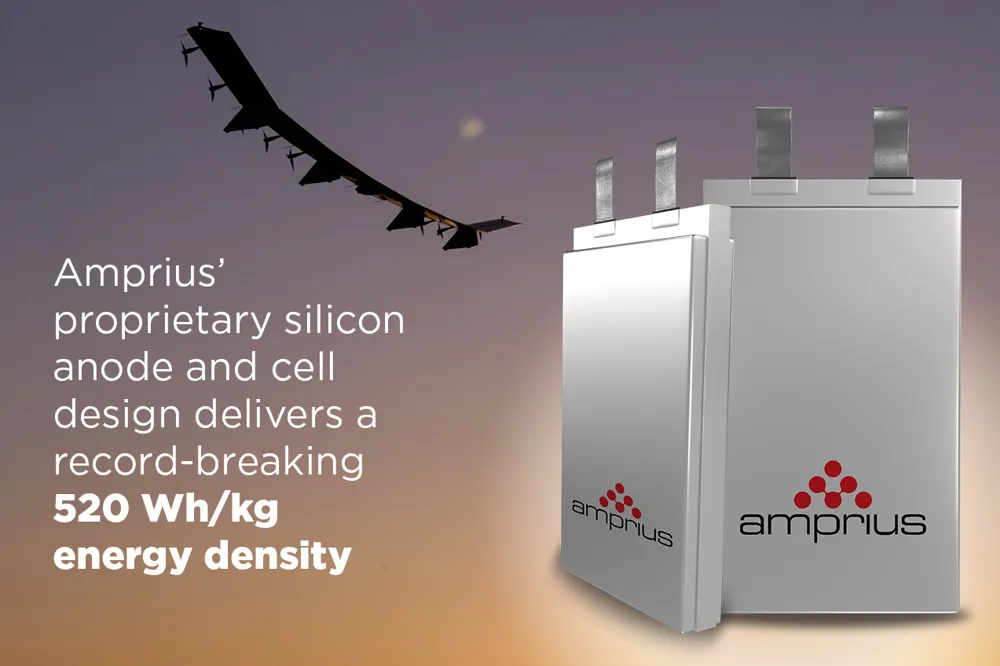
Ultra-High Energy Density Battery Opening the Drone and Electric Aircraft Era – A silicon nanostructure anode lithium-ion battery achieving a world-leading energy density of 520Wh per kg, storing twice the energy of existing batteries for the same weight, significantly increasing the flight time and operational radius of aircraft
HonoreeSustainability & Energy Transition고에너지 밀도 배터리차세대 배터리전기 항공드론배터리 기술Amprius
Amprius 520 Wh/kg 셀
40
0
Amprius Technologies
One-Line Product Definition
Problem Definition
Background Problem: Electric mobility in the sky, such as electric drones, eVTOLs, and electric airplanes, is emerging as a next-generation transportation method. However, current lithium-ion batteries are facing limitations in energy density (storage capacity per weight), which significantly restricts flight time and distance.
For example, existing drones can only fly for 20-30 minutes, and manned electric aircraft have difficulty flying even a few tens of kilometers. This is because the battery weight is too heavy and the capacity is insufficient.
Limitations of Existing Methods: Existing commercial lithium-ion batteries typically use graphite anodes, with an energy density of approximately 250 Wh/kg. Although there have been several attempts to improve this, they have not progressed beyond the laboratory stage or have encountered problems such as reduced lifespan.
Ultimately, the industry consensus was that long-duration drone flights or the practical use of electric airplanes would be impossible without a 2x performance improvement. Silicon anode technology was suggested as an alternative, but it faced difficulties in commercialization and remained"the dream battery."
Key Differentiators
World's Highest Energy Density – Achieving 520Wh/kg: Amprius' new battery cell stores 520Wh per 1kg, making it the highest energy density among commercially available batteries. This surpasses its own 2024 record (estimated at 450Wh/kg) and is twice that of a typical graphite battery (260 Wh/kg).
This groundbreaking improvement enables long-duration flights and high payload capacities that were previously impossible. For example, drones can fly twice as far with the same weight, or manned eVTOLs can operate over longer distances.
Silicon Nanostructure Anode Technology: Amprius has increased energy density by utilizing silicon nanowire-based anode technology. Silicon can theoretically store more than 10 times more lithium than graphite, but commercialization has been difficult due to expansion issues. Amprius has overcome expansion by using a nanostructure and applying it to commercial cells.
As a result, this figure has already been achieved in commercially producible cells, which is significant as it is an actual product specification, not a laboratory record.
Game Changer in the Aerospace Field: This battery accelerates the realization of electric aviation, which was impossible with existing batteries. For example, in next-generation drones, electric UAVs (unmanned aerial vehicles), and manned electric airplanes, operational efficiency can be maximized by extending flight time and increasing payload.
In fact, this cell has already been adopted in Nokia's drone "Drone-in-a-box" solution to improve performance, and new designs using this battery are becoming possible in the defense and aerospace fields. The biggest differentiator is that it has realized the saying: *"If the battery is twice as good, the landscape of air mobility will change."
Key Adopters
Purchasing Decision Makers: Drone manufacturers and aerospace/defense companies will primarily adopt this technology. For example, defense companies developing long-range reconnaissance drones and aviation startups preparing electric air taxis are the biggest customers.
Also, since secondary batteries are not finished products, battery pack manufacturers or electric aircraft project stakeholders are likely to partner with Amprius and purchase cells to build packs.
B2C/B2B/B2G Classification: B2B transaction. As a cell manufacturer rather than targeting end consumers, it is supplied on a business-to-business basis.
However, B2G contracts, such as in the defense sector, are also highly likely, and in the future, it may be indirectly provided to consumers in a B2B2C form by being incorporated into premium electronic devices (e.g., high-end drone equipment).
Scalability
Environmental/Regulatory Constraints: There are no special regulations as a battery, but to be used in aviation,safety certification (aviation cell certification)must be obtained. Amprius is also focusing onsafety management (heat generation, explosion prevention)of high-energy-density batteries and undergoing testing.
Also, there are lithium battery transportation regulations, but these are treated the same as existing products.
Industry/Market Expansion: This technology can also be applied to electric vehicles, wearables, etc., but Amprius is initially focusing onhigh value-added fields (aviation/space).In the future, as production scale expands and costs are reduced, it is expected to be used in electric vehicles and consumer electronics.
Currently, there is a pilot line in Fremont, USA, and plans to build a mass production facility in 2025-6, so expanding the mass production system is key to expansion. The market expects this technology to become one of the next-generation standards for lithium-ion batteries, and it has already secured capital through stock market listing and investment attraction, laying the foundation for expansion.
Judges' Evaluation
CES Best of Innovation Award and Reactions: Amprius' 520Wh/kg cell was a major topic of conversation at CES 2026, winning theBest of Innovation award.The industry hailed it as a "groundbreaking breakthrough in the battery field," and it is reported that the judges highly praised "the fact that this figure was achieved with a virtually commercialized product."
This gives confidence that it is not just a concept but a product that is already available.
Technological Completeness: This cell is currently commercially available, and its actual performance is being verified by customer cases such as Nokia. In addition to improving energy density, it is known to have achieved a volumetric energy density of 1150Wh/L and a charge-discharge cycle life of hundreds of times, ensuring practical durability.
Of course, there is industry discussion about self-discharge or initial efficiency problems unique to high-silicon content batteries, but overall, the technological reliability is highly regarded.
Market Expectations: This battery enables dramatic improvements such as doubling the drone's flight time, so the drone/aviation industry is paying close attention. In particular, it meets the needs of the US defense-related demand (high-performance UAVs), so government support is also expected.
Amprius' stock price and corporate value have also received significant attention in the stock market after winning the CES award, andthe expectation that "the dream battery has finally arrived"is being reflected.
Overvaluation/Undervaluation Factors: Some experts point out that"optimization at the pack level is necessary even if the cell energy density is high."In other words, the system energy density may be slightly lower when applied to actual products with heat dissipation structures and BMS designs.
In addition, there is a view that the price is likely to be high because the production scale is still small, so it will be limited to specific applications in the early stages of commercialization.
However,the prevailing opinion is that it is "a watershed moment for the commercialization of silicon batteries,"and many see it as a corresponding expectation rather than an overvaluation. The atmosphere is that *"the market will open up with this level of innovation,"* and there are few views that underestimate it.
Analyst Insights
🔥 High Marketability / Business Connection Possible (Already commercialized with secured customers, explosive market opportunities are expected as a key component of the electric aviation era)
The award list data is based on the official CES 2026 website, and detailed analysis content is produced by USLab.ai. For content modification requests or inquiries, please contact contact@uslab.ai. Free to use with source attribution (USLab.ai) (CC BY)
댓글 (0)
댓글을 불러오는 중...