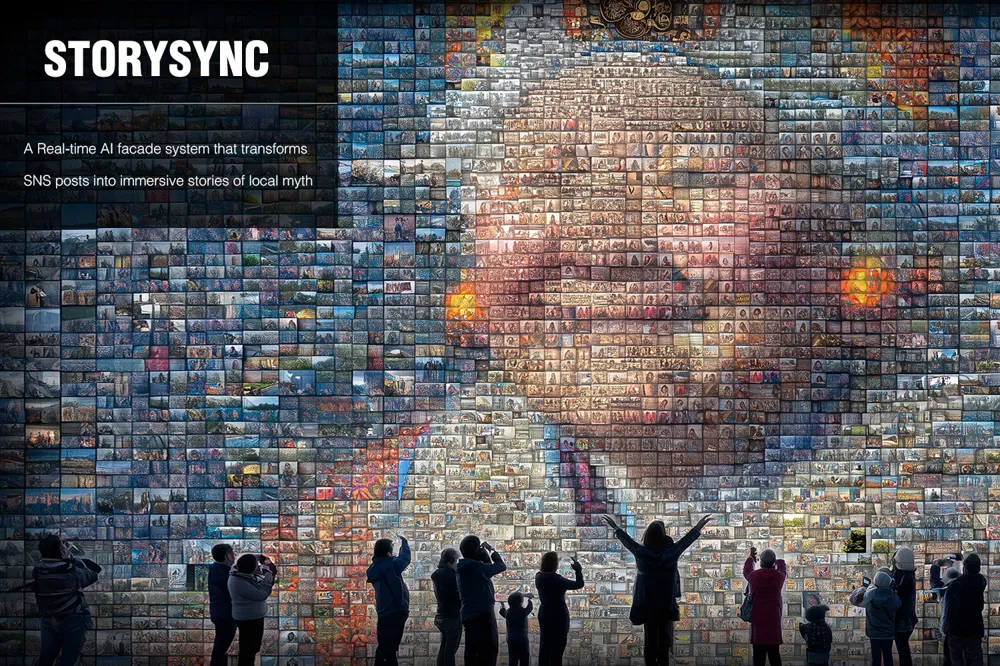
An AI-based interactive media facade system that analyzes visitors' SNS photos in real-time at a tourist destination themed around Jeju Island folklore, transforming personal memories into a media art story fused with local legends.
Best of InnovationkoFilmmaking & Distribution미디어 파사드인공지능컴퓨터 비전자연어 처리문화 관광프로젝션 매핑
스토리싱크: 신화 기반 실시간 인터랙티브 미디어 파사드
122
0
Artnova Co., Ltd. and NEXTEP studio Co., Ltd., Gachon University, DAMGARA Co., Ltd.
One-Line Product Definition
Problem Definition
In traditional tourist destinations and cultural heritage sites, visitors passively observe and take pictures, resulting in a lack of personalized experiences. The photos taken are shared separately on SNS, but are not linked to the on-site story.
Existing media facade shows are unidirectional content, limiting audience participation, and even participatory shows simply display audience photos on the screen. As a result, tourists in the digital age (especially the MZ generation) are thirsty for immersive cultural experiences where they become the main characters.
Key Differentiators
It is innovative in that AI converts each visitor's photos into story content in real-time. When visitors upload photos to SNS at designated locations, the system interprets the people and backgrounds in the photos using computer vision and NLP, and compares them with the Jeju mythology database to create a customized narrative in which the visitor appears as a character in the legend.
Then, using projection mapping technology, this story is projected onto outdoor curved structures as a huge media art, producing a "living folktale" where the visitor's own memories are fused with local mythology.This is the world's first case of not simply showing photos, but incorporating personal records into the local mythological context, giving the audience a strong emotional experience of becoming part of a fantasy story.
This real-time participatory interpretation of cultural heritage is differentiated from existing museum or tourist destination content and presents a new tourism paradigm for the social media age.
Key Adopters
Local governments such as Jeju Special Self-Governing ProvinceLocal governments (B2G)or cultural tourism public corporations are the main adopters. This project was also promoted in cooperation with Jeju Folk Village, and in the future, operating organizations of other tourist destinations (e.g., urban historical streets, historical site theme parks, etc.) at home and abroad may become customers.
In addition, theme park operators (B2B) and large resorts may consider adopting it to enhance the visitor experience. As it is developed in the form of a consortium of several companies and institutions, it is likely to be implemented in the form of project-based construction rather than sales. Ultimately, it is expected to spread as a B2G/B2B cooperation model in the cultural tourism sector.
Scalability
Although it started with the mythology of a specific region (Jeju), it can be applied to cultural heritage in any region around the world simply by localizing the content. For example, in Greek mythology regions, visitor photos can be transformed into Olympus background stories, and in European castles, into medieval legends, leaving room for a universal platform.
The technical components (AI vision/language, projection, etc.) are modularized and can be replaced with other stories. However, due to installation environment-dependent characteristics (on-site structures, projectors, etc.) and the necessity of collaborating with local story experts, customized development is required for each project, so complete and easy replication may be difficult.
In terms of regulations, there are no major restrictions on the application of technology, except for censorship issues regarding content expression. Global expansion is expected as cities actively adopt it to create smart tourism attractions in the international tourism market in the future.
Judges' Evaluation
CES 2026 Content & Entertainment CategoryBest of Innovationand was praised as"a fantastic fusion of local culture and personal experience."The judges highly praised the hyper-personalization of the tourism experience by combining AI and media art, and the award in a category linked to the Cannes International Film Festival's Cannes Next program also attracted a great deal of attention from the media industry.
However, from a commercial perspective, there is also the view that *"tech demos are great, but sustainable operation and monetization are separate challenges."* While visitor satisfaction is high for the current pilot operation in Jeju, it is pointed out that the marketability is unclear because the return on investment model is not clear.
In summary, the general opinion is that "it was praised as the best art technology on the CES stage, but it remains to be seen how much it will spread in the actual tourism industry."
Analyst Insights
📌 A solution limited to a specific niche (an experiential technology specialized in local cultural tourism, which is innovative but is expected to be used as an additional service for specific tourist destinations rather than a popular product).
The award list data is based on the official CES 2026 website, and detailed analysis content is produced by USLab.ai. For content modification requests or inquiries, please contact [email protected]. Free to use with source attribution (USLab.ai) (CC BY)
댓글 (0)
댓글을 불러오는 중...