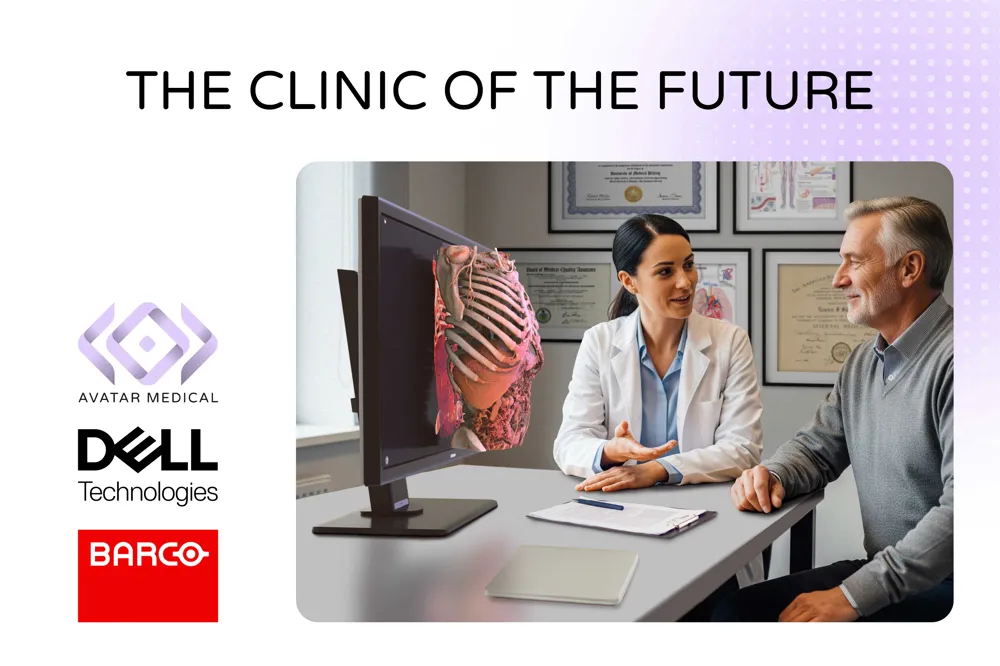
Glass-free 3D medical imaging consultation platform. This patient-centered medical imaging solution combines a clinical-grade floating 3D display that patients can view without glasses or headsets with FDA-approved 3D software, allowing surgeons and patients to intuitively share information about diseases and surgical plans while viewing 3D anatomical images (based on MRI/CT scans) of the patient's body together.
HonoreeDigital HealthAI 의료영상3D 시각화원격 의료디지털 헬스정밀 진단수술 시뮬레이션
Eonis Vision
8
0
Avatar Medical
One-Line Product Definition
Problem Definition
In traditional medical consultations, doctors diagnose and plan surgeries based on 2D black and white images such as CT and MRI scans, which are difficult for patients to understand, leading to communication challenges.
Patients have to imagine the location of their tumors or surgical methods using flat images, and their lack of understanding can cause anxiety and inefficient decision-making.
Although 3D imaging technology and AR/VR exist, they have not been used as practical consultation tools due to the inconvenience of wearing heavy 3D glasses or VR equipment and the lack of clinical-grade accuracy.
Doctors also face the burden of having to explain complex information in a limited amount of time.
The problem is the absence of an easy and immersive medical imaging communication tool that is suitable for patient-centered care and the era of precision medicine.
Key Differentiators
Eonis Vision integrates Barco's latest glasses-free 3D monitor and Avatar Medical's real-time 3D conversion software to create the world's first clinical-grade glass-free 3D imaging that can be viewed together by patients and doctors.
Patients can directly view and understand 3D color images of their own organs/lesions floating in the air, and doctors can easily explain by rotating the images with gestures or a ring controller.
It shows clear 3D without using cameras or headsets, so there is no dizziness, and real-time interaction (e.g., marking tumor locations, suggesting virtual surgical paths) is possible.
Medical accuracy is guaranteed with FDA-approved software, and high-performance computing on Dell workstations quickly converts large-capacity images into 3D.
"It has made the patient an active partner in the treatment process."As the evaluation suggests, it provides a paradigm-shifting experience that allows patients to intuitively recognize their condition and participate in decisions.
Key Adopters
The main adopters are hospitals and medical institutions.
In particular, it is highly utilized in departments such as cancer centers, neurosurgery, and orthopedics, where patient consultations are frequent before complex surgeries.
Hospital management can decide to purchase this solution with the expectation of improving patient satisfaction and differentiating medical services.
It can also be used as teaching material in medical education institutions or anatomy education sites and will be supplied to the market in the form of B2B delivery through medical device distributors.
Potentially,telemedicine platform companies (B2B2C)may develop services using this technology, but the primary model is expected to be direct sales to hospitals/clinics (B2B).
Scalability
This product is primarily tailored for specific uses such as radiology-surgery-patient consultation, but it has high scalability.
It can be expanded to remote collaboration or medical education in the future, and technically, it can be applied to AR healthcare (e.g., displaying 3D images in the operating room).
Locally, it needs to pass medical regulations in each country, such as CE certification, but since it has already obtained FDA approval, other regional approvals are expected to gain momentum.
In addition to medicine, a transition to non-medical 3D visualization markets such as museum exhibitions and educational tools can also be considered.
It can be quickly spread to hospitals around the world through Barco's global network, and the application area can be expanded to other clinical subjects (such as dermatology 3D simulation) by adding functions through software updates.
Judges' Evaluation
The reason for being selected for the CES 2026 Innovation Award (Digital Health category) was mainlythat it "significantly increased trust and understanding between doctors and patients.".
The industry calls itthe "Clinic of the Future,"and praised that patients' anxiety is reduced and participation is increased by experiencing their medical data in three dimensions.
In terms of technical completeness, the fact that it is an actual commercial solution that combines Barco's glasses-free 3D display released in Q4 2025 and FDA-approved software in 2026, making it immediately applicable to the field, also received high scores.
Market expectations are also quite high, with many hospitals already showing interest in the demonstration stage.
However, since it is an expensive professional equipment, initial adoption may be limited to tertiary general hospitals, and there are some concerns about the AR/VR bubble.
Overall,the positive evaluation that it is an "innovation that will change the landscape of medical communication"is dominant, and Avatar Medical has solidified its position in the global health tech scene through the CES award.
Analyst Insights
⚠️ Impressive technology but market uncertainty – Innovative as a patient-centered medical 3D solution, but initial adoption may be limited due to medical institution budgets and conservative field culture, so future adoption trends should be monitored.
The award list data is based on the official CES 2026 website, and detailed analysis content is produced by USLab.ai. For content modification requests or inquiries, please contact contact@uslab.ai. Free to use with source attribution (USLab.ai) (CC BY)
댓글 (0)
댓글을 불러오는 중...