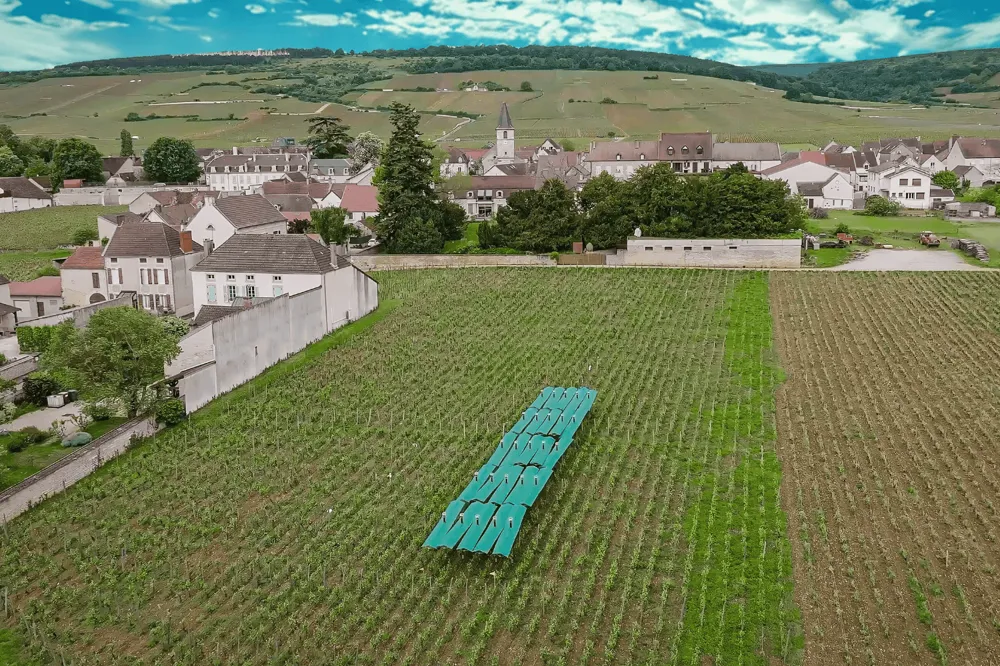
An AI-based robotic canopy solution for wine farms, permanently installed in vineyards and automatically deployed in adverse weather conditions to protect grapes.
HonoreeFood Tech스마트 농업로봇 자동화AI 기반 제어환경 제어농업 생산성 향상
로보틱 캐노피 BIENESIS
18
0
BIENESIS SAS
One-Line Product Definition
Problem Definition
Abnormal weather conditions due to climate change (late frosts, hailstorms, frequent heat waves, etc.) are increasing damage to grape harvests in wine regions such as France. Hailstorms can halve vineyard yields in a single event, and frosts during flowering can kill all new shoots, resulting in annual losses of hundreds of millions of euros. Existing responses includewind machines (fans)orsmudge pots (combustion heating)to prevent frost, and netting to prevent hail, but these are partial solutions and require a lot of manual labor, such as quickly removing them when the sun rises. Furthermore, continuously using nets or shade cloths creates a dilemma, as it reduces sunlight and lowers grape quality.
In short, there is a need for an intelligent system that allows full sunlight and ventilation under normal conditions, while automatically providing protection only when needed.
Key Differentiators
The BIENESIS Robotic Canopyanalyzes the grape's growth stage (phenology)and real-time microclimate data using AI, and automatically deploys when dangerous thresholds are reached, such as frost risk temperatures or hail forecasts. Otherwise, it remains folded, having almost no impact on the grapevines and not interfering with agricultural machinery operations. It operates on solar power, and multiple units are connected via 4G and Wirepas mesh for remote monitoring and control.
The material is a high-strength fabric developed by Michelin, which absorbs hail impact, allows adequate UV penetration, and regulates humidity above the crops to inhibit fungal growth. The system structure also considers sustainability, with over 95% recyclable aluminum and other materials. In 2024, tests in a Chardonnay vineyard in Burgundy, France, showed that just 18 automatic deployments reduced frost and hail damage enough to double the harvest yield. This data-driven proof is very convincing to farmers, and the advantages of 90% labor reduction and quality maintenance compared to manual netting have been confirmed. Ultimately, this technology innovates grape cultivation methods, enabling stable, high-quality wine production in the era of climate change.
Key Adopters
Wineries (farms owning vineyards) or agricultural corporations (B2B)will purchase or lease it directly. High-value vineyards producing premium wines are expected to be early adopters. Medium to large wineries in major grape-growing regions such as France, Italy, California (USA), and Australia are the key targets.
In addition, governments or local authorities mayprovide subsidies through agricultural support programs (B2G)to promote adoption. If the same principle is later applied to orchards (apples, peaches), those farmers will also become customers. The sales model is hardware sales + monitoring service subscription, and a monthly subscription model for farmers may also be considered.
Scalability
Currently, it is specialized for vineyards, but the technological elements (robotic canopy, AI deployment algorithm) can be applied to other high-value-added crops. For example, there is room for customized development for frost protection for fruit trees and shading for ginseng cultivation. As a Michelin Lab spin-off, BIENESIS mentions expanding ideas beyond agriculture, such as construction site protection and solar panel safety.
In terms of market size, the grape industry is global, and interest from the global wine industry has already increased due to the CES award, so expansion into regions outside of France is expected. There are no specific regulations, but the adoption rate may vary depending on agricultural subsidy policies and wine industry practices. Above all, demand will increase as the climate crisis intensifies, and first movers like Bienesis are likely to dominate the standard.
Judges' Evaluation
Selected as the Best of Innovation in the Food Tech categoryand hailed as the "Tesla of agriculture." Media outlets such as Forbes praised it, saying, "Finally, the ultimate use of AI and robots has appeared in the wine industry," and the technology community cited it as a "true example of physical AI." The technological completeness is proven with actual vineyard data, leaving little room for doubt, and market expectations are very high due to the needs caused by the climate crisis.
However, some raised concerns about the cost per unit (expected to be several thousand euros or more) upon full deployment, and reactions such as the robotic arm installation detracting from the traditional vineyard aesthetics. However, as it has innovated an area that was undervalued relative to its necessity, there has been a surge of investment attraction and pre-order inquiries since the award. Overall, it is highly regarded as an example of injecting innovation into an underestimated agricultural sector.
Analyst Insights
📌 A solution limited to a specific niche – a solution that is essential in specialized agricultural fields such as high-end wine farms. It is not a general consumer product, but it is highly likely to become standard equipment in the industry.
The award list data is based on the official CES 2026 website, and detailed analysis content is produced by USLab.ai. For content modification requests or inquiries, please contact contact@uslab.ai. Free to use with source attribution (USLab.ai) (CC BY)
댓글 (0)
댓글을 불러오는 중...