An ultra-low-power, always-on analog AI inference chip for battery-powered edge devices – performs operations such as always-listening voice recognition with minimal power consumption.
HonoreeMobile Devices, Accessories & Apps아날로그 AI 칩오디오 추론초저전력상시 구동엣지 컴퓨팅음성 인식
블루마인드 BM110 상시 구동 초소형 아날로그 AI 오디오 추론 칩
60
0
Blumind
One-Line Product Definition
Problem Definition
Implementing always-on voice recognition (e.g., waiting for a "Hey, ○○" hotword) in small devices like smartwatches and wireless earphones has been impractical due to high battery consumption. Existing digital AI chips increase power consumption and heat generation due to analog-to-digital conversion during computation, significantly reducing the battery life of small devices.
Relying on the cloud introduces communication delays and privacy issues, necessitating an ultra-low-power AI solution capable of running 24/7 on the edge device itself. However, overcoming the tenfold power difference with digital methods has been challenging until now.
Key Differentiators
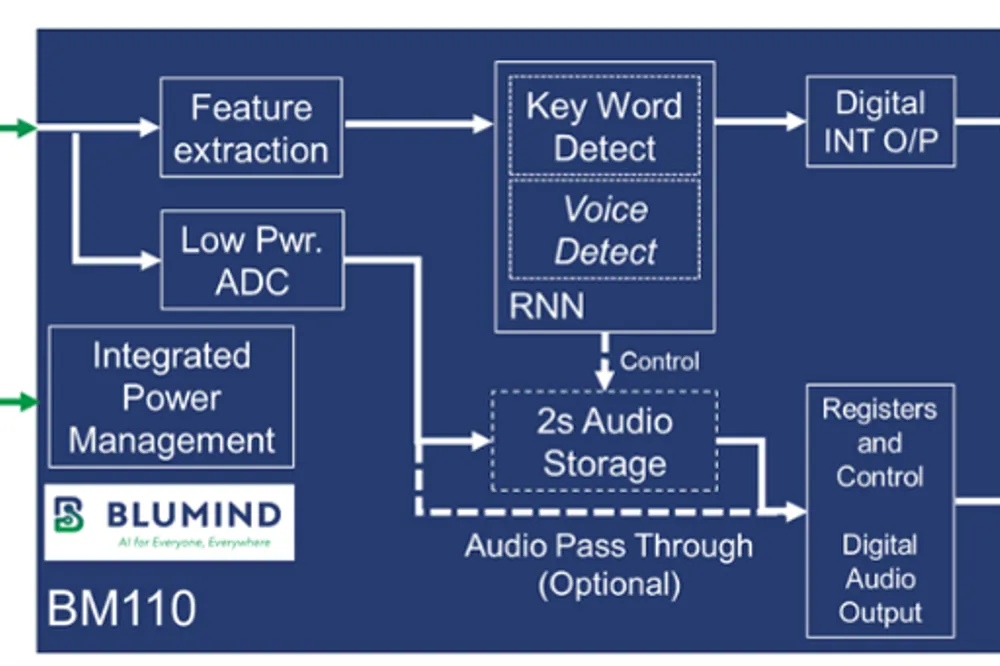
All-Analog Computation Architecture: The BM110 performs neuron computation and memory in an analog manner within the transistor. This Compute-in-Transistor design reduces power consumption to less than 5% of that of conventional digital AI chips by eliminating repeated data conversions. This translates to over 95% power savings for the same task.
Always-On Operation Optimization: Its ultra-low-power characteristics enable battery operation for years, meaning that even with a smart device's always-on voice trigger enabled, the impact on battery life is negligible. This allows devices to extend their usage time from days to years, making the implementation of always-on AI features a reality.
Brain-Inspired Structure: With a brain-inspired design that computes neurons with analog signals like brain synapses, it supports real-time processing even at low power. It is particularly optimized for handling time-continuous signals such as voice and sensors, performing tasks such as keyword detection and abnormal sound detection without delay.
Utilization of Standard CMOS Process: Implemented with existing semiconductor processes rather than special materials, considering cost and productivity. This is advantageous in terms of mass production and price competitiveness in the future, and is evaluated as having higher commercialization accessibility compared to other companies.
Key Adopters
Wearable device manufacturers (smartwatches, wireless earphones, etc.; B2B) – Embedding voice assistant standby mode, ambient sound detection, etc. into products
IoT sensor device companies (smart homes, security sensors; B2B) – Used for developing always-on sound/vibration detection sensors, etc.
Industrial monitoring companies (smart factory sensors; B2B) – Integrated into always-on monitoring devices such as equipment abnormal sound detection
Medical device companies – Can be adopted in devices that extend replacement cycles even with increased computation, such as wearable health monitors
Scalability
As an ultra-low-power chip universally needed in the edge AI era, its application range is very wide. There is a next-generation product roadmap to expand beyond voice recognition to image sensor processing, biosignal analysis, etc. (e.g., analog AI for video).
Although Blumind is a Canadian company, it is growing through global investment and collaboration, and is expected to pioneer the market through partnerships with various sensor and device companies.
In the market, there are initial doubts about the performance limitations or development difficulty of the new paradigm of analog AI, but as seen in recent large-scale investment attraction cases (similar startups such as the US company Mythic are rapidly increasing in value), industry interest is high.
However, the key to mass adoption is how perfectly the company has solved the potential entry of large semiconductor companies and the temperature/process variation issues unique to analog.
Judges' Evaluation
At CES, it attracted the attention of experts as an innovative semiconductor technology. While viewed positively as having "the potential to dramatically increase battery life," there are also indications that additional research is needed for broader AI applications, as it is currently limited to a few keyword detections.
The technological maturity is at the stage where the demonstration chip actually operates and successfully demonstrates keyword spotting, proving the concept. However, it is stillan early stage before the release of mass-produced products (test chip stage),so additional development is needed for commercialization.
Market expectations are considerable as a game-changer for IoT devices. It is evaluated that the potential market size is large because it can receive love calls from various industries that want low-power AI functions. On the other hand, there is a sober analysis that there are risks until a startup's single product establishes itself in the giant semiconductor market.
Analyst Insights
🧪 Cutting-edge technology at the concept verification stage, with a large ripple effect if commercialization is successful, but still strongly R&D-oriented
The award list data is based on the official CES 2026 website, and detailed analysis content is produced by USLab.ai. For content modification requests or inquiries, please contact [email protected]. Free to use with source attribution (USLab.ai) (CC BY)
댓글 (0)
댓글을 불러오는 중...