Back to list
51 / 452
IoT 스마트 카드
HonoreeFinTechIoT스마트 카드보안인증금융 기술디지털 보안

IoT 스마트 카드

12
0

CardNation Co., Ltd

One-Line Product Definition

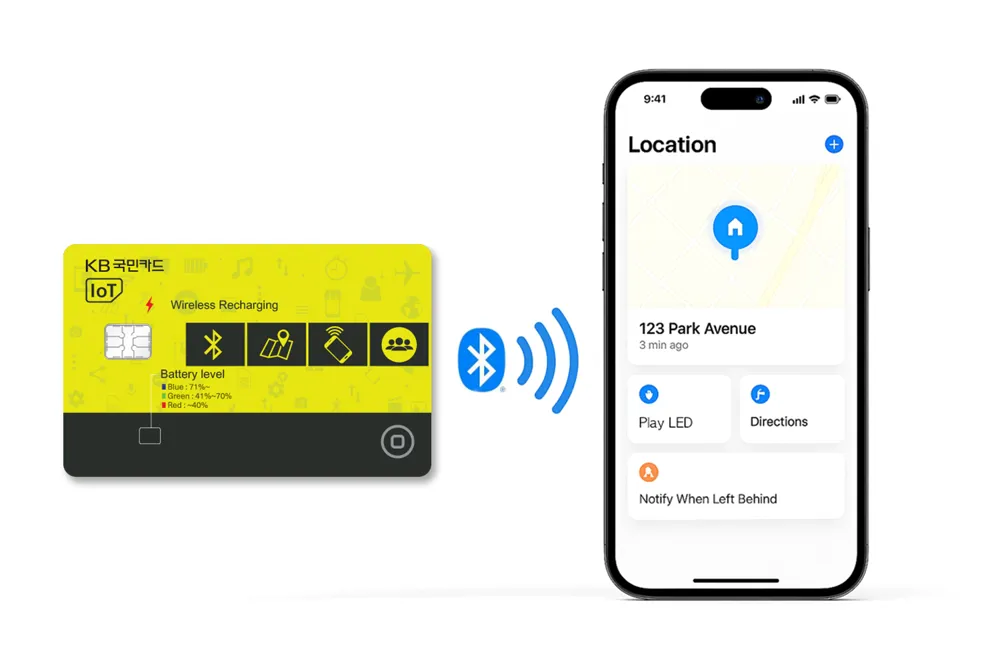
IoT Payment Card Platform for the Financial and Security Industries – A next-generation smart card that integrates BLE tracking, wireless charging, and multi-payment functions into a credit card, enhancing loss prevention and security authentication.

##

Problem Definition

In the event of a lost wallet or stolen card, it is impossible to know the location in real time, and it is inconvenient to carry multiple cards.

Existing credit cards have limited functions other than payment, and there is a high risk of unauthorized use in case of loss. In addition, various authentication methods such as employee ID cards and access cards are scattered, making management inefficient.

##

Key Differentiators

The IoT smart card is the world's first to comply with international standard credit card specifications (ISO 7810, etc.) while integrating BLE tracking, Qi wireless charging, ATM compatibility, and multi-payment support into a 0.84mm ultra-thin card [6].

BLE-based location tracking provides an alarm when the distance between the card and smartphone is exceeded, and the lost location can be checked in real time by linking with a smartphone app or SmartThings. In addition, multiple payments such as credit/debit/transportation cards are included on one card, and battery management is easy with two-way loss alarm (alarm on both smartphone and card) and wireless charging LED display [7]. This level of complex function integration is unmatched compared to existing smart cards or smart rings.

##
Key Adopters

Financial institutions (B2B) are the main customers, and banks or card companies will issue cards using this technology.

In addition, it can be adopted as an employee ID card and payment card in the corporate/public (B2B/B2G) sector. The end user is the general consumer, but it is expected to be distributed through B2B2C through banks rather than direct purchase.

##

Scalability

Since it complies with international card payment standards, it can be used in markets around the world. However, there are barriers to entry that require financial regulations and network certification procedures in each country.

In the future, the technology can be developed and expanded to other smart card fields such as digital IDs and healthcare IDs. Commercialization is already in place with related patents and mass production processes secured.

##

Judges' Evaluation

It has been recognized for its technological prowess and innovation by winning the CES Innovation Award for two consecutive years [8]. It is evaluated as a pioneering example of financial and IoT convergence, and expectations are high in terms of preventing card loss and convenience.

However, whether the conservative financial sector adopts it is a variable in the market. Although the technology is impressive, popularization requires partnerships with major card companies and infrastructure expansion, leaving challenges to be solved. At CES, it was positively evaluated as a practical innovation rather than an overestimation, but actual commercialization and mass issuance may take time.

##

Analyst Insights

⚠️ Impressive technology but market uncertainty – Excellent security and convenience, but success depends on whether the conservative financial market adopts it.

The award list data is based on the official CES 2026 website, and detailed analysis content is produced by USLab.ai. For content modification requests or inquiries, please contact contact@uslab.ai. Free to use with source attribution (USLab.ai) (CC BY)

댓글 (0)

댓글을 불러오는 중...