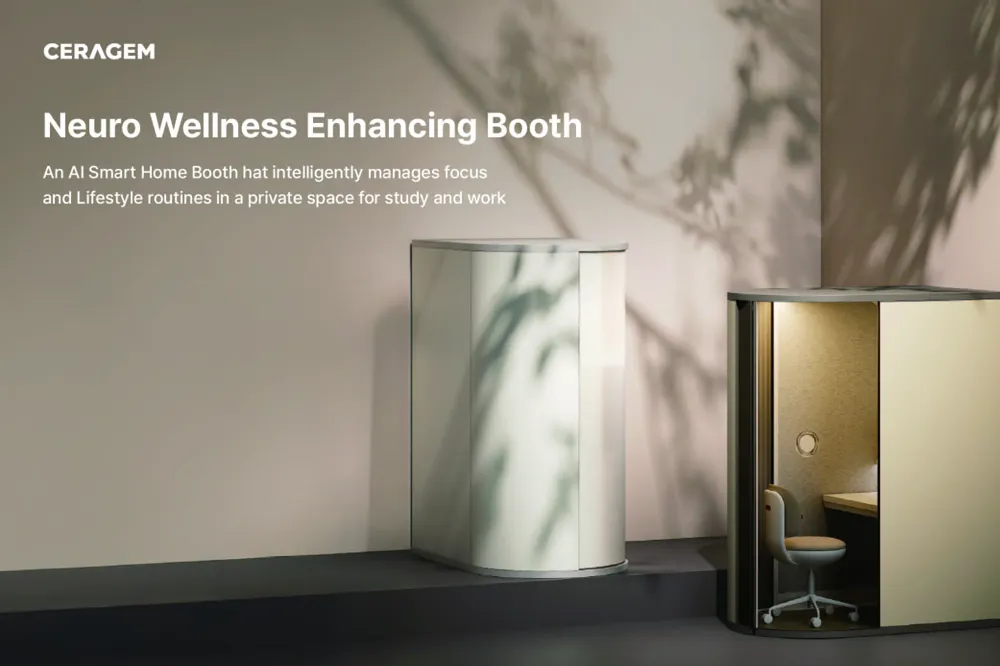
AI Brain Wellness Booth – A personal booth that measures bio-signals such as brainwaves to understand the user's concentration state and stress level, and provides a personalized concentration training/relaxation program by an AI coach.
HonoreekoSmart HomeAI 코칭정신 건강 관리개인 맞춤형 웰빙스트레스 관리심리 안정뉴로테크
세라젬 : Brain Booth with AI Coach
89
0
CERAGEM
One-Line Product Definition
Problem Definition
Modern people suffer from decreased concentration and chronic stress in work and learning environments, but effective solutions to improve this have been limited. Methods such as meditation or deep breathing are recommended, but it is difficult to practice them consistently alone, and it is difficult to know the degree of improvement without real-time feedback.
In addition, existing neurofeedback devices such as brainwave headsets only show numbers to users and do not change the environment, making it difficult to provide an immersive experience.
The Ceragem Brain Booth was developed to actively induce concentration improvement and relaxation by grasping the user's brain state in real time and controlling environmental stimuli within a small booth that can be installed in everyday spaces.
Key Differentiators
This product comprehensively measures the user's brainwaves, posture, heart rate, and fatigue by embedding EEG (brainwave) sensors and FSR (pressure)/BCG (heart rate) sensors in the seat. In real time, the AI coach interprets this data and provides the user withthe most necessary action (recommendation to extend concentration or rest)and automatically adjusts the lighting, sound, oxygen level, and fragrance in the booth.
For example, when concentration is needed, blue-toned lighting and clear sounds help with arousal, and when stress levels increase, the lighting is softened and binaural beat sounds or comfortable fragrances are provided to relieve tension. Dynamically changing the environment in this way is a strength of the Brain Booth that general apps or wearable devices cannot provide.
In addition, the 15.6-inch screen visualizes real-time status and daily feedback, allowing users to recognize their concentration patterns and set improvement goals. The booth structure is also modularly designed, making it easy to install in a corner of a home or office, and is designed not to detract from the interior. Operation is simple with voice control and smartphone app integration, and the open platform aimed at linking with third-party learning services or meditation apps is also a differentiating point.
Key Adoption Entities
The main customer base is divided into two groups:individual users (B2C) such as telecommuters and studentsand wellness investors (B2B) at the corporate/institutional level. First, from a B2C perspective, parents who want to install a concentration booth in their study room, or office workers who want to improve their concentration, may consider individual purchases. In particular, high-income professionals who invest in home offices will be interested.
From a B2B perspective, large corporations or startups can introduce this booth in their in-house rest areas and use it as a concentration training and stress management program for employees. In addition, libraries, schools, research institutes, etc. are expected to install multiple units to provide an immersive environment for their members. If the price is high, psychological counseling centers or mental care startups may operate it for customer experience in the form of rental.
In the public sector, it can be considered as a pilot project for local government youth spaces or public libraries as B2G, but the primary target is the premium individual and corporate market.
Scalability
There is sufficient marketability in this field as interest in mental health and productivity improvement is increasing worldwide. However, due to equipment prices and space constraints, it will be difficult to widely distribute it to general households right away, so it is expected to expand mainly to corporate and institutional use in the early stages.
In terms of regulations, it is a wellness device that is not classified as a medical device, so global sales are possible without special permits, and it has already attracted the attention of overseas buyers through CES.
In the future, if the technology is miniaturized and the cost is lowered, the product lineup can be expanded to include portable concentration training devices combined with VR headsets to make it more popular. Since Ceragem is promoting the concept of an AI wellness home and developing various product lines, a scenario is also expected in which the Brain Booth is expanded in connection with other smart furniture or healthcare devices as a module of a home wellness platform.
In the short term, it is a niche premium market, but in the long term, it has the potential to lead a new lifestyle of digital mental health management and grow the market pie itself.
Judges' Evaluation
Received attention at CES with the fresh concept of "Personal meditation capsule with an AI coach,"but there were also doubts about general consumer demand. Some foreign media criticized the product as *"a typical AI-based sauna that no one needs"*, showing a reaction that it was too much of a solution.
On the other hand, there is a view that it is an innovation in K-healthcare, and the Korean media highlighted the point that *"AI technology transforms everyday spaces into wellness spaces"*, and evaluated that Ceragem is leading the paradigm shift in wellness.
In terms of technological completeness, it is evaluated that the difficult task of integrating brainwave/biosignal measurement and environmental control has been relatively well implemented. However, there is a lack of data on how much the concentration improvement effect has been clinically verified, and it is pointed out that user experience and effect verification will be key to market expansion in the future.
Overall, there is a mixture of cautious reactions such as *"the idea is great, but there are question marks about effectiveness and economic feasibility"* and expectations such as *"a future-oriented product that may be in every home someday."
Analyst Insights
⚠️ Impressive technology but market uncertainty (Despite the innovation of personalized brainwave coaching, high prices and unclear demand make popularization uncertain in the near future)
The award list data is based on the official CES 2026 website, and detailed analysis content is produced by USLab.ai. For content modification requests or inquiries, please contact [email protected]. Free to use with source attribution (USLab.ai) (CC BY)
댓글 (0)
댓글을 불러오는 중...