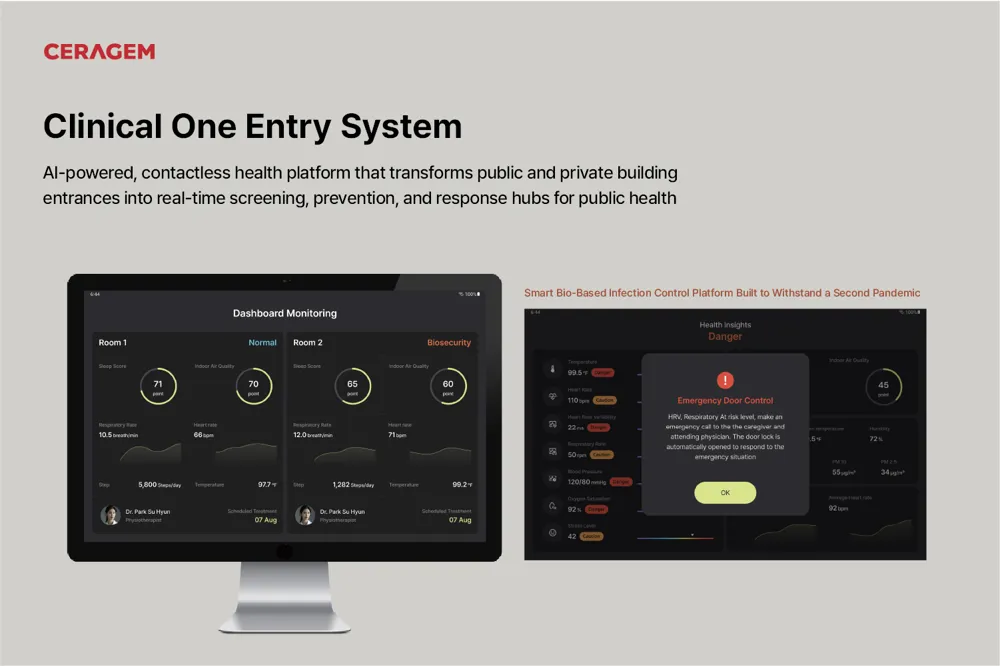
Entrance Health Screening Platform – An AI system installed at building entrances that measures key vital signs such as body temperature and heart rate using only facial recognition to screen and block those at risk of infection, and continuously monitors the health status of residents even inside the building.
HonoreekoDigital HealthAI 헬스케어IoT 의료텔레헬스디지털 건강원격 모니터링개인 맞춤형 건강관리
세라젬 : Clinical One Entry System
15
0
CERAGEM
One-Line Product Definition
Problem Definition
After the COVID-19 pandemic, fever checks and visitor logs became commonplace when entering buildings, but these were mostly done manually, making them inaccurate or placing a large burden on personnel. Especially in facilities vulnerable to infection, such as hospitals and nursing homes, it is important to prevent external sources of infection from entering, but it is difficult to filter out risks based on outward symptoms alone, and existing thermal imaging cameras, etc., have limitations in that they only measure body temperature.
In addition, for the elderly living inside facilities, it is important to detect and take action early in the event of deterioration, but in general facilities, there is a problem of delayed response to emergency situations due to a lack of personnel for constant monitoring.
Ceragem Clinical One Entry System was developed to solve these problems by combining automated entry screening using AI and real-time status monitoring to provide digital quarantine and care infrastructure.
Key Differentiators
The biggest feature of this system is that it simultaneously measures the body temperature, heart rate, respiration rate, and oxygen saturation of a person passing through the entrance using facial recognition-based non-contact sensing. It recognizes faces with camera video, extracts pulse and respiration using rPPG technology that analyzes subtle color changes in the skin, and measures body temperature with thermal imaging.
The vital signs extracted in this way are immediately analyzed by AI, and if they deviate from the normal range, the entry gate is automatically blocked and an alert is sent to the administrator. People who are allowed to pass are provided with hand sanitization (far-infrared UV sterilization) and air shower to remove viruses from their clothes, performing secondary quarantine.
Unlike existing systems, it is linked to the camera and sensor network inside the building even after entry, monitoring the resident's facial expressions, gait, activity level, etc.Early warning signs (e.g., falls or loss of consciousness)If detected, a nurse can be called immediately or a telemedicine connection can be made. In other words, continuous entry-indoor management is a key differentiator, and it has been recognized for its innovation in that it encompasses everything from infection prevention to emergency response as a single platform, unlike simple body temperature measurement devices.
Key Adopters
This product is mainly adopted byoperators of medical and welfare facilities (B2B/B2G).For example, it can be installed in places vulnerable to infection, such as nursing hospitals, nursing homes, and residential facilities for the disabled, for entry management and resident monitoring.
In addition, general hospitals and clinics can also install it at the entrances of hospital wards to screen the health status of visitors or outpatients. At the corporate level, it can be introduced to factories or research facilities where quarantine is important to prevent group infections. In the public sector, it can be applied to places where many people enter and exit, such as airports, ports, and government offices, as B2G to strengthen the prevention of infectious disease inflow.
However, the places with the greatest needs are long-term care facilities and hospitals, which include both public and private sectors. On the other hand, places with communal living, such as university campuses, dormitories, and military units, can also be customers, so it is an infrastructure-type solution that is widely targeted not only forB2B (private facilities)but also, if necessary,B2G (public facilities).It is an infrastructure-type solution that is widely targeted.
Scalability
This system is a solution that is likely to attract attention from various countries in line with the increased demand for quarantine infrastructure after the pandemic. However, there may be regulations on facial recognition and health data collection in some countries due to personal privacy issues.
To this end, this system is designed to process data with edge AI on-site so that personal biometric information is not transmitted externally, and it is expected that these technical measures will overcome regulatory hurdles in many regions.
In terms of expansion, although it is currently focused on infection control and emergency response, it has the potential to evolve into a smart building integrated platform in the future. For example, even in general buildings, business models can be expanded by using resident health data to link insurance discounts or healthcare services.
Industrially, as a component of digital health infrastructure, it can be used to build smart hospitals and smart senior homes by linking with other entry security systems or medical information systems. The market size has shrunk somewhat after the COVID-19 boom, but there is room for steady expansion considering the demand for constant infection prevention such as influenza and elderly care.
Judges' Evaluation
In the digital health field,"Healthcare evolves into infrastructure"In the trend, Clinical One Entry System is mentioned as a good example. It won the Digital Health Innovation Award at CES 2026, and in particular,“Transformed the entry system of long-term care facilities into a health hub”was highly praised.
Medical experts believe that the system has great potential to reduce secondary infections and increase patient safety, and it is a much more sophisticated preventive measure than thermal detection cameras that were temporarily introduced during the pandemic.
Some say that it is an overinvestment when the risk of infection is low, but if it can prevent fatal damage,“Preparedness prevents misfortune-type technology”It is being accepted as. On the other hand, there are also concerns about privacy, and some people are reluctant to constantly monitor the condition of individuals inside the facility. In response, the manufacturer said,“The raw data is processed only within the booth, and we have paid attention to personal information protection.”is emphasized.
Overall, this product is"Essential infrastructure in the post-COVID era"Positive evaluation and“Careful approach is needed for realistic application”Although there is a mixture of perspectives, it is recognized as a practical technology that can be used immediately in elderly care facilities.
Analyst Insights
📌 A solution limited to a specific niche (useful in limited environments such as infection-vulnerable facilities, and expansion to general-purpose facilities is expected to be limited)
The award list data is based on the official CES 2026 website, and detailed analysis content is produced by USLab.ai. For content modification requests or inquiries, please contact contact@uslab.ai. Free to use with source attribution (USLab.ai) (CC BY)
댓글 (0)
댓글을 불러오는 중...