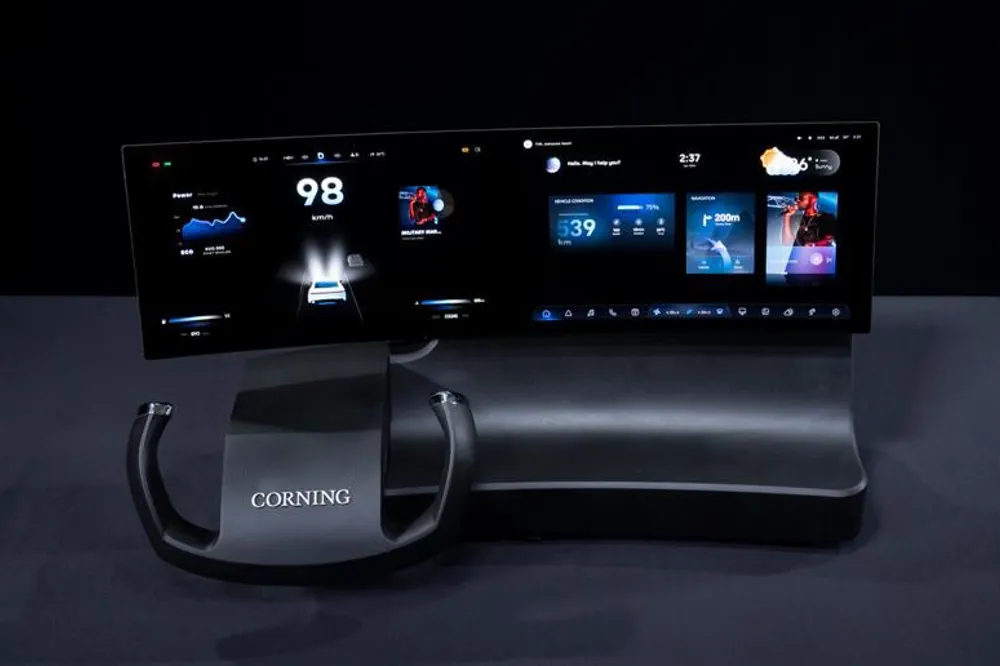
An advanced anti-reflection coating technology applied to automotive display panels that significantly reduces glare and color distortion, providing a clear screen even under various lighting conditions.
HonoreeVehicle Tech & Advanced Mobility반사 방지 코팅자동차 디스플레이시인성 향상첨단 모빌리티디스플레이 기술표면 처리 기술
코닝, 자동차 디스플레이용 고급 반사 방지 표면 처리
40
0
Corning Incorporated
One-Line Product Definition
Problem Definition
Background Problem: As the number of digital displays inside vehicles increases, screen glare and reduced readability due to direct sunlight or ambient lighting cause problems for driver experience and safety. In particular, if the car's instrument panel or navigation screen is not clearly visible in bright sunlight, the driver is at risk of missing information.
Limitations of Existing Methods: Currently, reflection is reduced and the screen is made to appear black when turned off by attaching polarizing films and printing ink masks. However, these existing ink solutions do not provide sufficient "dead front (hiding effect when the screen is off)" and have limitations in that color variations occur for each display.
In addition, adding multiple layers or increasing brightness to suppress reflection increases costs and energy consumption.
Key Differentiators
Corning's technology achieves a dead front effect that is 3 times better than standard ink masks, making the panel look like a single, seamless black glass when the screen is off. In addition, the ultra-low reflection coating minimizes screen reflection due to ambient light and provides clear readability even in strong sunlight by improving ambient contrast.
The patented color variation reduction technology maintains color consistency even when one cover glass is applied to multiple types of displays (e.g., OLED and LCD), enabling a design that integrates the car's instrument panel and center display into a single glass.
In summary, the differentiation lies in achieving both reflection reduction and color uniformity without additional films or complex layers.
Key Adopters
Entities that will actually pay: Automotive display panel manufacturers and finished car OEMs are the main customers. The cover glass with this technology will be used in automotive interiors byAutomobile manufacturers (B2B)will make the decision to adopt this.
It is also expected that automotive parts companies (Tier 1 suppliers) will receive this coated glass from Corning and deliver it to finished car companies.
B2C/B2B/B2G: B2B. The end consumer is the car buyer, but the technology adoption decision is made through business-to-business transactions. (In the future, when expanding to other industries such as smart windows, it will be mainly B2B.)
Scalability
Specific environment/country restrictions: Since it is a technology developed in accordance with automotive display standards, it can be applied to vehicles in any region of the world. With durability to meet automotive interior environment (vibration, temperature) standards, it can target the global market without regulatory restrictions.
However, it may take some time to enter the market as it must pass the automotive industry's certification process.
Industry/market scalability: First of all, it is highly marketable as it meets the trend of large, integrated displays in future cars. According to Corning's own announcement, the automotive industry is at an advantageous point, and demand for this technology is expected to increase as automakers seek differentiation with sleek glass surfaces and advanced displays.
In the future, applications may also be expanded to display fields in high-reflection environments such as aircraft instrumentation screens and outdoor digital signage.
Judges' Evaluation
CES Award Context: This technology was recognized by the industry as a CES 2026 Innovation Award Honoree in the In-Vehicle Entertainment category. The judging panel highly praised the innovation and feasibility of real-world application, as Corning, a global leader in glass materials, has introduced a solution that improves the display user experience.
Technology Completeness: According to Corning's announcement, this technology is an extension of the Gorilla Glass Matte technology already applied to laptops, and has been specialized for automotive use. The technology maturity and durability verification have been largely completed. This surface treatment, which satisfies both anti-reflection and durability, is considered highly likely to be mass-produced.
Market Expectations: Experts evaluate it as an essential technology for future vehicles. As the interior design of cars is becoming increasingly screen-based, securing driver visibility is directly related to safety, so finished car companies are expected to be highly interested. There is also speculation that Corning is already collaborating with several finished car companies, so there are high expectations for commercialization.
Overestimation/Underestimation Factors: Some may question the innovation because reflection reduction coatings have existed in the past, but Corning's solution solves practical industry problems by combining color uniformity and cost reduction effects.
The technology itself is highly valued, but the price factor may be a variable in mass adoption. However, considering Corning's size and supply chain, it is likely to be supplied at a reasonable price and quickly preempt the market.
Analyst Insights
🔥 High Marketability / Business Connection Potential: This solution targets a clear need for improving the quality of vehicle displays and is likely to be applied to major finished cars soon. Commercialization and market entry are also expected to be smooth through Corning's strong industry partnerships.
The award list data is based on the official CES 2026 website, and detailed analysis content is produced by USLab.ai. For content modification requests or inquiries, please contact [email protected]. Free to use with source attribution (USLab.ai) (CC BY)
댓글 (0)
댓글을 불러오는 중...