An all-in-one manufacturing system called the Single-Cell Manufacturing platform,Additive manufacturing (3D printing) of metals, plastics, etc.to milling, laser processing, component placement (Pick-and-Place), and even semiconductor lithography, a next-generation manufacturing solution that performs multiple processes in a single modular device. (Demo video: YouTube)
HonoreeSupply & Logistics차량 기술첨단 모빌리티ADAS자율 주행차량 안전시스템 효율성
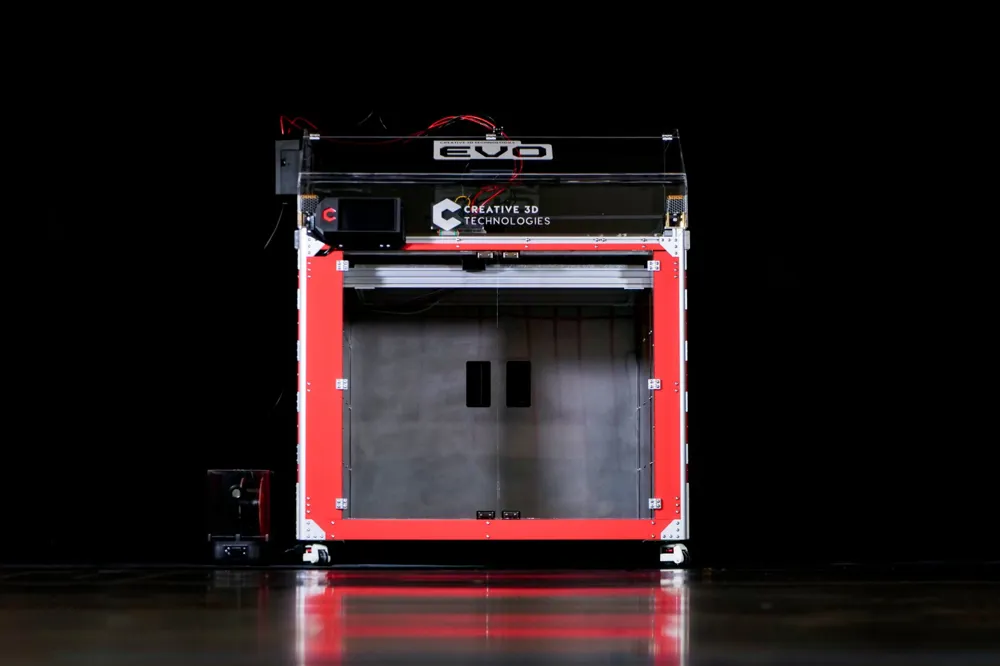
C3DT EVO
47
0
Creative 3D Technologies
One-Line Product Definition
Problem Definition
Manufacturing complex products typically requires multiple dedicated equipment such as cutting machines, printers, and assembly machines, as well as large factory spaces and skilled personnel. This fragmented manufacturing environment results in huge initial investment costs and inter-process logistics costs for small-quantity batch production or startup product development, making it difficult for SMEs or local communities to access state-of-the-art manufacturing.
For example, making one part involves going through several machines in the factory or sending it to an external process, which causes time delays and quality error risks. Furthermore, as the global supply chain is concentrated in a few countries, it has been dependent on a supply chain vulnerable to component supply and demand, and production disruptions have become a major problem when the supply chain is disrupted due to pandemics.
EVO emerged to innovate this distributed and vulnerable manufacturing structure, aiming to improve supply chain independence and manufacturing accessibility by integrating and executing multiple processes even in small spaces.
Key Differentiators
C3DT's EVO platform is based on the concept of a "factory cell," and its greatest innovation is that it handles tasks that required multiple individual machines in a single modular system. A single EVO device integrates the functions of more than 10 industrial 3D printers, and is based on metal, plastic, and composite 3D printing, with milling (cutting), laser marking/cutting, pick-and-place (mounting of electronic components), and evenSemiconductor microfabrication (lithography)can be performed by adding expansion modules.
In other words,Additiveand Subtractive, assembly, and microfabrication processes are executed sequentially on the same platform, allowing products that would normally go through multiple processes to be completed in one EVO. This modular scalability is called the "Mega Factory Stack" concept, and allows for flexible manufacturing facility configuration by adding output modules to increase production volume or mounting new process modules to expand functionality as needed.
As a result, it greatly reduces factory floor space, eliminates inter-process transfer time, shortens production lead time, and reduces initial equipment costs by performing various manufacturing processes with a single system investment. In addition, remote digital control and AI-based process optimization functions allow the equipment to continue working by itself, replacing multiple tools without the need for skilled technicians, lowering the barrier to entry into manufacturing.
EVO aims to createthe "iPhone moment of the manufacturing industry"with this integration, meaning that EVO will lead the democratization of manufacturing by integrating fragmented manufacturing lines into a single cell, just as smartphones integrated multiple devices into one hand. In practice, the application of EVO will enable SMEs and startups to perform complex production in small spaces, and enable the construction of a distributed supply chain that does not rely on distant overseas factories through local production hubs.
Thissingle-cell manufacturing (small footprint)and modular scalability, and multi-process convergence itself are EVO's overwhelming differentiators.
Key Adopters
Companies/institutions that need advanced manufacturing capabilities but are unable to equip large-scale factories are key customers. For example, hardware startups or small and medium-sized manufacturers can use EVO to handle everything from prototyping to small-volume mass production on their own, which is useful.
Also, in cases where various parts need to be produced on-site, such as in the defense and aerospace industries,industrial facilities in remote areas (offshore plants, space bases, etc.)It can also be used to internalize the parts supply chain. Educational and research institutions can also be interested in EVO because students can practice various processes in one system.
In the end, B2B-oriented companies seeking manufacturing innovation (e.g., auto parts companies, electronics startups), government/public research institutes (establishment of local manufacturing hubs), etc. are likely to be the investors. In the future, various B2B2G scenarios are expected, such as EVO being partially adopted as a flexible production cell in large companies' production lines, or installed in regional base factories to reduce parts logistics.
Scalability
Thanks to the trend of digital transformation and localization of manufacturing, EVO's concept is attracting great attention in the market. In particular, the importance of supply chain risk management has been highlighted since the pandemic, and there is global demand for self-sufficient distributed manufacturing solutions.
However, since this is the first attempt to unify so many processes, it is necessary to verify whether the actual performance of each process meets the level of specialized equipment. Some experts say that "putting everything in one machine can degrade each performance."Concerns (limitations of comprehensive tool expertise)is also raised.
In addition, the introduction of EVO is expected to involve a considerable initial investment cost, so price competitiveness is key for target customers, SMEs, to readily adopt it. Creative 3D Tech has recently expanded its production facilities in Texas, USA to prepare for mass production, but the establishment of a stable mass production system and the formation of a partner ecosystem (software, module development, etc.) are cited as challenges.
In terms of regulations, each module such as metal 3D printing must be certified (e.g., aerospace parts production certification, etc.), and the establishment of industry standards for processing multiple processes as a single process is a task to be solved in the future. Nevertheless, the industry has high expectations that it will be a "game changer that will change the manufacturing paradigm if it works properly," and its technical potential has already been recognized by receiving the CES Innovation Award.
If successful cases emerge through the Pilot program in the future, investment attraction and market expansion are expected to accelerate, andManufacturing SaaS (manufacturing process subscription model)Even new business models are possible. In summary, EVO has very high market scalability, but there are also considerable technical and commercialization hurdles to overcome.
Judges' Evaluation
With the CES 2026 Best of Innovation Award (Supply & Logistics), EVO received rave reviews from the judging panel, befitting its self-proclaimed "iPhone moment of the manufacturing industry." Experts called the concept of combining fragmented processes into one a "new era of manufacturing process integration," and especially noted it as a core technology in the post-COVID era that would reduce supply chain vulnerability.
Industry media also expressed expectations that it would be a solution that would lead to the democratization of manufacturing, saying that it "gives founders and small businesses their own factories in their hands."democratizationHowever, commercialization difficulties were also mentioned from a realistic perspective.
Some reviews advised, "Since it can be suspected of being a desk concept, actual operation demonstrations and success stories must be created quickly," and traditional manufacturing officials generally responded, "The concept is great, but more verification is needed before it can be brought into our line." Therefore, although it was praised as the best innovation at the CES stage,"There are many practical tasks to be solved in order to settle in the market."is the common opinion of experts.
In summary, a cautious optimism has formed, acknowledging the technological ripple effect but also pointing out the commercialization risks.
Analyst Insights
⚠️ Highest technological innovation but business feasibility needs observation – A disruptive innovation technology that integrates manufacturing processes has a high potential to change the industry landscape, but realistic challenges such as cost and performance verification remain, making it too early to guarantee immediate commercial success.
The award list data is based on the official CES 2026 website, and detailed analysis content is produced by USLab.ai. For content modification requests or inquiries, please contact [email protected]. Free to use with source attribution (USLab.ai) (CC BY)
댓글 (0)
댓글을 불러오는 중...