A new paradigm for AI computing GPU cloud – a participatory AI cloud service that gathers idle GPUs from corporate servers to gaming PCs around the world to create a massive distributed infrastructure, and realizes the lowest cost for users and fair compensation for providers through Web3-based settlement.
HonoreekoArtificial Intelligence인공지능(AI)모바일 솔루션데이터 분석효율성 향상산업 혁신임상 데이터 관리
지큐브(gcube)
62
0
Data-alliance
One-Line Product Definition
Problem Definition
The explosive demand for AI such as ChatGPT is intensifying the shortage and soaring costs of GPU computing resources. Startups and researchers face high entry barriers as they must purchase expensive GPU servers or bear the high costs of a few cloud providers (AWS, Azure, etc.).
Existing cloud models are based on large-scale data centers, resulting in enormous initial investment and operating costs, as well as issues with power consumption and carbon emissions. In addition, the market is dominated by a few large players, leaving small and medium-sized players with no price negotiation power, creating an industry imbalance.
Meanwhile, GPUs in general PCs and corporate servers scattered around the world are often idle, which is inefficient in terms of resource utilization.
In short,"GPUs to spare on one side, GPUs in short supply on the other"This situation highlights the problem: the lack of an effective infrastructure to connect them. While there have been attempts at blockchain-based distributed computing, they have limitations when applied to large workloads such as AI learning.
Key Differentiators
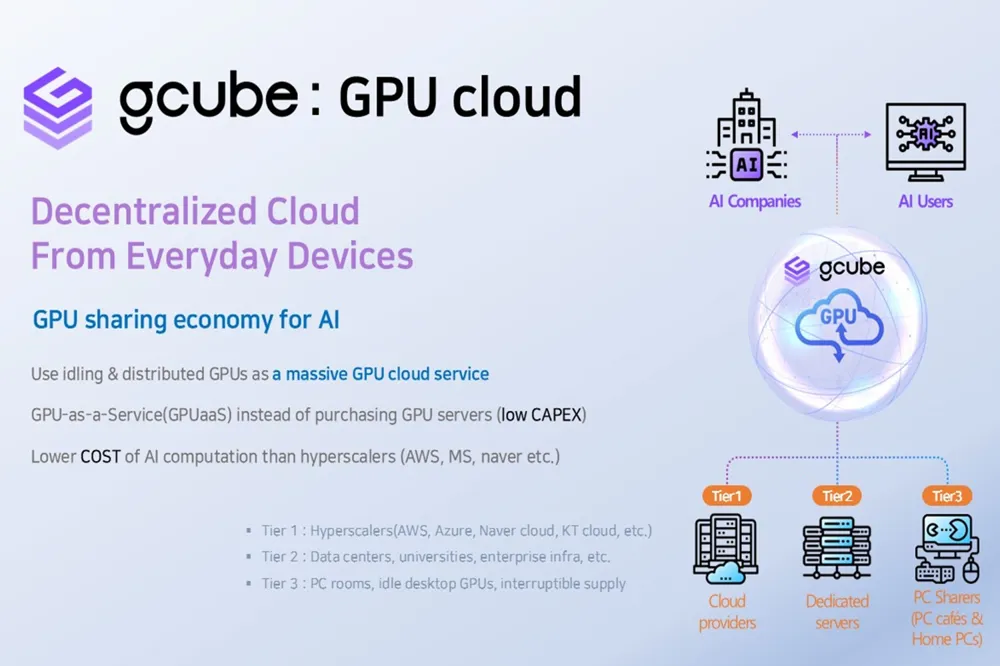
In a nutshell, the gcube platform is"the Airbnb of GPUs"It does not rely on expensive central data centers like before, but connects unused GPUs scattered around the world to form a huge virtual cloud.
To this end, container orchestration technology is used to provide uniform services even with GPUs in different environments, and a Web3 (blockchain)-based accounting system is used to transparently and safely compensate participants according to their usage.
As a result, AI developers can secure the GPU computing power they need at up to 70% lower cost than AWS, and general PC gamers or companies can lend their idle GPUs toearn revenue, creating a "shared economy model".
In particular, by putting high-performance GPUs left over after the Ethereum mining boom into AI computation, it achieves both recycling of existing resources and cost efficiency.
This decentralized, participatory structure is completely different from existing clouds, and the biggest differentiation is that it democratizes the GPU supply structure that was concentrated in a few large corporations. In addition, the platform itself has sophisticated container technology that optimizes performance while distributing large-scale computing tasks across multiple distributed GPUs, and users can easily utilize it as if it were one huge GPU farm.
In short, gcube has pioneereda new category: "Decentralized Cloud for the AI Era".
Key Adopters
Companies/institutions with high AI computing demand are the main customers. For example, AI startups, university labs, and video/game companies can rent GPUs from gcube instead of existing clouds. These entities contract with gcube services in a B2B format to purchase the necessary GPU time.
Conversely, on the supply side, entities with spare GPU capacity, such as gamers, individual miners, and corporate data centers, participate as node providers to earn revenue. In other words, the gcube ecosystem includesboth consumers (B2B AI companies)and suppliers (B2C individuals or B2B companies).
On the demand side, small and medium-sized AI developers in particular want a "cheap GPU cloud" and are expected to actively adopt it, and some AI teams at large companies that want to reduce cloud budgets may also use it. In addition, national institutions (which need GPUs for ultra-large-scale research) can also become customers.
In summary, the target is companies in all industries that need GPUs, and initially, the user base will be formed mainly by cost-sensitive startups/research institutes.
Scalability
The gcube model has a structure in which the service scale automatically expands as the number of participating nodes increases. Although it already started in Korea, it aims for a global network and can connect GPU resources around the world, including the United States, Europe, and Asia.
Technically, it is also cloud-native, so it works anywhere without environmental restrictions, and Web3 accounting supports global settlement without borders.
On the other hand, there may be concerns about running sensitive data on other people's PCs according to each country's data sovereignty/security regulations, but security can be secured through container isolation, and regional node selection can be designed if necessary.
In addition, although it currently focuses on AI learning/inference tasks, it can be expanded to other high-computing power demand areas such as edge computing, distributed render farms, and blockchain node services in the future. In other words, if gcube succeeds, it has the potential to evolve into a distributed supercomputer platform that expands not only GPUs but also CPUs and memory.
The key is to form an initial network effect, but once it is on track, it has a very scalable structure.
Judges' Evaluation
Winning the CES Innovation Award in the AI category is evaluated asintroducing "the potential of Korean-style distributed cloud"to the international stage. The domestic media was encouraged, saying, *"Korea's own distributed GPU infrastructure technology is recognized for its competitiveness in the world,"* and the AI industry is paying attention to it as *"the key to solving the GPU problem, which is a bottleneck in AI development."*
Like the analogy of "Airbnb in the AI field,"the concept itself is intuitively appealing to everyone, so investors are also very interested. However, the market is watching the verification of actual performance and stability.
Some experts have expressed caution, saying that *"communication delays between distributed nodes and responses to failures may be more complex than in existing centralized systems,"* and the possibility that large cloud companies may counter with price cuts is also mentioned as a risk.
Nevertheless, at the CES site, there were many positive responses to"the realization of the idea of collecting all the GPUs that are idle", and VentureBeat and others introduced gcube as *"a leading example of AI infrastructure cost innovation."*
Overall, it is evaluated as a solution that has both the creativity of the concept and the practical needs of the market, but there is also a realistic outlook that its actual success depends on the formation of the ecosystem in the future.
Analyst Insights
⚠️ Impressive technology but market uncertainty – The distributed AI cloud vision presented by gcube is innovative, but as a business model that challenges large central clouds, there are significant variables such as securing participants and building trust. It has succeeded in proof of concept, but it remains to be seen whether it will actually change the market landscape.
The award list data is based on the official CES 2026 website, and detailed analysis content is produced by USLab.ai. For content modification requests or inquiries, please contact [email protected]. Free to use with source attribution (USLab.ai) (CC BY)
댓글 (0)
댓글을 불러오는 중...