A non-contact, non-invasive health monitoring system that uses an air pressure-based BCG (Ballistocardiography) sensor to continuously measure heart rate, respiration, and movement without direct contact with the user. It employs AI to detect abnormal patterns and provide real-time alerts for risks such as falls and sleep apnea, offering a comprehensive care solution.
HonoreeDigital HealthAI 헬스케어IoT 융합텔레헬스디지털 건강차량용 건강 모니터링응급 상황 대응
Carearly
69
0
DolbomDream Co., Ltd.
One-Line Product Definition
Problem Definition
Existing methods for monitoring the vital signs of the elderly or patients rely on wearable devices (such as heart rate bands) or pressure sensor pads within bed mattresses. However, these require attachment to the body or the user to remain still for accurate readings, causing inconvenience.
Furthermore, typical air pressure sensors are vulnerable to ambient noise and changes in the user's posture, often misreading signals and triggering false alarms, leading to low reliability.
Consequently, monitoring falls or abnormal breathing becomes difficult when the user moves or speaks, hindering meaningful continuous monitoring. Families and caregivers of patients requiring 24-hour care bear the burden of constant observation.
In essence, the lack of accurate non-contact bio-monitoring technology and the environmental sensitivity of existing devices are major issues in care settings.
Key Differentiators
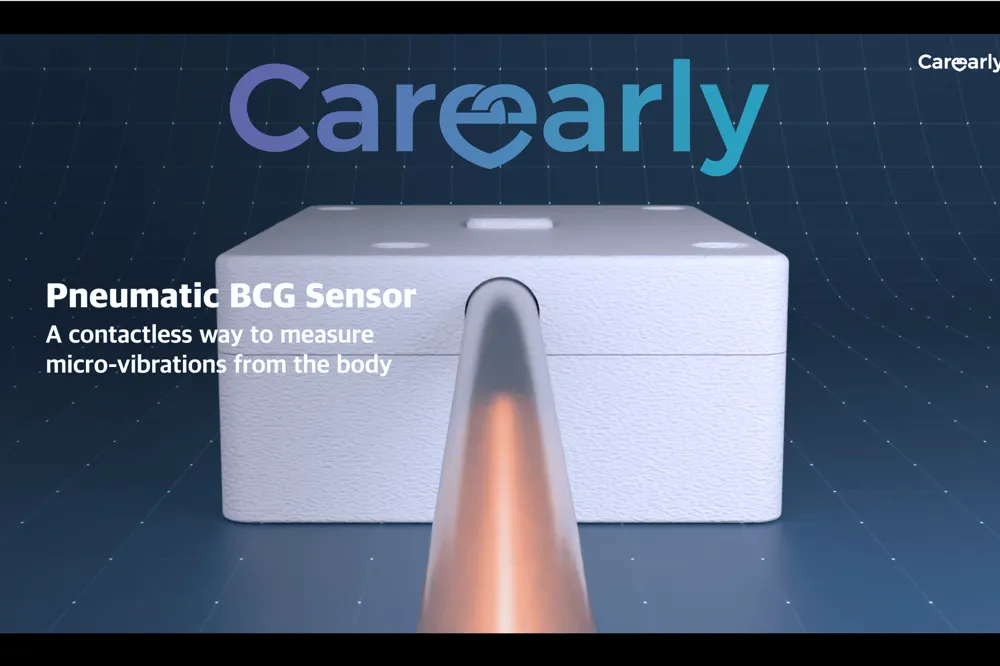
Carearly adopts the P-BCG (Pneumatic Ballistocardiography) sensor, independently developed by DolbomDream, to detect subtle body vibrations caused by heartbeats as air pressure variations without touching the user.
A specialized air channel design filters out interference from ambient noise and pressure changes, achieving a bio-signal accuracy of up to 98%. This allows for continuous and accurate measurements even when the user moves, speaks, or changes posture.
The system records heart rate, respiration rate, and movements such as tossing and turning during sleep in real-time, and also detects falls from the bed without skin contact.
With the application of AI algorithms, the system filters out noise signals and, upon identifying signs of sleep apnea, prolonged inactivity (reduced activity), or irregular heartbeats from the detected bio-patterns, immediately sends alert notifications to caregivers/medical staff.
Additionally, it calculates emotional state indicators such as stress and anxiety levels through subtle changes in the measured pulse, which can be used to monitor the mental health of those being cared for.
This year's demonstration revealed plans to add functions for monitoring signs of chronic disease exacerbation and predicting dementia risk in the future, which implies the incorporation of a predictive model based on accumulated long-term bio-data.
In short, Carearly can accurately monitor a patient's health status 24 hours a day in their daily environment without requiring any attachments, and its robust sensing technology, which does not malfunction even with movement or ambient noise, is a key differentiator.
This is establishing it as an innovative tool for early detection and response to fall accidents and cardiac arrest in elderly living alone or those with dementia, while also reducing the burden of constant monitoring for caregivers.
Key Adopters
Individuals/institutions caring for the elderly and patients with mobility issues are the main customers.At home, children (B2C) who want to monitor their elderly parents from afarcan install and utilize Carearly,Nursing homes and elderly welfare facilities (B2B)can adopt the system to manage the safety of multiple residents.
Also,Hospitals (especially rehabilitation/neurology wards)can use it to non-invasively track patients' sleep status and vital signs, and local governments/public entities may also pursue projects (B2G) to distribute it to elderly living alone.
Since DolbomDream started as a mental healthcare startup and also handles mental health data such as depression, there is room for collaboration in community care programs or health management services linked to insurance companies.
Currently, it is being pilot-applied in versions for individual homes and facilities, and is particularly attracting attention in the Korean market as a solution for addressing the aging population.
Ultimately,"Everywhere the elderly need care"can be seen as the potential market.
Scalability
With rapid aging, the demand for non-face-to-face monitoring technology is surging globally, making Carearly's market prospects bright.
From a regulatory perspective, it is relatively easy to enter the market if classified as a wellness/prevention device rather than a strict treatment or diagnostic device.
It has already built initial awareness through domestic and international awards and interest from government agencies, and can be further expanded to include insurance discount links or the establishment of community health networks once data is accumulated.
However, clinical validation and reliability verification are very important, so AI tuning work must be done in advance to reduce the frequency of false alarms and select only meaningful warnings during actual long-term use.
In addition, elderly users may have resistance to devices, so it is necessary to promote the advantages of the non-invasive and non-wearing method while increasing installation convenience (such as home router integration).
Since DolbomDream is still a startup, partnerships and investment are needed to secure large-scale production and service networks, and medical device certification should also be considered to enter the medical field.
Nevertheless,Conforming to the huge trend of "untact care,"it is evaluated to have very high scalability in government-level smart care projects or the private health tech market.
In summary, it appears to be a solution with the potential to advance beyond the domestic market to the global silver industry market if product completeness and data reliability are secured.
Judges' Evaluation
Winning the CES 2026 Digital Health Innovation Award, it was praised for opening a new horizon in non-invasive monitoring technology.
The judges especially praised Carearly's sensing technology, saying, "It's amazing that it can measure so accurately without attaching a single band to the user," and recognized its social value as a preventive care technology essential for an aging society.
US media outlets such as Electronics360 introduced Carearly first in CES healthcare innovation articles, emphasizing that "it achieves 98% accuracy at the medical level despite being non-contact."
Domestic experts also noted DolbomDream's potential, saying, "It has made the presence of Korean care technology known through CES."
However, some pointed out the need for data verification and insurance recognition for actual commercialization, stating, "Despite positive CES feedback, commercial verification is not yet sufficient." This is because clinical data from a large user base has not yet been accumulated.
In summary,The evaluation can be summarized as "Very innovative and positive based on the CES showcase, but verification in the actual market is insufficient."is the evaluation summarized as.
Meanwhile, market expectations are high as it is a product that well addresses the needs of the care field, and there is also an opinion that the technology's completeness will not be underestimated if it comes out as demonstrated.
Analyst Insights
⚠️ Technically innovative but market verification is insufficient – It has shown new possibilities in the care/healthcare field and received favorable reviews at CES, but reliability verification and distribution strategies at the commercial stage are key to future success.
The award list data is based on the official CES 2026 website, and detailed analysis content is produced by USLab.ai. For content modification requests or inquiries, please contact [email protected]. Free to use with source attribution (USLab.ai) (CC BY)
댓글 (0)
댓글을 불러오는 중...