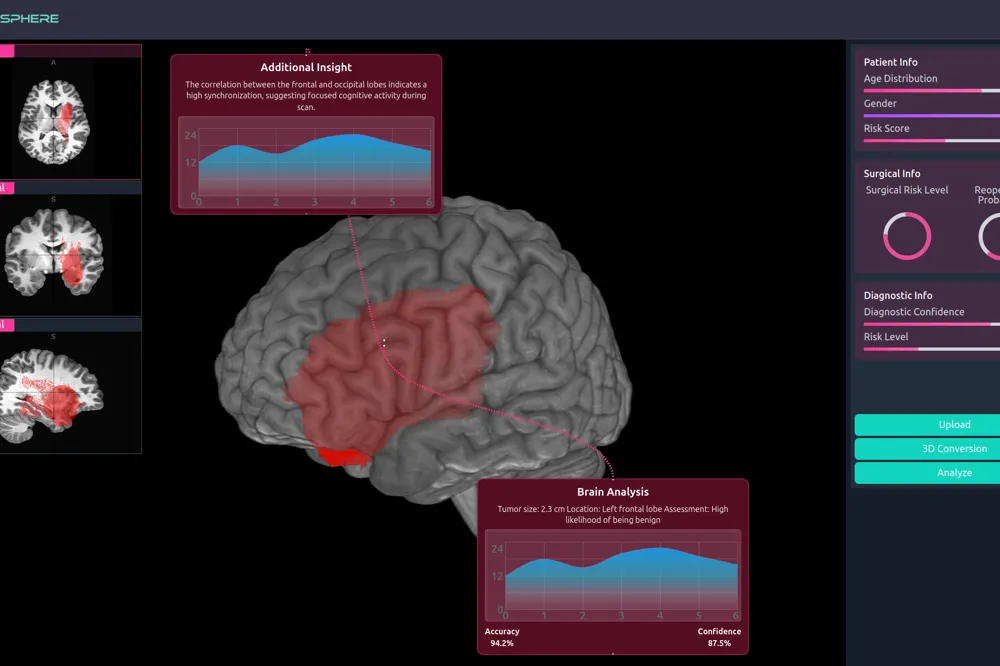
Software that supports neurosurgical planning by converting multi-view MRI images of brain tumor patients into 3D models.
HonoreekoDigital HealthAI 기반 헬스케어IoT 의료기기텔레헬스 솔루션디지털 헬스운전자 모니터링에너지 효율
MedNeuro3D
76
0
EAN HIGHTECH
One-Line Product Definition
Problem Definition
Existing brain tumor surgical plans rely on 2D MRI images, making it difficult to fully understand the spatial structure of the tumor and limiting the prediction of surgical paths and safety assurance. This raises concerns about the risk of damage to important structures or inaccuracies in planning during surgery. Experts have pointed out the need for 3D simulations before complex procedures.
Key Differentiators
MedNeuro3D creates precise 3D brain tumor models based on multi-angle MRI. It visualizes tumor volume, extent, and shape, going beyond simple detection, and helps design optimized surgical paths and avoid key structures. In particular, it is characterized by increased medical accessibility through multinational remote collaboration capabilities and cloud-based workflows.
While existing solutions are limited to determining the presence or absence of tumors or simple segmentation, MedNeuro3D provides a 3D interface specialized for surgical planning.
Key Adopters
Target customers are hospitals and medical institutions (neurosurgery). Neurosurgeons or radiology experts are likely to be the actual purchasers or adopters (B2B), and the situation is similar for government or public medical institutions (B2G). It is not intended for individual patients (B2C) and is likely to be introduced into hospital systems in the form of a license or subscription.
Scalability
Due to the nature of cloud-based software, it can be expanded without being tied to specific countries or regulations. However, there are barriers to entry as medical devices may require FDA and CE certification.
The basic technology (3D reconstruction of medical images) can be applied to surgical planning for other brain diseases or body parts (heart, liver, etc.), making it highly scalable. However, it is optimized for brain-specific workflows, so additional development may be required when applied to other fields.
Judges' Evaluation
The technical completeness was recognized by winning the CES Innovation Award Honoree in the digital health category. Although the information is limited, the application specialized for brain tumors seems to have been highly evaluated.
In the medical device market, AI-based software is highly anticipated, but there may be a lack of verified clinical data, and the adoption speed of medical infrastructure is slow. Currently, it is in the research and pilot stage, and market response is expected to vary depending on actual clinical application. (Technical completeness seems high, but there are challenges until market adoption)
Analyst Insights
⚠ The technology is impressive, but market and regulatory verification is needed. Core takeaway excluding marketing jargon: 3D visualization for precision surgery support is useful for medical staff, but marketability will only fully open up after medical certification and demonstration.
The award list data is based on the official CES 2026 website, and detailed analysis content is produced by USLab.ai. For content modification requests or inquiries, please contact [email protected]. Free to use with source attribution (USLab.ai) (CC BY)
댓글 (0)
댓글을 불러오는 중...