A health management app for workers that provides AI-based video analysis and customized rehabilitation exercises for musculoskeletal disease management.
HonoreeDigital HealthAI 기반 분석개인 맞춤형 재활IoT 센서원격 의료근골격 회복디지털 헬스
MORA Care, AI 기반 개인 맞춤형 근골격 회복 솔루션
46
0
EverEx
One-Line Product Definition
Problem Definition
Musculoskeletal pain is a major cause of absenteeism and disability in industrial and office settings, but access to professional rehabilitation services is difficult.
Companies want preventive healthcare tools, but face cost and accessibility limitations with in-person rehabilitation with doctors and physical therapists.
Existing self-diagnosis apps or wearables only provide exercise posture correction, lacking customized prescriptions and long-term tracking based on individual conditions.
Key Differentiators
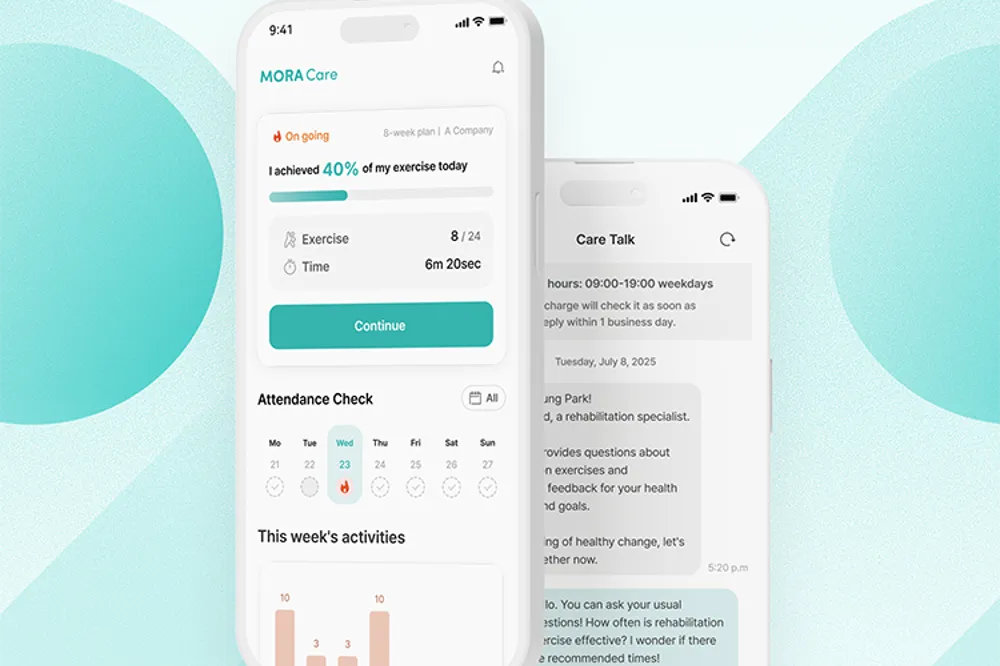
MORA Care diagnoses joint range of motion and asymmetry through computer vision analysis using a smartphone camera.
Based on this, it suggests personalized exercise programs and tracks progress.
It is characterized by explaining the results using natural language processing (LLM) and visual language models, and providing daily coaching notifications.
Enterprises can adopt it through a licensing model, and manage exercise participation and risk group distribution at the organizational level through a dashboard.
Compared to existing healthcare apps, the main differentiator is the integrated provision of medically validated algorithms and an enterprise management dashboard.
Key Adopters
The main customers are corporations and public institutions (B2B, B2G).
It is adopted into corporate welfare programs to promote worker/employee health, and hospitals/clinics can also use it for patient management.
Rather than individuals (B2C), companies (manufacturers, construction companies, government ministries, etc.) are more likely to bear the costs and adopt the solution.
Scalability
As a cloud-based app, it is globally scalable in the telemedicine and healthcare market.
It has completed US FDA Class II medical device registration and has successfully entered the US RTM (Remote Therapeutic Monitoring) market, and is linked to an insurance reimbursement model.
Service expansion is easy once medical regulations in Europe and Asia are secured.
In addition, the scope of application can be expanded to community health and senior health management in addition to the workplace.
Judges' Evaluation
It was selected as a CES Healthcare Honoree and has already been introduced into a network of 400 hospitals and clinics in the United States, receiving positive evaluations.
The digital health industry noted it as a "solution that connects clinical practice and daily life."
High expectations in the industry due to solid technical completeness and commercialization performance (US market entry, FDA approval, partnerships).
On the other hand, challenges are also mentioned, such as the need for additional real-world usage data regarding integration with existing medical procedures and maintaining user engagement.
The market consensus is that "technology + business model validation has been achieved."
Analyst Insights
🔥 High marketability / Business connection possible. Growth potential is very high as it has already secured a real operating network, is incorporated into the insurance model, and the global rehabilitation market is growing.
The award list data is based on the official CES 2026 website, and detailed analysis content is produced by USLab.ai. For content modification requests or inquiries, please contact [email protected]. Free to use with source attribution (USLab.ai) (CC BY)
댓글 (0)
댓글을 불러오는 중...