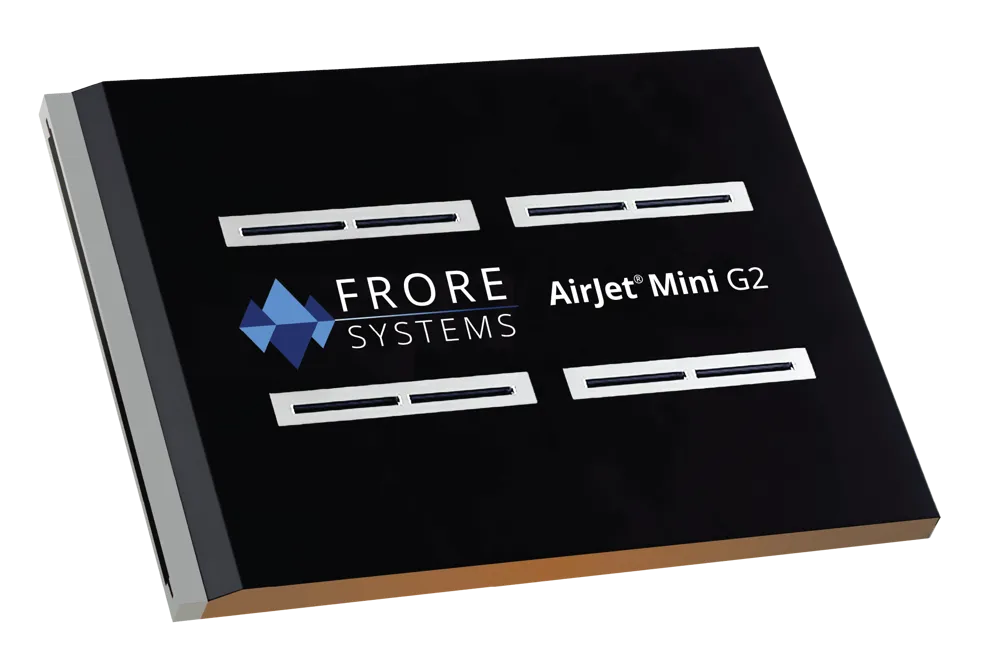
The world's first 2nd-generation solid-state (active) cooling chip developed to solve heat issues in ultra-small electronic devices from smartphones to laptops. It is an innovative cooling solution that removes 7.5W of heat per chip without a fan, preventing device performance degradation (throttling).
HonoreeComputer Hardware & Components능동 냉각열 관리솔리드 스테이트칩셋성능 향상소형화
AirJet Mini G2
26
0
Frore Systems
One-Line Product Definition
Problem Definition
In small electronic devices such as laptops, smartphones, VR HMDs, and mini PCs, performance degradation due to heat has been a major obstacle to implementing high performance. Existing solutions have relied on small fans or heat pipes, but fans are difficult to mount due to thickness limitations, and cause noise, vibration, and dust intrusion issues. Heat pipes alone are insufficient to actively dissipate heat.
As a result, high-performance chips often fail to perform properly because their clock speeds are reduced (throttled) when heat builds up. For example, gaming smartphones get hot within minutes and the frame rate drops, or fanless tablets stutter under sustained load. Also, when using fans, small devices have noticeable fan noise, and there are concerns about failures due to dust.
In other words, there was a need for a “quiet, thin, and efficient way to cool heat,” and the first-generation AirJet pointed the way, but with a heat dissipation of around 5W, it was insufficient for high-power chips.
Key Differentiators
AirJet Mini G2 is a solid-state cooling solution that completely replaces fans, achieving innovative improvements in heat removal capability and form factor compared to competing technologies. The 2nd generation product has 50% improved heat dissipation compared to the 1st generation, removing 7.5W of heat per chip, and multiple chips can be placed in parallel to linearly increase heat throughput (e.g., 2 chips for 15W, 3 chips for 22.5W). This means that designers can adjust cooling performance modularly as needed.
In addition, the ultra-thin package, only about 2.8mm thick, can be built into almost any device without adding bulk, and there are no vibrating or rotating parts, so it is completely silent and has very little risk of dust accumulation or failure. In fact, prototype devices adopting the AirJet cooling solution have demonstrated more than 3x sustained performance improvement on the same device, proving superior performance compared to the existing fan + heat pipe structure.
In summary, AirJet Mini G2 is a cooling technology that achieves the three goals of "small size, silent operation, and high efficiency," and its overwhelming form factor advantages and reliability compared to existing fans are the key differentiators.
Key Adopters
AirJet Mini G2 is not a product sold directly to end consumers, but a B2B solution for electronic device manufacturers (OEMs). Therefore, the main adopters are notebook/tablet manufacturers, smartphone manufacturers, and IoT/industrial device developers who want to adopt this technology to create devices.
For example, a PC company that makes ultra-thin laptops may adopt AirJet instead of fans, or an industrial camera manufacturer that is sensitive to heat may improve reliability with this technology. Technology licensing or module sales are conducted in a B2B format, and general consumers will indirectly benefit from products incorporating this technology in the future (e.g., specific model laptops, VR headsets, etc.). (Category: B2B-focused)
Scalability
AirJet Mini G2 is a universal technology solution that is not limited by specific countries or regulations, and its range of applications is very wide. This is because any industry can consider applying it as long as there is a heat dissipation problem.
Currently, it is focused on compact IT devices, but in the future, it will also be useful in fields where fans are prone to failure in extreme environments, such as automotive electronics and military/aerospace electronic equipment. In addition, Frore Systems is also developing scale-up solutions such as the AirJet PAK module, which combines multiple AirJets, and is showing its willingness to expand to edge AI servers that generate high heat.
In summary, it is a universal technology that solves the heat limitations of electronic products and has a large potential market, and it can target all global device manufacturers as customers without being limited to one or two companies or countries. However, the actual adoption rate is expected to be gradual, depending on factors such as manufacturers' conservatism in design changes and unit costs.
Judges' Evaluation
At CES, AirJet Mini G2 is called a "small but big change" and has been consistently attracting attention from the industry, receiving the Innovation Award for three consecutive years. At the on-site demo, the product was installed in a Qualcomm Snapdragon X2-based reference laptop, etc., and showed that it maintained high performance without a fan, earning praise from visitors and experts.
In particular, in an era of increasing AI computation, it was evaluated as a "thermal solution that doubles computing performance without heat constraints," and the news that it has begun to be applied to actual commercial products (e.g., AT&T's rugged MegaConnect device) has proven the maturity of the technology. However, since there are still few tangible examples for general consumers, some experts believe that large-scale adoption in the real market will take more time.
In summary, there is no disagreement that it is very innovative and useful based on CES evaluation criteria, and there are few overestimation factors, but many view that market verification has only just begun - "Positive based on the CES showcase, but actual popularization remains to be seen."
Analyst Insights
⚠️ Impressive technology but market uncertainty – A solution with enormous potential to change the electronic device cooling paradigm, but in the early stages with uncertainty remaining until widespread industry adoption.
The award list data is based on the official CES 2026 website, and detailed analysis content is produced by USLab.ai. For content modification requests or inquiries, please contact [email protected]. Free to use with source attribution (USLab.ai) (CC BY)
댓글 (0)
댓글을 불러오는 중...