A combined urban small wind turbine and climate sensor network. Ultra-low-noise vertical axis wind turbines generate electricity in urban, coastal, and remote areas while simultaneously collecting and sharing real-time environmental data such as temperature, humidity, pressure, and wind speed, providing both energy independence and local climate intelligence infrastructure.
HonoreekoSustainability & Energy TransitionAI기반풍력 발전기후 인프라에너지 최적화분산 에너지지속가능한 에너지
Grassroots Climate Grid: GeoWind의 AI 기반 풍력 및 기후 인프라
8
0
GeoWind
One-Line Product Definition
Problem Definition
The demand for detailed environmental data at the city or regional level is increasing to address climate change, but existing weather observation networks are built with coarse and sparse density, missing local microclimate information.
Also, even when trying to utilize wind power in urban areas to expand renewable energy, traditional wind power generation is centered on large turbines, making installation space and noise problems obstacles.
For example, current urban weather sensors are only located on a few building rooftops, making it difficult to grasp microclimate changes in real-time, and existing wind power generation requires large sites and strong winds, which is a limitation.
Due to the limitations of existing methods, local communities have had difficulty achieving both energy independence and environmental monitoring.
Key Differentiators
The Grassroots Climate Grid solution is innovative in that a single small wind turbine performs both power generation and environmental data collection simultaneously.
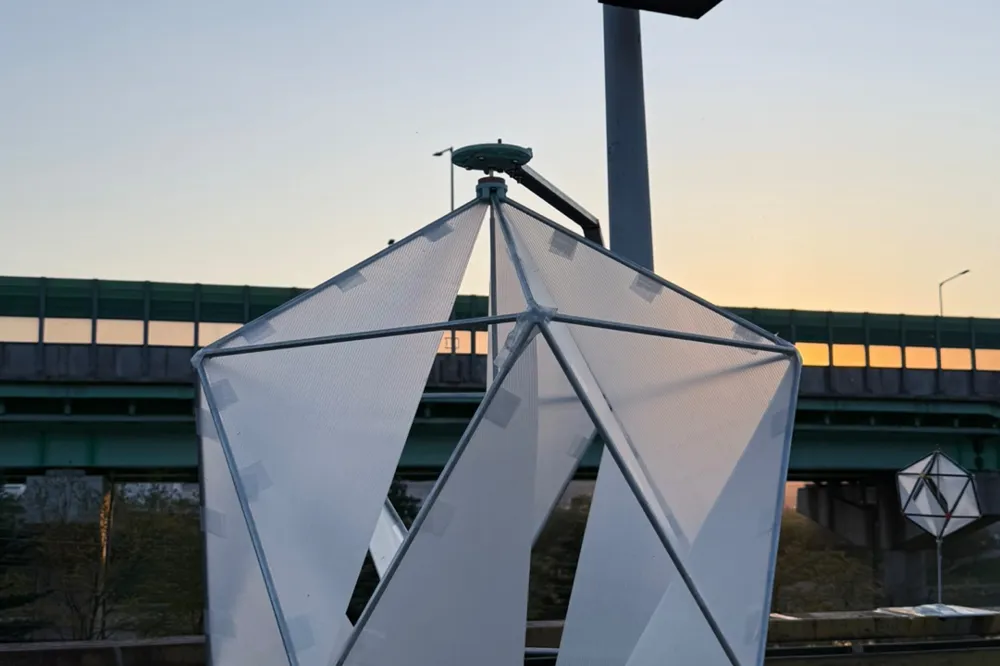
GeoWind's patented geodesic structure vertical axis turbine can rotate even at low wind speeds of 4m/s, allowing it to operate even in weak urban winds, and the noise is below 45dB, quiet enough not to interfere with daily life.
Each turbine has built-in temperature, humidity, pressure, and wind speed sensors and an edge AI processor, which analyzes hyperlocal climate data in real-time and shares it to the cloud.
In addition, the modular design allows it to be installed in various locations such as city streets, coastlines, and building rooftops as a landmark design, establishing itself as an infrastructure that encourages community participation.
In short, these turbines generate electricity while acting as distributed climate observatories, and are differentiated from other similar solutions in that they are designed to contribute to achieving ESG goals and supporting energy equity.
Key Benefits
The main adopters of this solution will be local governments, public institutions, and corporate campuses.
For example, local governments promoting smart cities can install it throughout the city to collect microclimate information and produce renewable energy. In addition, port or coastal management agencies can install it along the coastline to obtain marine climate data and power supply at the same time, or university/corporate research campuses can introduce it as their own energy infrastructure to secure eco-friendly image and data.
Rather than general households or individuals, B2G (government/public) and B2B (industrial/research complex) installations are expected to take the lead. There is also a possibility that it will be partially introduced in the form of a local residents' cooperative as a community-led energy project.
Scalability
The technology itself is not limited to a specific country and can be applied anywhere. It can be installed from deserts to high-rise building rooftops as long as wind conditions are met, so geographical scalability is high.
In particular, the turbine design is modular, making it easy to scale, and the cloud-based data platform has the potential to expand into a global urban climate network.
However, in terms of licensing and permits, there is a challenge in passing building/safety regulations when installing wind power facilities in urban areas. In addition, since wind speed conditions vary from region to region, the installation effect may vary by region.
In terms of industry, it can be applied to various markets such as smart cities, renewable energy, and environmental monitoring as a cross-cutting field of energy generation and IoT climate data. Therefore, it is currently a niche market specializing in sustainability/environment, but it can be widely expanded if it is adopted as an urban infrastructure standard in the future.
Judges' Evaluation
In the context of the CES award, this product was well-received as a fusion of climate tech and energy tech. Like the catchphrase "redefining wind energy," the elevation of wind turbines to data infrastructure was considered innovative.
The judges focused on the implementation of multiple functions such as low-noise design and AI data processing in terms of technical completeness. Market expectations are also somewhat high, and cities or companies with carbon neutral goals are expected to be particularly interested.
However, some experts say that there may be limitations in wind power generation efficiency (output of 1.5kW), so actual power generation and data quality verification are needed to avoid overestimation.
Overall, positive responses such as *"a solution that captures energy and environmental information at once"* are dominant, and it is praised as a small but smart infrastructure that increases urban environmental resilience.
Analyst Insights
📌 A solution limited to a specific niche (useful for a clear demand base for sustainable cities and climate response, but not a general consumer product and should seek continuous verification and adoption in the field)
The award list data is based on the official CES 2026 website, and detailed analysis content is produced by USLab.ai. For content modification requests or inquiries, please contact contact@uslab.ai. Free to use with source attribution (USLab.ai) (CC BY)
댓글 (0)
댓글을 불러오는 중...