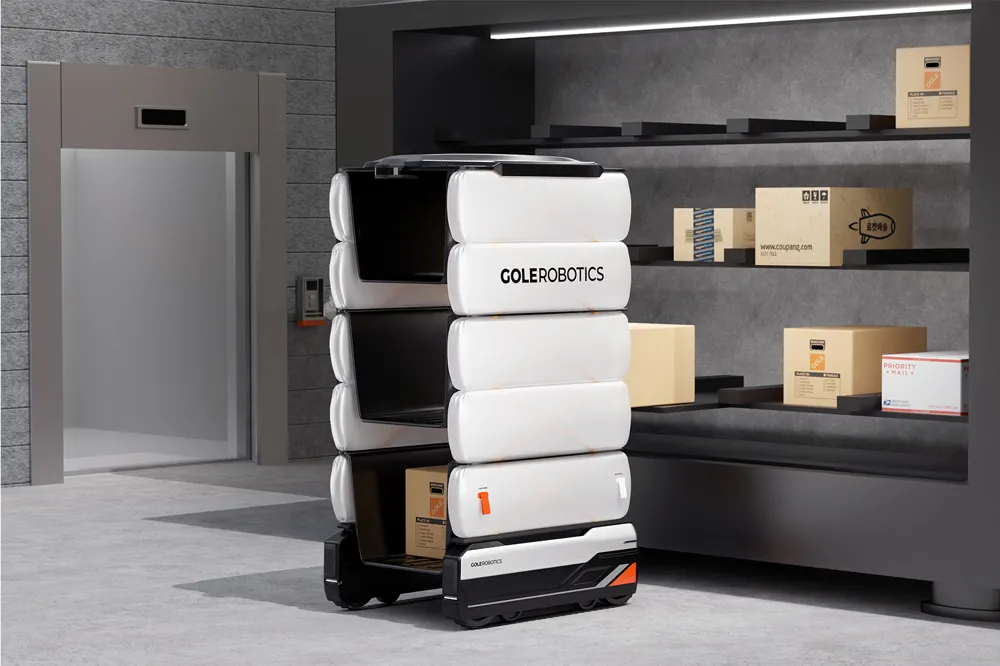
AA-2 / 자율 배송 AI 로봇 (프리미엄 레지던스용)
GoLe-Robotics
AA-2 Autonomous Delivery Robot (for Premium Residences, GoLe-Robotics)
Basic Information
Company Name: GoLe-Robotics
Company Website: (Not in DB)
Korean Company: Global (DB: is_korean_company = false)
Original Link:https://www.ces.tech/ces-innovation-awards/2026/aa-2-autonomous-delivery-ai-robot-for-premium-residences/
One-Line Product Definition: AA-2 / Autonomous Delivery AI Robot (for Premium Residences)
Problem Definition
Increased Burden of Last-Mile Delivery: With the rapid increase in dawn delivery and online shopping, the volume of deliveries within apartment complexes has exploded, leading to problems such as overwork for delivery drivers, safety accidents, and elevator congestion. In particular, premium residences have access restrictions for security reasons, causing inconvenience in face-to-face delivery by delivery personnel and burdening concierge staff.
Limitations of Existing Methods: Even when trying to introduce robot delivery, general delivery robots cannot use elevators on their own, making it difficult to move between floors without human assistance. In addition, robots with hard metal bodies are dangerous in the event of collisions with children or the elderly, and their large size can obstruct passage in hallways. For these reasons, safe and quiet delivery automation solutions have been required for high-end residential spaces.
Key Differentiators
World's First Elevator Interlocking: The AA-2 can call and board elevators on its own through its self-developed EV-1 elevator interface. Thanks to this, it is capable of fully autonomous inter-floor movement within buildings, and performs continuous delivery to up to 3 households at a time, reducing elevator congestion and increasing efficiency. This is an advantage in that the level of delivery route automation is superior compared to similar robots.
Ultra-Lightweight Air Tube Frame: This robot achieves the lightest weight in its class by adopting a balloon-type frame made of pneumatic tubes. Because it is lightweight and made of flexible material, it absorbs impact in the event of a collision, making it safe even if it collides with residents, children, or pets. In addition, the function of reducing volume by releasing air pressure after delivery is completed makes it very compact for storage.
Intelligent Multi-Drop and Night Mode: AI-based route optimization enables a multi-drop function that delivers sequentially to multiple homes at once by elevator, which is evaluated to be more than 30% more efficient than humans. In addition, it provides delicate modes suitable for premium residential environments, such as low-noise driving and LED light sensitivity adjustment at night. This improves upon the limitations of existing robots, which have been restricted from nighttime operation due to noise and light pollution.
Automatic Charging & Air Charging: It is also differentiated by the fact that it can automatically charge both the battery and air tubes when returning to the base, allowing it to be redeployed immediately. This maximizes continuous operation time and increases responsiveness during peak hours.
Key Adopters
B2B (Luxury Residential Facility Operators): Management offices of luxury apartments and mixed-use buildings, and operators of condominiums/officetels can directly introduce this robot and provide it as a service to residents. For example, premium complexes that want to reduce operating costs by automating paid concierge services are the target.
Logistics Company Partnership: It is also possible for a courier company or last-mile logistics company to partner with a specific complex, deploy robots, and provide delivery services. In this case, it is a B2B2C model, in which residents pay a subscription fee and gain convenience.
B2G Utilization: Cases where local governments introduce the robot to apartments within their jurisdiction as a smart city pilot project, or introduce it to quasi-residential spaces such as university campus dormitories, can also be considered.
Scalability
Expansion to Various Living Environments: Initially targeting luxury residences, it can also be applied to general apartment complexes or office campuses once technology stabilization and price reduction are achieved. Since only the elevator interface needs to be added to the building, the market can be expanded to almost any building with an elevator. Demand is expected not only in Korea but also in Asian cities with developed high-rise residential culture and the US condo market.
Utilization in Other Industries: The core technologies of autonomous driving + elevator interlocking can also be applied to hotel room service robots, hospital goods transport robots, etc. In addition, airbag frame technology can be extended to other robots, such as improving the safety of warehouse robots and preventing indoor drone collisions.
Regulatory Aspects: Since it operates inside buildings, it is not subject to strict road traffic regulations like self-driving cars. However, elevator safety regulations and radio wave certification must be met in each country, and social factors such as labor union opposition must be considered.
Judges' Evaluation
Focus on Practicality: In the CES Innovation Awards judging, the AA-2 was evaluated as **"showing practical progress rather than a concept-level robot."** In particular, the flexible material and elevator compatibility were highly regarded for their ability to be immediately deployed in actual living spaces. Foreign media such as Trend Hunter also introduced it as a "realistic autonomous delivery solution targeting high-end complexes that value privacy and convenience," and positively mentioned the technological completeness of obstacle avoidance and complex terrain driving.
Technological Completeness: GoLe-Robotics, which originated from the Incheon startup incubation program, has already launched the AA-2, leveraging its experience in developing several robots such as the ND-3 (outdoor robot), and showcased a demo run directly at CES. The safety mechanism that automatically turns off in the event of a collision and the accuracy of autonomous elevator boarding were demonstrated, and it was evaluated that technical reliability was secured.
Market Expectations: Korean media called it *"an early signal of last-mile delivery automation"*, interpreting it as the beginning of the popularization of robot delivery in high-density residential environments. However, there are also realistic criticisms that the price is still high, so it may be limited to a niche market in the early stages, and that **residents' psychological resistance (unfamiliarity with robots)** must be overcome.
Analyst Insights
⚠️ Impressive Technology but Market Uncertainty: Although it solves the indoor delivery problem with technological innovations such as the world's first autonomous elevator utilization, the initial market is a limited niche of luxury housing, and verification of cost-effectiveness is needed. Although the technological potential is high, it is expected to take time before widespread commercialization.
The award list data is based on the official CES 2026 website, and detailed analysis content is produced by USLab.ai. For content modification requests or inquiries, please contact [email protected]. Free to use with source attribution (USLab.ai) (CC BY)