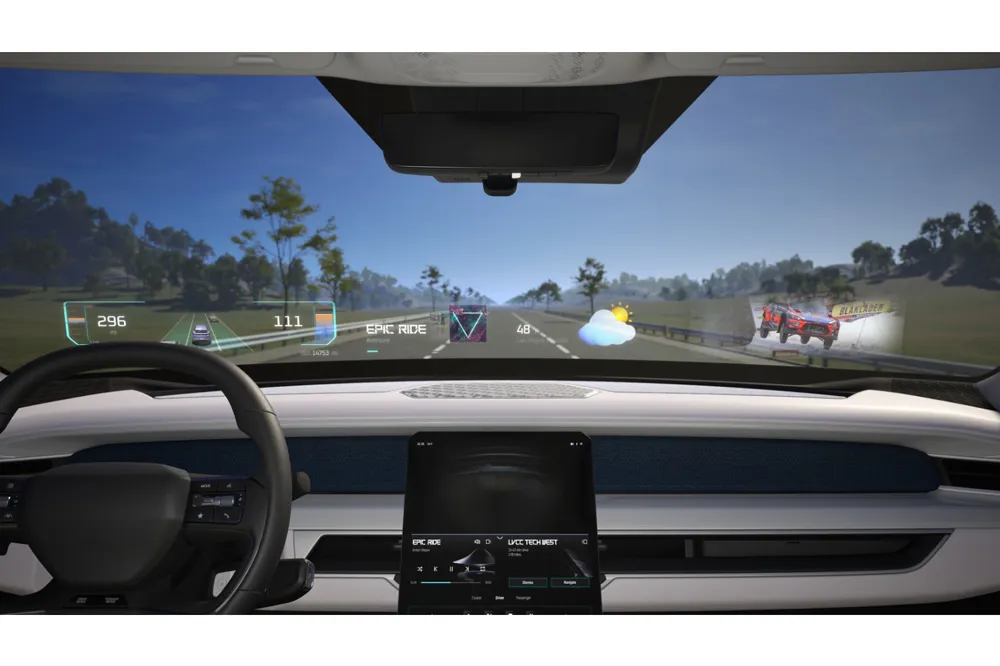
A full-glass integrated holographic display that uses a special film (HOE) and a projector to display navigation and ADAS information in augmented reality on the entire vehicle windshield, turning the driver's field of vision directly into an instrument panel, representing a next-generation interface.
HonoreeVehicle Tech & Advanced Mobility홀로그램 디스플레이AR HUD차량용 증강현실운전자 보조 시스템자율주행 기술차세대 HUD
홀로그램 윈드쉴드 디스플레이
41
0
Hyundai Mobis
One-Line Product Definition
Problem Definition
Existing vehicle head-up displays (HUDs) project limited images onto a small area, and their separate reflector structure results in large installation volume and high cost.
Furthermore, the driving environment, which requires drivers to alternate between multiple screens such as navigation, clusters, and center fascia, causes distraction and delayed reaction, making it unsafe. Even when trying to display entertainment for passengers while driving, there were many restrictions, such as installing a separate screen so as not to disturb the driver.
In short, there was a need for a display solution that utilizes the entire field of view while satisfying the needs of both the driver and passengers.
Key Differentiators
Hyundai Mobis' Holographic Windshield Display (HWD) inserts a holographic optical element (HOE) film into the windshield, and ahigh-brightness projector (DLP),hidden in the dashboard, projects images to transform the glass itself into a transparent screen.
Since the thin HOE film diffracts only specific RGB wavelengths and transmits the remaining light, it overlaps clear images without obstructing the driver's forward view. With this technology,driving information (speed, navigation route, ADAS warnings)can be displayed directly on the road in augmented reality, allowing the driver to obtain information without moving their gaze.
In addition, different images can be projected onto the driver's seat and passenger seat. Due to the characteristics of HOE, it is designed to appear differently depending on the viewing angle, so the driver can enjoy only driving information, while the passenger can simultaneously enjoy individual content such as movies or games. This is a groundbreaking advantage not found in existing HUDs.
Ultimately, HWD unifies the instrument panel and center display into the glass, increasing safety and design freedom, and leading to innovation in the use of vehicle interior space.
Key Adopters
Automobile OEMs (B2B)are the main customers. Hyundai Mobis is trying to supply this technology not only to its parent company Hyundai Kia Motors but also to global automakers, and has already announced that it is conducting joint development with major global automakers.
It is highly likely that it will be adopted first in luxury car lines, and is expected to become a core entertainment display for autonomous vehicles in the future. In addition, there is room for future application to aircraft cockpit HUDs and railway vehicles, but the automotive industry is the primary target. General consumers will encounter this technology by selecting vehicles with this technology applied as an option.
Scalability
Hyundai Mobis isdeveloping this technology in collaboration with Zeiss,and aims to mass-produce it in 2029. As a somewhat long development period is required, they are focusing on improving technological completeness and lowering costs.
Once commercialized, it can be expanded from luxury cars to popular cars, causing a paradigm shift in automotive displays. There is sufficient marketability as demand for augmented reality navigation and autonomous driving mode content display increases.
In terms of regulations, there are concerns about obstructing the driver's view, but this technology can only show information necessary for the driver, which is said to be advantageous for safety. Global vehicle safety regulations are also trending toward encouraging HUDs.
However, the schedule for mass production in 2029 is mid-term in terms of industrial speed, so it is necessary to maintain an advantage over competitors (such as WayRay) in the meantime. Since Hyundai Mobis aims for global orders with this as a core strategic product, it is highly likely to grow into an important axis of the automotive display market in the future.
Judges' Evaluation
As an Innovation Award winner in the Vehicle Tech & Advanced Mobility category,the point of being the "world's first extra-large HUD using holographic film"was highlighted. In the industry,it is said that "Mobis has opened a new horizon for automotive displays,"and in particular, the passenger separation video function was praised.
Many media outlets introduced this technology by citing the CES Innovation Award announcement data, andevaluated it as a "technology that will eliminate large instrument panels and innovate the interior of future cars."Hyundai Mobis itself emphasized this technology as a representative innovation case among the 30 or so new technologies it unveiled, attracting the attention of buyers.
On the other hand, it is also pointed out that market verification is just beginning, so the actual reactions of drivers and the completeness of the product at the time of mass production are important. However, as joint development participation by global automakers is currently underway, expectations outweigh overestimation.
In summary, it was well-received at CES for its recognized technological concept and potential, and is evaluated as an innovation that makes the automotive industry look forward to the next 5 years.
Analyst Insights
🧪 R&D and Concept Verification Stage – It presents the future of automotive displays, but it is a development-stage solution with gates remaining such as technology maturation and adoption by complete vehicles until actual mass production.
The award list data is based on the official CES 2026 website, and detailed analysis content is produced by USLab.ai. For content modification requests or inquiries, please contact [email protected]. Free to use with source attribution (USLab.ai) (CC BY)
댓글 (0)
댓글을 불러오는 중...