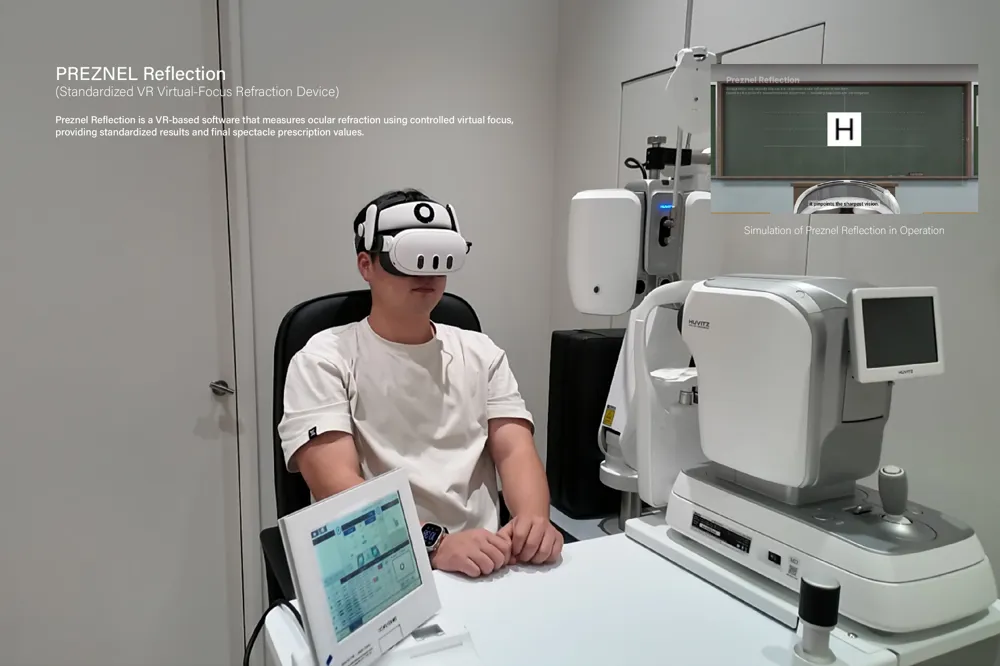
A VR-based vision refraction testing system that measures refractive errors of the eye in a virtual environment, enabling portable digital ophthalmic examinations.
HonoreeXR & Spatial Computing인터랙티브 스트리밍프리뷰포인트 기술멀티 앵글 스트리밍MEMS 스피커스마트 글래스실감 미디어
프레즈넬 리플렉션
22
0
ICU Corporation Inc.
One-Line Product Definition
Problem Definition
Existing vision tests and refraction measurements rely on bulky table-top equipment (ophthalmoscopes, autorefractometers, etc.), limiting them to hospitals or optical shops. This makes regular check-ups difficult for children, the elderly, and patients in remote areas, leading to delayed detection of refractive errors (myopia, astigmatism, etc.).
Furthermore, conventional methods are prone to errors depending on the examiner's skill level, and there is a lack of standardized tools for special examinations such as strabismus and amblyopia. Against this backdrop, there is a growing demand for accurate eye refraction tests anytime, anywhere.
Key Differentiators
Fresnel Reflection is the world's first refraction measurement program using a VR headset. It evaluates refractive errors by presenting focus-adjustable visual stimuli in virtual reality without traditional equipment.
The software precisely measures the user's gaze point and accommodation response to calculate refractive values for various distances, including far and near. By integrating vision testing algorithms and data recording functions into a portable headset platform, standardized, repeatable testing is possible and can be used in remote/mobile environments.
In summary, the greatest strength is the accurate implementation of refraction measurement with VR without large equipment.
Key Adopters
The main customers are B2B in the medical field, such as eye hospitals, optometry clinics, and public health centers. For example, mobile vision screening vehicles for school check-ups, local government telemedicine systems, and eye health organizations in developing countries can benefit from this technology.
It can also be adopted by optical chain stores or optician training institutions for on-site testing or training. Rather than direct purchase by general consumers, it is a service provided by medical professionals, and can be expanded to B2G public health projects in the future.
Scalability
Since the solution is software-centric, it can be deployed anywhere in the world with the spread of VR/AR devices. With multilingual support and the incorporation of AI, it can be developed into a large-scale data-driven remote examination platform.
In terms of regulation, medical device approval is key, but there are expected to be no major restrictions as a non-invasive examination device. Coupled with the trends of 5G telemedicine and digital therapeutics, market scalability is high, and the product lineup can be expanded to other ophthalmic digital treatment areas such as strabismus rehabilitation training in the future.
Judges' Evaluation
Selected as an Innovation Award winner in the XR & Spatial Computing category, it has been recognized for its fusion of digital health and optical technology. In particular,Ophthalmic field DTx (Digital Therapeutics)It is attracting attention as a case of a Korean startup that pioneered the field, and there is positive feedback on the innovation compared to existing examination equipment.
However, clinical validation and acceptance by doctors are necessary due to the nature of the medical field, and it is currently in the stage of building reliability through collaboration with university hospitals and companies. In the market,"Potential for a paradigm shift in optometry"While talking about the possibility of a paradigm shift in optometry, some suggest that additional time is needed for commercialization, considering the conservative adoption rate of the medical community.
Overall, the CES evaluation team is favorable to the potential of remote vision testing, but is cautiously optimistic about its establishment as a real commercial product.
Analyst Insights
⚠️ Impressive technology but market uncertainty – Despite the value of innovating ophthalmic examinations, commercial success remains uncertain due to medical regulations and the conservatism of the professional field.
The award list data is based on the official CES 2026 website, and detailed analysis content is produced by USLab.ai. For content modification requests or inquiries, please contact [email protected]. Free to use with source attribution (USLab.ai) (CC BY)
댓글 (0)
댓글을 불러오는 중...