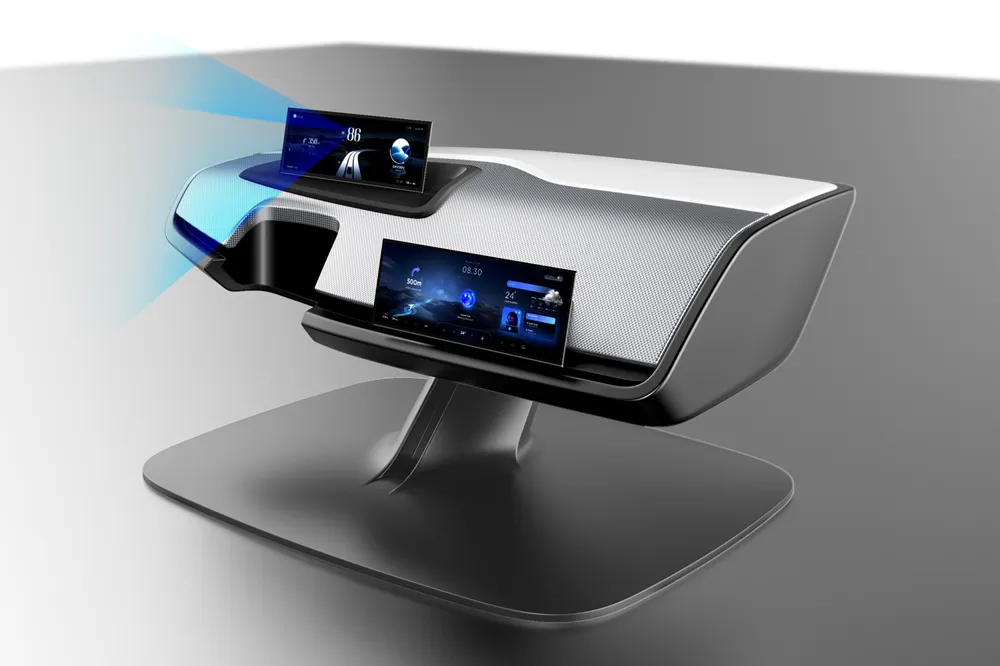
12” UDC-IR OLED
LG Display
12" UDC-IR OLED (LG Display)
Basic Information
Company Name: LG Display
Company Website:https://www.lgdisplay.com/kor
Korean Company: Global (DB: is_korean_company = false, but actually a Korean company)
Original Link:https://www.ces.tech/ces-innovation-awards/2026/12-udc-ir-oled/
One-Line Product Definition: 12" UDC-IR OLED
Problem Definition
Mandatory Driver Monitoring: With the advent of the autonomous driving era, the installation of DMS (Driver Monitoring System) to detect drowsiness or inattentiveness while driving is required by law in various countries. Previously, a separate camera was exposed on the dashboard, raising concerns about driver privacy and hindering interior design.
Limitations of Existing Methods: Typical vehicle cameras protrude from the dashboard or steering wheel, causing psychological burden to the driver and damaging the design. Attempts have been made to place the camera behind the display, but there was a technical challenge in that the screen blocked the infrared transmission of the camera, resulting in image quality degradation.
Key Differentiators
Display-Integrated IR Camera: LG Display solved the above problem with its proprietary technology to hide the IR camera behind the OLED panel. By overcoming the infrared transmission limitations of P-OLED through optimized pixel design, it secures the minimum IR transmittance required by the camera while maintaining general screen quality. As a result, the camera hole is not visible, so the driver does not feel uncomfortable, and the difference in lifespan between the general area and the camera area is minimized.
AI Image Quality Correction: In collaboration with its subsidiary LG Innotek, LG Display applied AI-based image restoration software to restore the degraded image of the camera behind the screen to 99%, solving the image quality degradation problem of existing UDCs. This differentiated transparent+AI design is evaluated as superior to similar products in that it implements clear monitoring while the camera is completely invisible.
Key Adopters
B2B (Automobile Manufacturers): The end customers are vehicle drivers, but the actual buyers are finished vehicle manufacturers and primary vehicle parts companies. When a vehicle manufacturer adopts DMS to comply with regulations, they will choose LG Display's panel. It is highly likely to be integrated into the instrument panel or infotainment display of premium cars.
Application Fields: It is mainly applied to passenger cars and autonomous driving level 2+ vehicles to detect driver inattentiveness. In the future, it can be expanded to fields where safety is important, such as commercial vehicles or fleet vehicles (B2B2C nature).
Scalability
Global Market Application: The mandatory driver monitoring is expected to increase the demand for the technology globally, starting with **Europe (from July 2026)** and also being reviewed in the United States, China, and Japan. Rather than being subject to specific national regulations, it is likely to become a global automotive industry standard.
Application to Other Industries: Currently, it is used for vehicle DMS, but the camera behind the screen technology can also be applied to laptops, smartphones, etc. However, the size (12 inches) and IR focus of this product are specialized for the vehicle environment, so it is expected to focus on the infotainment/instrument panel market first.
Judges' Evaluation
Positive Evaluation of Harmony Between Safety and Design: The CES Innovation Award highly valued the fact that this technology achieved both improved safety and **improved user experience (privacy protection)**. In particular, it is evaluated as a highly complete solution that proactively prepares for European regulations. In the industry, automobile manufacturers who have been reluctant to adopt UDC due to image quality degradation are showing interest, and adoption is being discussed mainly for premium brands.
Technological Completeness: LG Display has already demonstrated high completeness in the demonstration stage, to the point where the camera area within the screen is not visible. However, additional costs due to AI correction and yield management during mass production are mentioned as future challenges.
Market Expectations: It is said that the timing is appropriate in that commercialization is ready in time for the implementation of regulations. It accurately matches the trend of strengthening driver safety in the automotive industry, and investors are also paying attention to the possibility of it becoming an essential function in the future. However, it is also pointed out that it is important to prove actual performance rather than over-promotion concerns in that it is an AI and sensor fusion.
Analyst Insights
🔥 High Marketability: It is highly likely to become an essential technology that meets global vehicle safety regulations. By solving the technical implementation challenges, it has preempted the demand of finished vehicle manufacturers, and commercialization and mass adoption are promising in that it has captured both safety and design.
The award list data is based on the official CES 2026 website, and detailed analysis content is produced by USLab.ai. For content modification requests or inquiries, please contact contact@uslab.ai. Free to use with source attribution (USLab.ai) (CC BY)