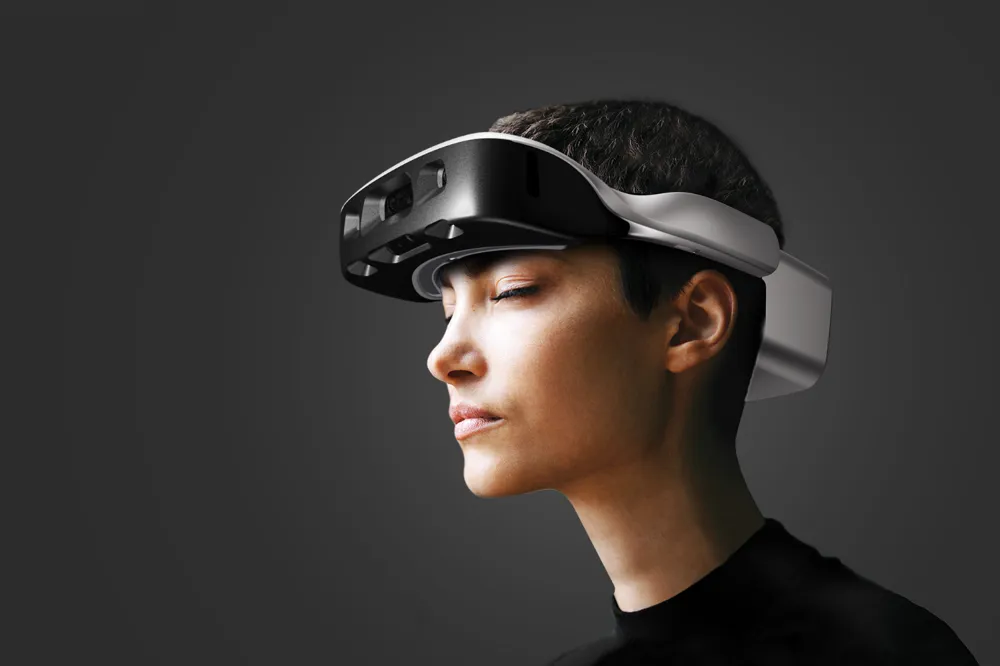
An AI glasses that mimics the function of a guide dog for the visually impaired. It is a wearable device that uses a camera, AI vision, and haptic feedback to identify the user's surrounding environment and provide real-time guidance for safe navigation.
HonoreeAccessibility & LongevityAI 기반 객체 인식음성 안내 시스템실시간 환경 분석보행 보조 기술시각 장애인 지원웨어러블 디바이스
.lumen 시각장애인용 안경
393
0
.lumen
One-Line Product Definition
Problem Definition
Those who cannot see rely on white canes and mobility training, but still face significant risks in unfamiliar environments. Guide dogs provide excellent assistance, but it costs tens of thousands of dollars and years to train one, and only a small number of people benefit.
Many visually impaired people are reluctant to go out alone for long distances and face difficulties when they get lost or encounter obstacles. GPS voice guidance and other aids exist, but real-time obstacle avoidance and stair/door recognition still require human intervention.
In summary: The problem was the absence of *"a technological substitute that provides comprehensive environmental awareness and guidance at the level of a guide dog"*. The .lumen team sought to solve this mobility problem for the visually impaired by drawing on autonomous driving technology.
Key Differentiators
.lumen glasses are "the world's first digital guide dog."It provides comprehensive mobility assistance functions. It uses a camera + LiDAR to grasp 3D spatial information in the direction of sight, and AI vision algorithms recognize walkways, obstacles, and entrances in real time.
Using PAD (Pedestrian Autonomous Driving) AI technology, it maps and plans routes in the surrounding environment like a self-driving car, and guides the user by giving left/right/straight signals with vibration motors built into the glasses frame. In addition, the temple of the glasses provides tactile feedback like a Braille pad, allowing the user to intuitively understand the direction and situation (※ Internally, the accelerometer/gyro sensor also provides feedback on the user's movements).
It operates with only onboard AI without the Internet or prior infrastructure, so it can perform the role of a guide dog anytime, anywhere, just by carrying it around. While some existing smart glasses only read text, .lumen is the only product that solves the fundamental problem of "wayfinding." Especially,existing technologies (Braille, voice)It is innovative in that it makes its own judgments and guides, going beyond the limitations of.
Key Adopters
Individuals with complete blindness or severe visual impairment (B2C)are the main customers. Those who are waiting for a guide dog or have difficulty with mobility training are likely to purchase these glasses personally.
Since the price is high, there is a high possibility of supply through government subsidies or non-profit organization support. For example, the Romanian government provided support for the development of .lumen, and visual impairment organizations throughout Europe are showing interest.
Special schools or rehabilitation training institutions (B2B)can also purchase it for training purposes. In addition, through partnerships with autonomous driving technology companies, it can participate in government projects (B2G) and be distributed as a public assistive device.
Currently, .lumen has secured more than 1,500 pre-orders, confirming initial market demand, and plans to expand into the Americas and Asia in the future.
Scalability
It is much cheaper than a guide dog and can be mass-produced, so“popularization of guide dogs”can be achieved. Considering the millions of potential demands worldwide, the market is large, and national certification and regulations are relatively easy (classified as wearable assistive devices).
In addition, .lumen's Pedestrian AI platform can be transferred to other fields such as indoor navigation and logistics robots. For example, this technology can be applied to self-driving wheelchairs in airports or large malls.
Adding 5G connectivity enables servitization such as remote support and cloud map updates, which can be expanded into a software subscription model. However, additional tuning is required to adapt to individual visually impaired people's walking habits, and adaptation training may be required for the elderly who are not familiar with wearing glasses.
Nevertheless, the product format is glasses, which is commonplace, so it can be integrated with AR glasses in the future and expanded to a wider consumer base (e.g., night glasses for hikers).
Judges' Evaluation
"The function of a guide dog has been implemented with technology" – This is the biggest compliment received after winning the Innovation Award at CES 2026. The judges highly praised .lumen for connecting advanced AI with inclusive design, and mentioned it as "an exemplary case of technology promoting human freedom and dignity" (CTA official comment).
In particular, as the first CES award-winning case in Romania, it has received great attention from local media and the European tech industry. Professional media outlets have described .lumen as"a game changer that will replace real guide dogs"or"a breath of fresh air in visual aid technology that has been stagnant for years."It was praised as.
However, it is also mentioned that there are still procedures such as clinical trials left before commercialization, so more extensive feedback from actual users is needed. Although the technology has been proven by winning the U.S. military technology competition in 2025, product mass production and service network construction are cited as future tasks.
Overall,Expectations and interest are very high, but there is a cautious view that "constant verification is needed to be as trusted as a guide dog."There is a theory.
Analyst Insights
.lumen is an AI-based digital guide dog that seeks to innovate mobility for the visually impaired, but requires verification for market stabilization due to remaining challenges such as high prices, user adaptation, and service network construction.
The award list data is based on the official CES 2026 website, and detailed analysis content is produced by USLab.ai. For content modification requests or inquiries, please contact contact@uslab.ai. Free to use with source attribution (USLab.ai) (CC BY)
댓글 (0)
댓글을 불러오는 중...