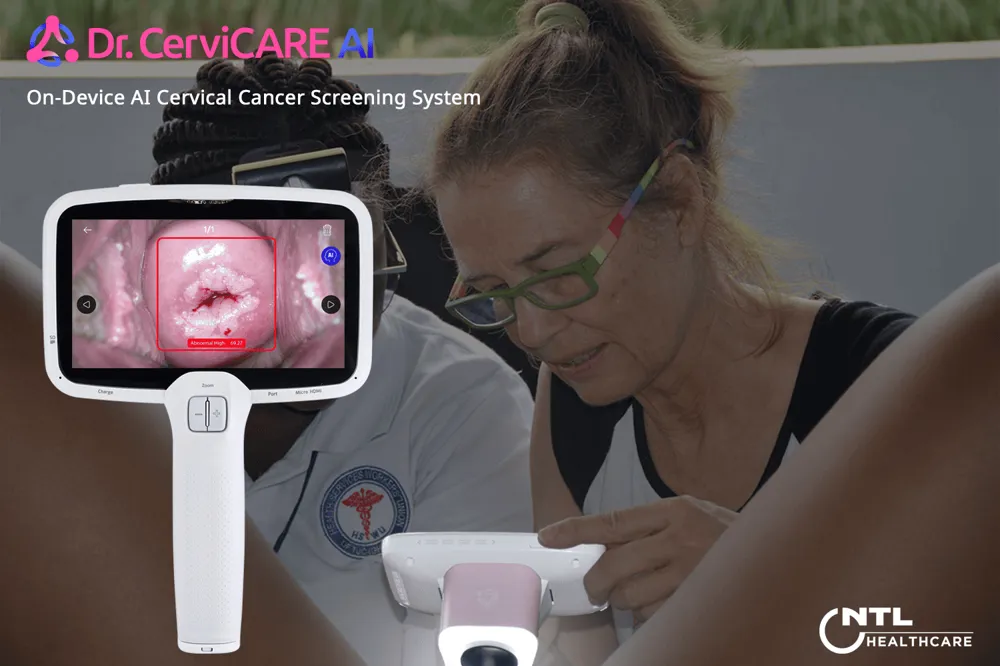
An AI-powered cervical cancer screening system usable on-site without internet, this on-device (Edge)-based portable cervical cancer screening device helps women in developing countries easily get screened and detect early-stage cancer.
HonoreekoArtificial Intelligence온-디바이스 AI자궁경부암 스크리닝의료 진단AI 의료조기 진단이미지 분석
닥터 CerviCARE® AI: 온-디바이스 AI 자궁경부암 스크리닝 시스템
7
0
NTL Healthcare Co., Ltd.
One-Line Product Definition
Problem Definition
Cervical cancer is the fourth leading cause of cancer death in women worldwide, butMore than 94% occur in low- and middle-income countries (LMIC)The imbalance in access to screening is severe. Existing cervical cancer screening requires specialized personnel, laboratories, and internet networks, making it difficult for women in rural/remote areas to receive regular checkups, resulting in missed early-stage cancer and high mortality rates.
In addition, existing digital reading solutions rely on cloud computing, rendering them useless in areas without internet access.
In short, the main problem was the lack of low-cost, automated testing tools that can be used in the field in developing countries.
Key Differentiators
Dr. CerviCARE AI has a built-in edge AI model in a high-resolution camera-based mobile screening device, enabling on-site cervical image capture → AI analysis → results reading within 5 seconds without an internet connection. It is designed for on-site use to comply with the WHO 90-70-90 strategy, and it is differentiated by providing consistent quality analysis regardless of the examiner's skill level, reducing regional disparities.
Because it works without the cloud, it can be used in rural areas with poor internet infrastructure, and AI-based image quality guidance optimizes the process from the shooting stage to reduce false positives. Recent field tests in the Can Tho region of Vietnam, involving approximately 1,500 people, identified approximately 80 positive cases and 12 cancer diagnoses, demonstrating its on-site utility by enabling early treatment.
The ability to screen for cancer at the level of a specialist with a single portable device is fundamentally different from existing communication network-dependent solutions.
Key Adopters
Health authorities and public health NGOs are expected to take the lead in distributing the device to front-line health centers and health centers in developing countries (B2G / B2B). For example,International organizations (UNICEF, WHO)or Doctors Without Borders can purchase this device in bulk and use it for screening campaigns.
In addition, hospitals and women's clinics in low-income countries can introduce it themselves, and it can also be used in mobile screening buses. In developed countries such as Korea, obstetrics and gynecology hospitals and clinics may have it as a supplementary device for rapid testing, or it may be supplied to B2B in partnership with screening kit manufacturers.
However, the main demand will be from the public health sector in areas with low access to cancer screening.
Scalability
This product is directly related to the challenge of promoting global women's health and can be rapidly disseminated through support from international health organizations. In line with the WHO's early screening campaign, it can be scaled up to Africa, South Asia, and Latin America, and there is also room for it to be incorporated into national cancer screening programs through collaboration with health ministries in each country.
In terms of regulations, medical device approval is required, but if performance is proven, the process can be accelerated through emergency use authorization. In addition, the AI analysis engine can be modified and applied to screening for other cancers (e.g., oral cancer, skin cancer), allowing for product line expansion.
By preempting the concept of a cloudless Edge AI medical device and targeting markets with insufficient telemedicine infrastructure, it is possible to become a de facto standard before other companies enter the market.
Judges' Evaluation
In the CES review,It was praised as a "realistic solution to reduce unequal medical disparities,"and was selected as a 2026 Innovation Award Honoree in the Artificial Intelligence category. The fact that cloud-level AI performance was incorporated into an offline device was mentioned as a technological achievement, and the results of field demonstrations gained the trust of healthcare professionals.
The level of technological completeness is highly rated, as it has progressed beyond the prototype stage to field testing, and market expectations are also high, especially among government officials in developing countries. There are almost no overestimation factors, and there is even a reaction that it is a pity that such a product has not been commercialized sooner.
However, there is also realistic advice that tasks such as equipment unit costs and local personnel training remain, so it is necessary to secure subsidies and localize the project.
Overall,A "game changer that will contribute to global public health"Positive reviews are the mainstream.
Analyst Insights
🔥 High marketability / Business connection possible – There is immediate demand in the global public health sector, and social impact and commercial viability are high, so large-scale distribution and commercialization are expected.
The award list data is based on the official CES 2026 website, and detailed analysis content is produced by USLab.ai. For content modification requests or inquiries, please contact contact@uslab.ai. Free to use with source attribution (USLab.ai) (CC BY)
댓글 (0)
댓글을 불러오는 중...