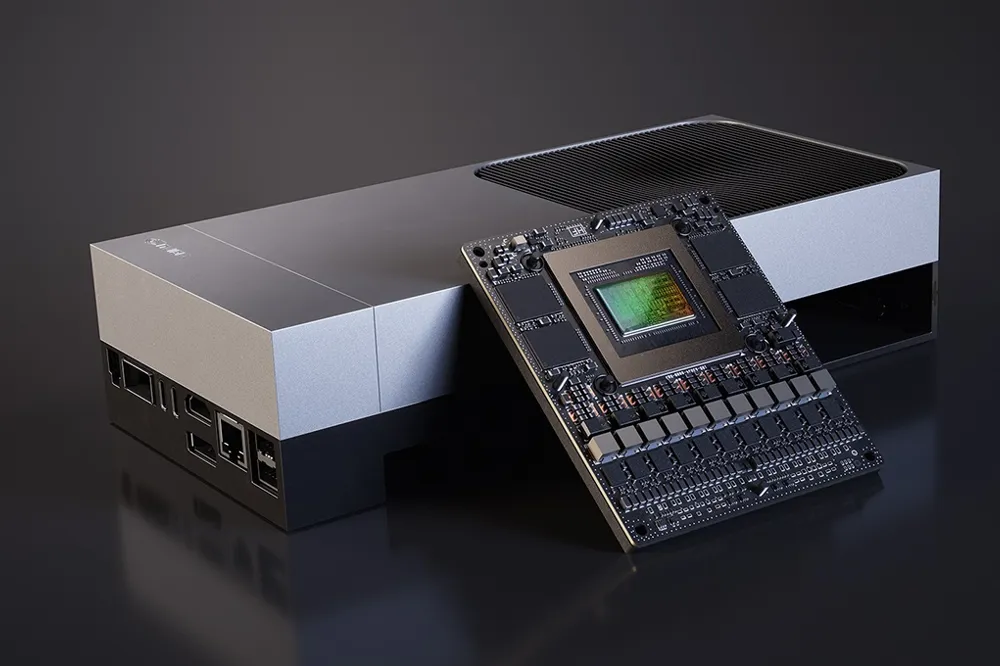
Next-generation edge AI computing platform – An ultra-efficient AI supercomputer module with server-grade computing power, designed to be mounted on advanced edge devices such as humanoid robots, autonomous machines, and medical devices, enabling real-time execution of complex AI inference and decision-making in the field.
Best of InnovationArtificial IntelligenceAI 플랫폼엣지 컴퓨팅임베디드 시스템자율 주행로봇 공학의료 영상
엔비디아 젯슨 토르
4
0
NVIDIA
One-Line Product Definition
Problem Definition
Edge devices like autonomous driving robots and advanced medical equipment need to recognize and make decisions about their surrounding environment in real-time, but existing embedded computing performance has made it difficult to smoothly run large-scale deep learning models.
Large models had to be sent to the cloud for processing, which caused communication delays and reliability issues. Furthermore, processing complex computations on-board required high power consumption and heat generation, making it unsuitable for battery-powered devices.
Also, real-time performance is critical in industrial robots and other applications, but existing edge computers could not deliver the same inference speed as data center GPUs.
NVIDIA Jetson Thor was developed to address these performance bottlenecks in edge AI, providing data center-level performance while maintaining energy efficiency and a compact form factor.
Key Differentiators
Jetson Thor is the latest in the NVIDIA Jetson series, achieving a dramatic performance improvement over previous generations.
By integrating server-grade CPU+GPU cores into a single module, it is small enough to be mounted directly on robots or machines, yet capable of performing real-time inference of complex AI models.
In particular, it is"a real-time inference AI supercomputer."Its strength lies in handling high-dimensional cognition and reasoning for autonomous operation of humanoid robots.
For example, tasks that require reasoning, such as a humanoid robot understanding human behavior and processing the context of conversations, can be executed locally via Thor without cloud assistance.
In addition, it is optimized for energy efficiency compared to its peers, making it suitable for mobile robots powered by batteries or medical devices with thermal constraints.
This enables complete autonomy at the edge, and with the Thor platform, developers can design products without having to compromise on functionality due to AI computing power limitations.
In short, Jetson Thor is"a data center AI brought to the edge,"differentiating itself from competing products with unprecedented performance/power ratio.
Key Adopters
B2B hardware manufacturers such as robot manufacturers, industrial machinery companies, and medical device companies are the customers of this platform.
For example, humanoid robot startups, autonomous mobile robot (AMR) developers, and smart factory equipment companies will adopt the Thor module.
Also,construction equipment companies (e.g., Caterpillar)are planning to use this module to add AI assistants or autonomous functions to heavy equipment.
Since NVIDIA sells Jetson in module form, researchers/students who purchase development kits to create prototypes are also target customers.
However, the main source of revenue will be corporate OEMs, in the form of embedding Thor into their own products.
Accordingly, sales will be conducted B2B through NVIDIA partners, and it is expected to be actively used in the development community, as is traditional with the Jetson series.
Scalability
The Jetson Thor platform is highly versatile and can be expanded into various edge fields.
NVIDIA is already creating application examples with domain partners in logistics robots, smart cities, autonomous driving tests, and more.
Software compatibility is also good, inheriting the existing Jetson ecosystem (AI JetPack SDK, etc.), so there is a rich pool of developers.
There are no special regulatory barriers, but the final device manufacturer must resolve the certification process when mounting it on medical devices.
From NVIDIA's perspective, it is aiming for a robot platform standard based on Thor, and will expand the ecosystem through partnerships with partners (e.g., ADLINK's launch of a Thor-based edge box).
In addition, various industry leaders such as Caterpillar and Orbbec have already announced collaborations, indicating that the Thor module will be used extensively from heavy equipment to 3D sensors.
Overall, Jetson Thor is likely to become the next-generation standard edge AI platform, and is expected to rapidly expand into the global market with NVIDIA's support.
Judges' Evaluation
It won the Innovation Award in the Artificial Intelligence (AI) category at CES 2026 and has been recognized as a key driver of robotics.
Experts analyzed the influence of the Thor platform, saying, *"NVIDIA is aiming to play a role like the Android OS for edge robotics."
In particular, media outlets such as TechCrunch reported on NVIDIA's unveiling of afull-stack robotics ecosystem (software + simulator + hardware)at CES, and evaluated Jetson Thor as *"a game-changer in the robotics industry, now allowing startups to challenge themselves with human-like robots."
There are also positive reviews about its performance, saying it is *"the first edge module to meet the requirements for humanoid development."
However, on the other hand, there are concerns about *"increasing NVIDIA dependency for all robots"*, and concerns about the speed of adoption due to the expected high price.
However, there is a prevailing consensus that *"NVIDIA will effectively lead this field"* because there are currently no clear competitors.
With the CES Innovation Award and the subsequent announcement of partnerships with Caterpillar, Orbbec, etc., real-world use cases have been revealed, and it is evaluated that it has entered the stage of connecting market expectations with actual demand.
Analyst Insights
🔥 High marketability / Business connection potential – As a high-performance platform desperately needed in the robotics and edge AI fields, collaboration with major companies is already underway, and it is highly likely to be adopted in numerous edge devices in the coming years.
The award list data is based on the official CES 2026 website, and detailed analysis content is produced by USLab.ai. For content modification requests or inquiries, please contact contact@uslab.ai. Free to use with source attribution (USLab.ai) (CC BY)
댓글 (0)
댓글을 불러오는 중...