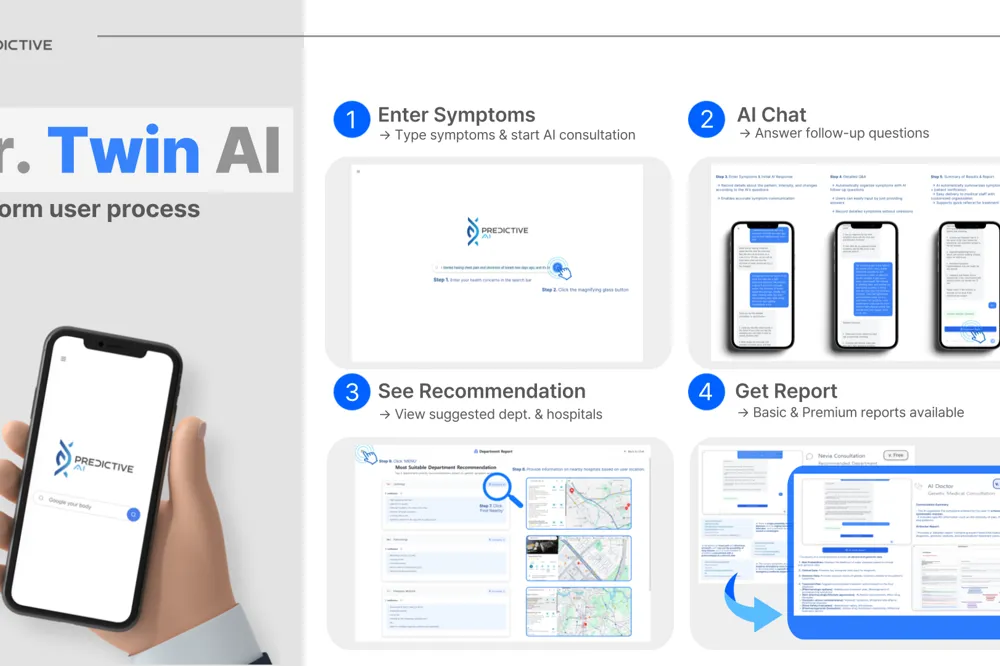
The world's first DNA-based digital patient twin healthcare platform that improves diagnostic delays and errors by supporting medical decision-making through the creation of a digital twin of a patient's genomic (DNA) data.
HonoreekoDigital HealthAI 헬스케어개인 맞춤형 의료유전체 분석디지털 헬스원격 의료AI 예측
닥터 트윈 AI - 유전자 기반 개인 맞춤형 헬스케어 AI 솔루션
2
0
Predictive AI, INC.
One-Line Product Definition
Problem Definition
In the current healthcare system, patients often wait weeks for appointments even after symptoms appear, and rare diseases are frequently misdiagnosed. In the United States, the average wait time to see a specialist is 31 days, highlighting diagnostic delays. Furthermore, fragmented medical data leads to inadequate comprehensive assessments and the risk of adverse drug reactions.
The inability to consider a patient's genetic predisposition or individual drug response differences has hindered personalized medicine, leading to inefficiencies and medical incidents. Ultimately, the lack of precision medicine and insufficient data utilization have perpetuated increased patient wait times and diagnostic errors.
Key Differentiators
Dr. Twin AI createsdigital twins (virtual patient replicas)based on a patient's whole-genome sequence and integrates them into a medical AI decision-making platform to perform virtual medical simulations identical to real-world patients. Utilizing Retrieval-Augmented Generation (RAG) techniques and multi-agent AI, it learns from 347,000 medical records and expert papers to derive disease predictions and optimal treatment options with 98.6% accuracy.
For example, by identifying patients who will not metabolize a specific drug through genetic analysis, drug selection can be altered, or AI agents can check for conflicts between specialist prescriptions in real-time to prevent adverse drug reactions. Additionally, by monitoring a patient's molecular-level information in real-time, it dramatically reduces bottlenecks in treatment by suggesting expected diagnoses and optimal treatment pathways before arrival at the emergency room.
The biggest differentiator is that it has more extensive data evidence (hundreds of thousands of cases) and is updated in real-time compared to existing clinical decision-making, thereby enhancing both personalized care and overall system efficiency.
Key Adopters
Large hospitals and medical institutions are expected to adopt this platform and use it as a clinical decision support system (CDSS) tool (B2B). For example, if general hospitals and specialized clinics connect the Dr. Twin service to patients who have undergone genomic testing, physicians can refer to it for diagnosis/prescription.
In addition, telemedicine platform companies and health insurance/insurance companies can also adopt this technology and use it as an AI pre-screening or disease prediction service (B2B2C). For individual consumers (B2C), it is more likely to be provided as a test package through hospitals or included in corporate health checkup programs rather than being sold directly. At the government level, there may also be B2G opportunities to link this platform to national precision medicine projects or health insurance review and assessment systems.
Scalability
The global healthcare market is the target, but the speed of expansion depends on each country's medical data infrastructure and regulations. In the United States and other countries, demand for such platforms is expected to increase as the cost of genetic testing decreases, and there are opportunities in Korea as well due to the precision medicine support project.
Since data privacy and medical laws must be complied with, it is necessary to initially position the platform as an aid to decision-making to build trust with healthcare professionals. Technically, it is possible to expand the knowledge base toadditional disease areas (cancer, rare diseases, etc.)or expand into other healthcare fields by using it for pharmaceutical R&D, such as clinical trial simulations. Developed as a cloud-based service, it can be deployed to large hospital networks, and building an ecosystem through collaboration with insurance companies and pharmaceutical companies is also an expansion point.
Judges' Evaluation
Winning the CES Innovation Award in the digital health sector has led to the evaluation that"it has opened the era of gene-based digital twin medicine."Medical experts are paying attention to it as a realistic solution for realizing precision medicine, but there are also discussions on how to integrate it into the actual clinical workflow. USLab.ai is also mentioned.
The technical completeness appears very high, as seen in the 347k medical data learning and 98.6% diagnostic accuracy figures, but more on-site validation is needed in the future. Market expectations are quite high as it is one of the most innovative in medical AI, but at the same time, there is some cautious opinion that it may be overvalued due to the conservatism of the medical field. It is pointed out that it will be explosive if more multi-center clinical trial data is accumulated and approvals such as FDA are obtained, but otherwise, there is a risk of remaining at the concept level. Currently, expectations for technological potential are high, but it is seen as a stage where regulatory and integration hurdles must be overcome.
Analyst Insights
⚠️ Impressive technology but market uncertainty – A revolutionary platform that will change the medical paradigm, but its success will depend on adoption in the strict medical environment and regulatory passage.
The award list data is based on the official CES 2026 website, and detailed analysis content is produced by USLab.ai. For content modification requests or inquiries, please contact contact@uslab.ai. Free to use with source attribution (USLab.ai) (CC BY)
댓글 (0)
댓글을 불러오는 중...