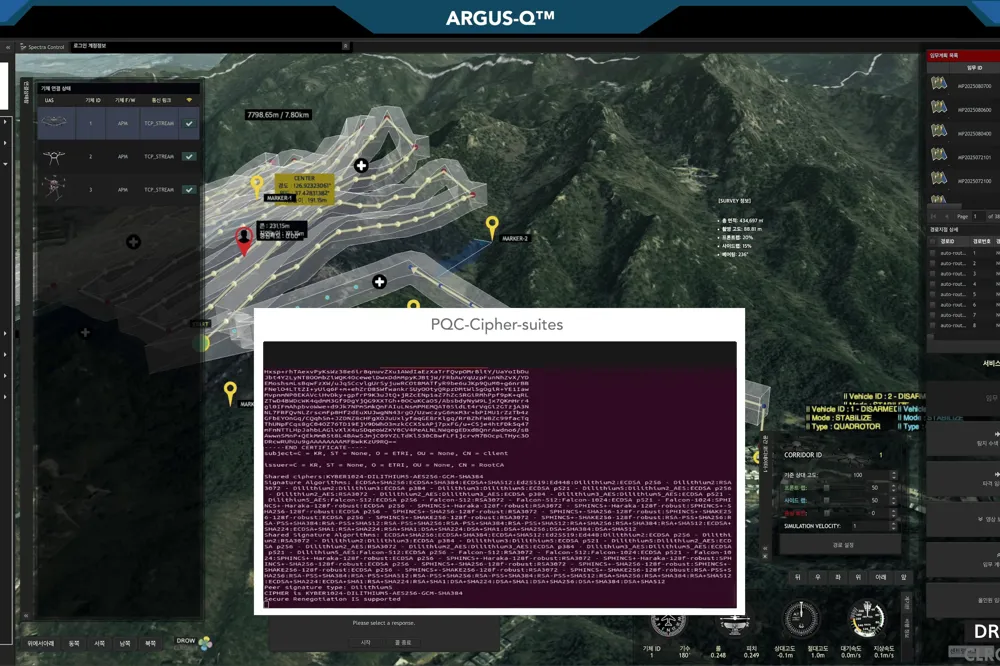
A 3D drone integrated platform that controls and searches multiple drones in real time based on Post-Quantum Cryptography (PQC) technology. It is a next-generation drone command and search system with communication security that is impossible to hack even in the quantum computing era.
HonoreekoCybersecurity드론양자 내성 암호3D 플랫폼자율 탐색AI군집 제어
아르거스-Q™
2
0
Satoshi Holdings Co., Ltd.
One-Line Product Definition
Problem Definition
Even when drones are used for disaster relief or military reconnaissance, simultaneous control of multiple drones and communication security have been major challenges.
Current drone communication is vulnerable to hacking with the advancement of quantum computers, posing a risk to hostile environments (conflict zones, etc.) or long-term operations.
In addition, efficient drone operation has been limited because it is difficult to ensure compatibility and real-time data integration when using heterogeneous drones with different sensors/functions all at once.
Existing drone control systems are centered on individual aircraft, making it difficult to systematically utilize drone swarms in wide-ranging search and reconnaissance missions.
Key Differentiators
Quantum-safe encryptionThe key is that by introducing this into drone communication, a secure communication network that cannot be solved even with a quantum computer has been established.
The ARGUS-Q platform applies a PQC algorithm transferred from ETRI technology to securely transmit all command and video data between drones and ground stations even in the quantum era. This fundamentally blocks enemy hacking and jamming, ensuring reliability for military/security missions.
At the same time, the platform controls multiple heterogeneous drones simultaneously, monitors real-time location and status on a 3D terrain map, and performs target identification through AI video analysis.
For example, in mountain searches, a swarm of camera drones + thermal imaging drones can be managed on one screen, AI detects human figures and alerts, and searches are performed by autonomous flight even in non line of sight areas.
This safe and intelligent integrated drone operation capability is differentiated from commercial drone + VPN combinations that rely on existing single drone control or trust between users. In other words, it implements next-generation drone control in terms of security, scale, and intelligence.
Key Adopters
Government agencies in the military defense sector (B2G) andDefense industry (B2B)are the primary customers.
For example, the Ministry of National Defense, SWAT, and the National Fire Agency can use this platform to build a multi-drone-based search and reconnaissance system.
It can also be adopted in drone control of industrial facilities where security is important (nuclear power plants, oil refineries, etc.) or smart city control centers.
Satoshi Holdings' main target is the overseas defense market, and it is already in POC discussions with defense/security agencies in the Americas and the Middle East.
Ultimately, the final cost will be paid by the government or large corporations, and ARGUS-Q will likely be introduced in the form of a project or through technology licensing.
Scalability
There is an opportunity to preempt the global standard in the emerging field of quantum security drones.
The timing is right as the adoption of quantum-resistant cryptography is increasing in each country, and the fact that a Korean company like Satoshi has entered this field is receiving international attention.
Since this technology is in the form of platform software, there are few border restrictions as long as it is linked to various drone hardware. However, since it is related to national security, there may be restrictions such as government approval when exporting.
In addition, the competitive environment should be closely monitored as major players in the global drone industry such as the United States and Israel are likely to be developing similar technologies.
However, it has been recognized for its technology by winning the early CES award and is in discussions with several defense companies for collaboration, and has the will to expand to the private sector such as autonomous delivery drone networks in the future. In other words, the potential market is considerable as the scope of use can be expanded in the order of defense → public safety → industry.
Judges' Evaluation
The CES 2026 Innovation Award in the Cybersecurity category"Quantum Security Drone"attracted attention by pioneering a new category.
In the industry,"Korean companies have entered the global quantum security drone competition"It is meaningful and highly evaluates the technical achievement in that it proves the commercial implementation of PQC technology.
In particular, the fact that it is *"a drone platform that can be used with confidence even in the post-quantum era"* appealed to defense officials, and it is said that consultations with buyers from the United States and the Middle East were active at the CES booth.
However, evaluations of marketability are cautious.
An industry expert said, *"Winning the Innovation Award proves technological prowess, but the key is whether it will lead to actual business results beyond technology demonstrations,"* pointing out the difficulty of entering the global defense market and securing references. In other words, while technological innovation is recognized, commercial success will be judged by future order results.
Analyst Insights
⚠️ Impressive technology but market uncertainty (a promising field supported by the global security environment, but requires more time and verification to achieve results due to the nature of the defense and security market)
The award list data is based on the official CES 2026 website, and detailed analysis content is produced by USLab.ai. For content modification requests or inquiries, please contact contact@uslab.ai. Free to use with source attribution (USLab.ai) (CC BY)
댓글 (0)
댓글을 불러오는 중...