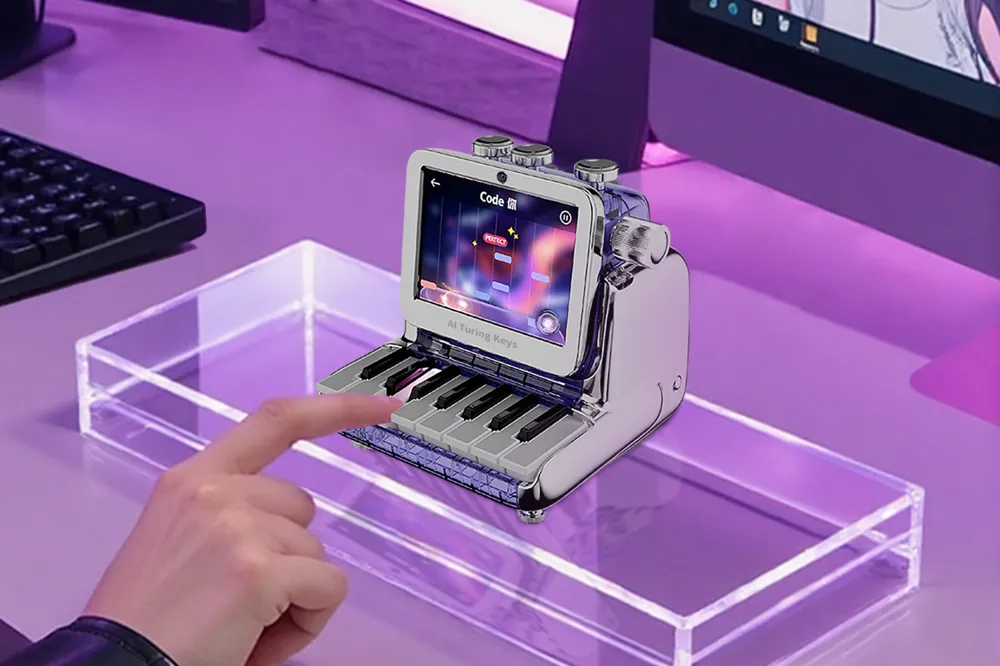
AI 튜링 키
Shenzhen AIRSMART Technology Co., Ltd.
AI Turing Keys (AIRSMART)
Basic Information
Company Name: Shenzhen AIRSMART Technology Co., Ltd.
Company Website: (Not in DB)
Korean Company: Global (DB: is_korean_company = false)
Original Link:https://www.ces.tech/ces-innovation-awards/2026/ai-turing-keys/
One-Line Product Definition: AI Turing Keys
Problem Definition
Desire to relieve emotions through music: Many people want to relieve or express their feelings through music, but learning to play an instrument has a high barrier to entry, and it is not easy to find customized music. Streaming services only identify preferences and do not respond to real-time emotional changes.
Limitations of passive listening: Existing music listening is passive, so users have to play music when they are sad, and there is no guarantee that the music will be suitable. Playing directly is an active expression, but most people don't know how to do it, which is frustrating. The problem was the lack of a way for ordinary people to easily express their emotions through music.
Difficulty in emotional exchange: Modern people spend a lot of time with smart devices, but they lack the experience of devices understanding and responding to their emotional state. AI speakers only play songs according to commands and do not provide interactions that empathize with the user's emotions.
Key Differentiators
Real-time Emotion Recognition AI: AI Turing Keys uses a camera and microphone to analyze the user's facial expressions and voice tone to determine their current emotions. For example, it recognizes joy/sadness/stress based on facial muscles and timbre, and determines musical motifs that match the emotion. This real-time emotional feedback loop is a unique feature not found in existing music devices.
Instant Music Generation (Text-to-Music AI): It has a built-in text-to-music AI model that converts the user's emotional state into **music language (chord progression, melody pattern)**. As a result, it instantly composes and plays personalized theme music tailored to the user's emotions. For example, it creates warm and soft melodies when you are depressed, and fast and cheerful rhythms when you are energetic. This generated music is so creative that the same situation is rarely repeated.
Interactive Keyboard & Sheet Music: It doesn't just play the generated music, but also lights up the LED lights on the keyboard keys in real time as you play. At the same time, it shows the sheet music on the installed display, so users can participate by playing along on the keyboard on the spot. Even beginners can play by simply following the lights, allowing them to feel actively immersed.
24-Hour Personalized Audio Streaming: The AI matches the user's behavior patterns and the vast amount of music content in the cloud through tag matching, and continues the music like a seamless personal radio broadcast. When the user's emotions change, the song selection atmosphere also changes, and when the user plays a specific key, the song switches to a song that responds to it, creating two-way streaming. This creates an emotional connection between the user and the AI.
Key Adopters
B2C (General Consumers): The main targets are general people, students, and office workers who like music but cannot play it. It can be purchased for stress relief or mood change in daily life, or as a new type of healing gadget. It is attractive to those who want emotional exchange like a digital pet or AI friend.
Music/Art Therapy Field: Music therapists, psychological counselors, etc. can use it as a tool to help patients and clients express their emotions. It can be used in therapy sessions where patients are encouraged to express their emotions through music and listen together (B2B).
Education Market: Schools or parents can purchase it as a kit for children's creativity education or sensitivity development. It can also be used as an introduction to learning musical instruments, and can be positioned as a STEAM educational tool for learning emotions while playing with AI.
Scalability
Global Young Market: Since MZ generations familiar with music and tech are the main customer base, there is a possibility that it will become a global trend through SNS viral such as TikTok. It supports multilingual voice recognition such as English/Chinese, so it is expected to be sold regardless of region.
Software Platformization: In addition to device sales, it is possible to expand by providing emotion-music matching services in the form of smartphone/PC apps, or by partnering with streaming platforms to operate AI curation channels. The accumulated emotion-music database can be applied to various industries such as games and movie music recommendations in the future.
Other Device Forms: Currently, it is in the form of a keyboard, but it is possible to develop derivative products such as guitar-shaped devices, AI Mood DJ for vehicles, and emotion music generation linked to smart watches. The core technology of emotion recognition and real-time response can be applied to IoT in general.
Constraints: Due to cultural differences in emotional expression, there is a task of tuning the accuracy of emotion recognition to each cultural area. In addition, due to the nature of emotion-related products, there may be ethical issues such as privacy and emotional dependence (discussion about users relying too much on AI, etc.).
Judges' Evaluation
Unique Emotional AI Device: While AEON humanoids and industrial technologies are attracting attention at CES, Forbes commented that "The hidden fun of CES 2026 was the ingenious AI devices of Chinese manufacturers" and mentioned AI Turing Keys. A MikeWorldWide report said that this product is **"an example of AI entering the emotional realm of humans in earnest"**, and positively evaluated the use of technology for emotional care.
Technical Completeness: Those who experienced the demo on-site were surprised by the quality of the music generated by AI, and the experience of visitors playing along on the spot following the keyboard lights was well received. However, music experts commented that the generated music still has many simple repetitive patterns and is not as delicate as human composition, suggesting that there is room for advancement in AI composition algorithms in the future. The response was that voice recognition rate and emotion classification accuracy were generally satisfactory.
Market Reaction: Young visitors were amazed, saying, "My own DJ who knows my feelings," and some were interested in it as a good source of TikTok content. Investors highly appreciated it for pioneering a new lifestyle device category, but there are mixed views on the actual scale of demand. Meanwhile, the music education industry expressed expectations that this could be a tool to increase children's interest in music.
Analyst Insights
⚠️ Impressive Technology but Market Uncertainty: It is fresh as the first attempt to create music by responding to emotions with AI, but the sustainability to attract long-term public interest and the scale of commercial demand are unclear. Although it is an innovative concept, it is judged to be a product closer to the R&D/concept stage that requires further market verification.
The award list data is based on the official CES 2026 website, and detailed analysis content is produced by USLab.ai. For content modification requests or inquiries, please contact contact@uslab.ai. Free to use with source attribution (USLab.ai) (CC BY)