Drone+AI-based search and rescue system specialized in searching for victims in areas without cell phone signals (technology that reduces the search area by 1/25 and increases the speed by 200 times using radio relay drones and algorithms).
HonoreekoSmart CommunitiesIoT5G인공지능(AI)재난 안전인명 구조실종자 탐색
SOLVIT-BRIDGE: 인명 구조 사각지대 신속 탐색 기술
0
0
SOLVIT System Co., Ltd.
One-Line Product Definition
Problem Definition
When searching for people in situations such as missing hikers or disastersCell phone signals (GPS-based E911)Areas where signals do not reach are known as"Dark Zones of Rescue"In these radio blind spots, rescue teams have to search a wide area manually, making it difficult to find victims within the golden time. At night or in bad weather, thermal imaging drones are often rendered useless because they are obscured by forest canopies.
Previously, estimating the final location of a missing person required hours of manual map analysis, followed by search teams having to search several km² of mountainous terrain on foot. Due to the limitations of these conventional rescue methods, time was wasted, drastically reducing the chances of survival, or putting rescue workers in dangerous search situations. In other words, the lack of a way to quickly locate people in areas without cell phone signals was a major problem.
Key Differentiators
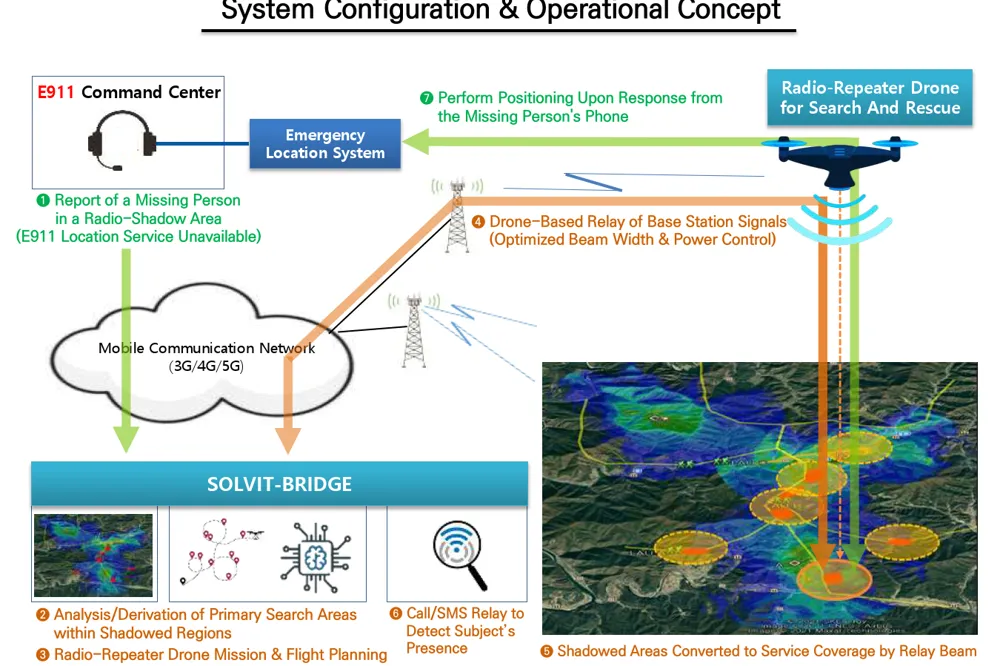
SOLVIT-BRIDGE offers a new approach to "finding even when you can't see" based on wireless communication technology. First, AI analyzes base station access records and time-series diffusion models to automatically infer the likely area where the missing person is located, reducing the initial search area to 1/25 of the previous size. This speeds up initial response by calculating data-driven results within minutes, rather than relying on expert intuition as in the past.
Second,Relay Drones (Radio Repeater Drones)are sent into the airspace above the area where the victim is suspected to be, reconnecting the cell phone signal. This allows the cell phone to temporarily connect to the network even in "No Service" areas, allowing rescuers to identify the presence and approximate location of the victim simply by the cell phone signal response. This neutralizes visibility constraints such as night/fog/foliage, allowing detection as long as there is a cell phone signal, even in situations where it is not visible.
As a result, SOLVIT-BRIDGE can scan a wide area 200 times faster than a human search team, and is 10-50 times faster and more than 95% reliable compared to camera drones. With fundamental differentiators such as no line-of-sight requirement and no dependence on night/bad weather, it has proven to be more efficient than all existing search methods.
Key Adopters
Key adopters: Public safety agencies (B2G) that will use this system in rescue situations are the main customers.Public safety agencies (B2G)For example, fire departments, forestry agencies, police mountain rescue teams, and coast guards can adopt SOLVIT-BRIDGE to help search for missing persons. It can also be adopted by the National Park Service orMilitary (military search teams).
Overseas,Disaster response agencies (such as FEMA) or large natural park management authorities will be the main adopters. In the private sector, specialized mountain rescue NGOs or adventure tour companies may operate the equipment, but it will mainly be a government-led purchase model. Therefore, it is B2G-centric, and due to the nature of the solution,Disaster response agencies (such as FEMA)Service form (providing subcontracted services to B2G)is also possible, but equipment/system sales are expected first.
B2C/B2B/B2G classification: B2G (targeting government and public safety agencies), and secondarily B2B (private rescue companies, etc.)
Scalability
Environmental/regulatory constraints: Since it uses radio waves, it must comply with frequency usage permits and emergency rescue communication regulations, but since the purpose is to save lives, regulatory agencies in each country are likely to set permissible limits. Drone operation requires special approvals such as night flight and beyond visual line of sight (BVLOS) flight permits, but exceptions may be granted for public purposes.
Industry/market scalability: As major disasters such as wildfires and floods due to climate change increase, the demand for life search technology is also increasing globally. SOLVIT-BRIDGE can be applied not only to mountain disappearances but also to disaster sites where base stations are down due to earthquakes, so the market is wide. SOLVIT System has already secured a number of related patents to gain a competitive advantage and has attracted the attention of the international disaster prevention community by winning the CES 2026 award. There is also room for future cooperation with UN disaster relief agencies, international Red Cross organizations, etc. to spread the technology.
However, since the purchasers are government/public, there are barriers to entry such as budget acquisition and bureaucracy, and system customization is necessary due to differences in emergency number systems (E911 vs. European 112, etc.) in each country. However, persuasion is easy by emphasizing the value of saving lives, and the insurance industry can also support the introduction of technology, so there is a solid logic for promoting commercialization.
Overall,Specific niche (search and rescue)Although it belongs to a specific niche (search and rescue), the niche is global and directly related to life, so the justification for budget investment is high, and a stable market is expected to form.
Judges' Evaluation
SOLVIT-BRIDGE was selected as Best of Innovation in the Smart Cities/Communities category along with the CES 2026 Innovation Award (Best in Category) and received rave reviews from judges. In particular,"Saving lives with cell phone signals"The concept made a strong impression on the judges and visitors.
Technology magazine Ubergizmo introduced the system in detail and said"Game changer for traditional rescue methods"and"You can be found anywhere in the forest if you have a cell phone"The point was cited as an innovation point. Experts say that it is virtually a proven technology, and that it is a step forward from the iSAR technology (25x area reduction) previously developed by SOLVIT, and predict that it could become standard equipment in rescue sites within a few years.
The level of technical completeness is currently in the pilot stage, but it has already achieved results in domestic mountain rescue field demonstrations (200x search speed, etc.) and has been recognized for its originality as it is protected by numerous patents and algorithms. In terms of market expectations,"Very useful niche solution"There are many opinions that
However, some say"The sales cycle will be long due to the nature of the B2G market"There is also a realistic outlook that immediate commercialization may take time. There are also challenges to be solved, such as drone communication stability and limitations in urban/underground searches.
However, despite these limitations, there are no underestimated aspects due to the noble value of saving lives and the overwhelming improvement in efficiency, and the atmosphere is that both technological prowess and social value have been recognized by winning the award at CES.
Analyst Insights
📌 A solution limited to a specific niche (an innovative effect in the special area of cell phone-based life search, but a specialized solution whose main demand is limited to the public rescue field.)
The award list data is based on the official CES 2026 website, and detailed analysis content is produced by USLab.ai. For content modification requests or inquiries, please contact contact@uslab.ai. Free to use with source attribution (USLab.ai) (CC BY)
댓글 (0)
댓글을 불러오는 중...