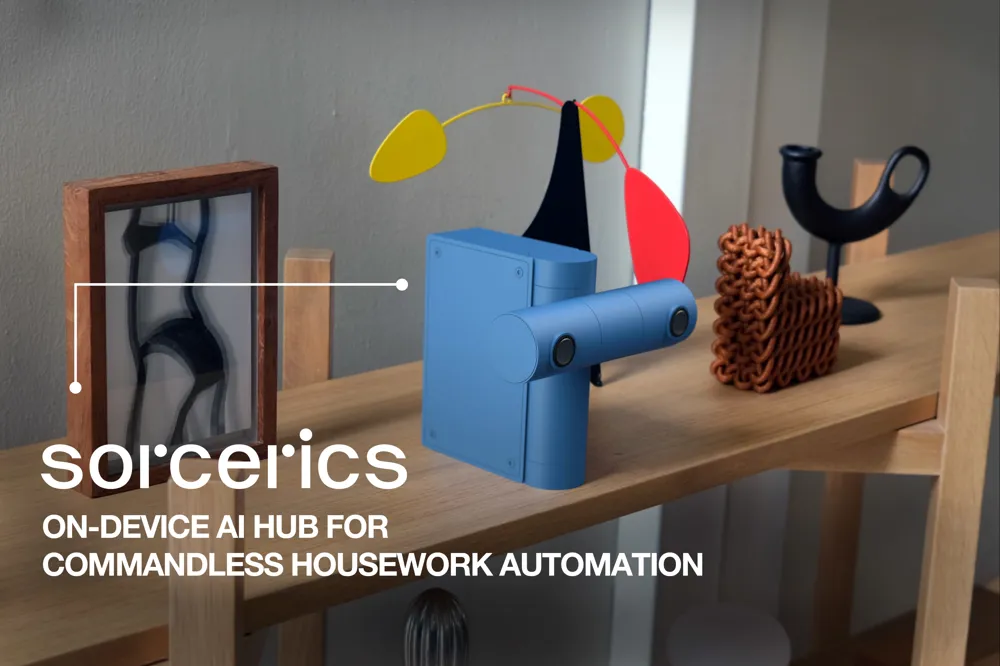
An on-device AI smart home hub that recognizes human behavior in living spaces and performs household tasks automatically (a solution that automatically controls the home environment without user commands).
HonoreekoHome Appliances스마트 홈자동화AI상황 인식컨텍스트개인화
SOL: 스마트 홈을 위한 상황 인식 자동화
9
0
Sorcerics
One-Line Product Definition
Problem Definition
Although smart home devices have become widespread, users still have to directly operate apps or issue voice commands in most cases. This acts as an inconvenience for smart home adoption, creating a barrier to entry for the elderly or disabled who are not familiar with technology.
For example, even with smart lighting or AI speakers, there is the hassle of having to say "turn off the lights" or turn on the app to control them, and scenarios that link multiple devices require users to set up automation rules in advance, which is complicated for the average person.
The limitations of the existing method are: ① the house does not move unless the user commands it, ② there are concerns about personal information and privacy because it is mainly linked to the cloud, and ③ compatibility between devices of different brands is poor, making integrated automation difficult.
In the end, for smart homes to become popular,"A house that really does it on its own"is needed, but until now, there has been no such natural context-aware smart home.
Key Differentiators
SOL's greatest strength is that it automatically manages the home environment without explicit user commands, based on the "Zero-Command" concept.
Equipped with "Sorcerics Lens," an on-device vision AI hub, it senses every corner of the house and understands user behavior and situational context in real time.
For example, if the user lies on the sofa, reads a book, and falls asleep, it detects this with a camera + AI, gradually turns off the lights, adjusts the temperature to a suitable level for sleep, and raises the brightness again before morning to wake them up (all this is done without commands).
Implemented with edge AI, video data is processed inside the device without being sent to the cloud, which is also a differentiating factor in protecting privacy.
In addition, the combination of ultra-lightweight vision AI + customized large language model (LLM) understands the meaning of user behavior and performs situation-optimized actions, rather than simple sensor triggers. For example, it determines that "if you nod off on the sofa late at night = high probability of falling asleep" and prepares the bedroom environment.
It also has excellent interoperability with different devices, integrating and controlling various devices such as lights, curtains, and robot vacuum cleaners in the house with a single SOL hub, and automatically recognizes and synchronizes existing devices as soon as they are installed with plug and play.
In short, it differs from existing smart home hubs in that it is an ambient AI butler that takes care of household chores "intuitively" without the user having to think about anything.
Key Adopters
Key adopters: Individuals who want smart home convenienceIndividual households (B2C)is the primary target. In particular, consumer groups with low IT familiarity (the elderly, the disabled, etc.) or convenience-seeking single-person households are expected to be the main demand sources.
In addition, home IoT service providers or construction companies may introduce the solution in the form of B2B partnerships to incorporate it into their smart home systems.
For example, the solution can be included as an AI home network hub provided as standard in apartment complexes, or a smart robot developer can license the SOL engine as the robot's brain. Sorcerics also stated that it discussed PoC cooperation with global smart home and robot companies at CES.
In summary, a mixed model of B2C direct sales + B2B2C partnership (solution provision) is expected.
B2C/B2B classification: B2C main, B2B partnership secondary
Scalability
Environmental/regulatory constraints: As a camera-based solution, there may be concerns about privacy monitoring, but legal issues have been minimized because all calculations are processed locally and the design does not store or transmit information.
However, consumers may be reluctant to have cameras in their homes, so transparent explanations and choices (e.g., cap processing) are needed.
In addition, since standards between smart home devices are being established (Matter, etc.), only compliance with standards needs to be considered rather than regulations if compatibility is well matched.
Industrial/market scalability: The smart home market is continuing to grow, and the trend of minimizing user intervention (Ambient AI) is cited as the next-generation direction.
SOL is expected to have a preemptive effect as an early solution that implements this next-generation smart home UX.
In Korea, it was developed with the support of the Seoul Metropolitan Government, so it is likely to enter the domestic apartment market in the future, and it may be well-received overseas as a solution to address aging.
In addition, Sorcerics has announced plans to expand its technology into the robotics field in the future, which suggests that it can apply its spatial context recognition AI to household robots or care robots to create robots that move proactively.
The market ranges from general consumer IoT to service robots and commercial space automation.
As a variable, competition is expected as big tech companies are also pursuing similar concepts (Amazon Ambient Home, etc.), but Sorcerics is evaluated to be one step ahead due to technological differentiation such as on-device implementation and LLM integration.
Overall, there are great opportunities in a growing market with an innovative approach, but capital and ecosystem building as a startup will be a challenge.
Judges' Evaluation
At CES 2026, SOL was named an Innovation Award honoree in the Home Appliances category and was mentioned as a case that stood out for its fresh approach from a startup.
Domestic and foreign media call this technology"Smart without being told, a truly smart home"and praised it for realizing consumers' long-held wishes.
In particular, it was noted that a Korean startup won the Innovation Award alongside major overseas companies, and experts evaluate that it presented a new direction for AI utilization (edge computing, emphasis on privacy).
In terms of technological completeness, it still seems to be in the PoC stage, but the CES demo showed lighting and home appliances operating naturally in response to people's movements, earning the response that "concept verification is sufficient."
Market expectations are high, but uncertainties also exist. There are some concerns, such as the criticism that "the technology is impressive, but there is a psychological hurdle for the general public to bring camera AI into their homes," or "concerns about privacy violations in the event of AI malfunctions."
However, these concerns have been largely dispelled by the on-device design, and the prevailing positive evaluation is that it has given a fresh stimulus to the smart home industry.
In summary, its potential is recognized to the extent that some argue that it is a solution that is still undervalued and deserves more attention than overvalued.
Analyst Insights
⚠️ The technology is impressive but the market is uncertain (Expectations are high for an innovative Zero-Command smart home, but commercial success is uncertain due to barriers to consumer acceptance and ecosystem building.)
The award list data is based on the official CES 2026 website, and detailed analysis content is produced by USLab.ai. For content modification requests or inquiries, please contact contact@uslab.ai. Free to use with source attribution (USLab.ai) (CC BY)
댓글 (0)
댓글을 불러오는 중...