A circuit breaker that fundamentally prevents electrical shock and power outage accidents even in flooded conditions. It is the world's first circuit breaker device designed to prevent leakage and electric shock without cutting off power even when submerged in water, providing an innovative solution that ensures both continuity and safety of electricity supply even during disasters such as floods.
HonoreekoProducts in Support of Human Security for All회로 차단기전기 안전IoT 스마트 제어침수 방지재난 안전전력 안정성
Dynamic CB
3
0
VISION TECH Corporation
One-Line Product Definition
Problem Definition
Risk of Electrical Accidents During Floods: When basements, subways, and first floors of buildings are flooded, there is a high risk of electric shock due to leakage and fire due to short circuits. To prevent this, existing switchboards use earth leakage circuit breakers (ELCBs) that immediately cut off power. While this prevents electric shock, it also causes a complete power outage in the building, leading to secondary damage such as the stoppage of drainage pumps and the extinguishing of lights.
In reality, there have been cases where damage was exacerbated due to the shutdown of drainage facilities caused by power outages during floods, and conversely, there was a dilemma of electric shock accidents occurring if the power was not cut off.
Limitations of Existing Measures: Currently, electrical equipment is protected by waterproof enclosures or installation in high-altitude areas, but perfect waterproofing is difficult and insufficient for unexpected rapid flooding. In addition, the recovery time after a circuit breaker trips is long, which delays electrical recovery even after floodwaters recede, slowing down damage recovery.
Ultimately, with the current method,"Flooding = Power Outage"This formula remains unbroken, posing a significant limitation to disaster response.
Concerns about Personal Injury: There are life-threatening problems if the circuit breaker fails to operate or is delayed, such as electric shock accidents in flooded underground parking lots. Conversely, cutting off power over a wide area as a preventive measure can create other risks such as people trapped in elevators or the shutdown of medical equipment.
The coexistence of electricity and water is taken for granted as impossible, making it difficult to balance safety and functionality.
Key Differentiators
World's First Non-Waterproof Flood Safety Circuit Breaker: Dynamic CB applies a unique technology that fundamentally eliminates leakage current during flooding without waterproofing the circuit breaker itself. By applying physical principles such as Gauss's law and Faraday's law, it guides the current to flow only within the circuit without leaking into the water, controlling the current so that it does not flow through dangerous paths even when it comes into contact with water. As a result, safety is ensured without having to cut off power unconditionally when water enters, as in the past.
This opens a new paradigm of a circuit breaker that "does not cause electric shock even if water penetrates."
Continuous Operation During Flooding: This circuit breaker continues to operate electrical equipment even in flooded conditions. In other words, connected loads such as pumps and lights operate normally even when wet, allowing disaster response functions to be maintained.
This means flood response without power outages. For example, in the event of flooding in an underground space, the pump does not stop and continues to drain water, reducing damage. This is a major advancement that resolves the dilemma between power outages and electric shock.
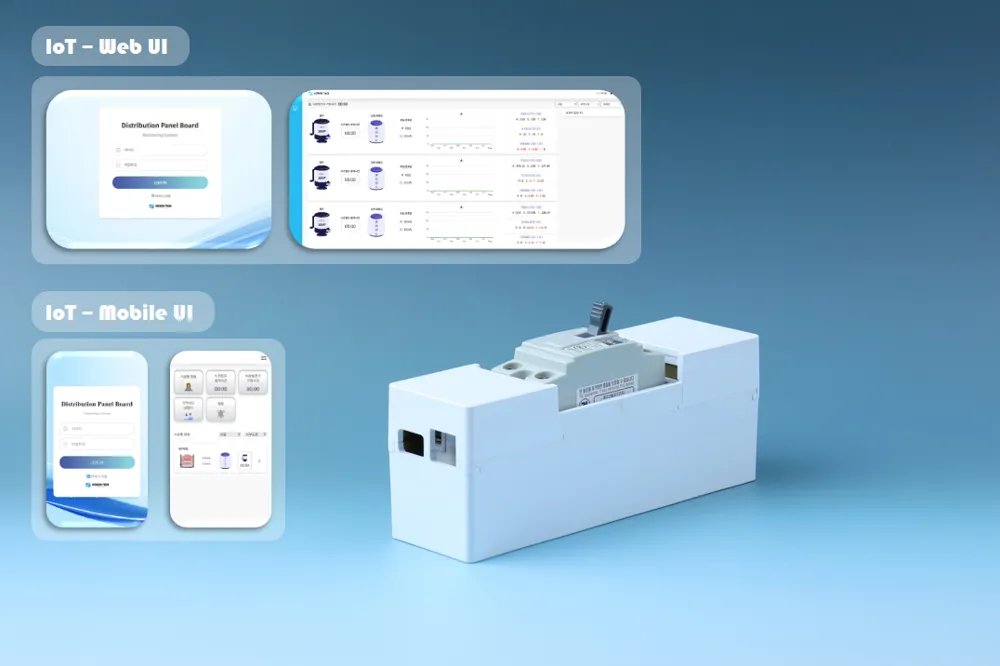
IoT Smart Monitoring Integration: Dynamic CB is linked to an IoT-based smart control system, providing real-time leakage current monitoring, remote trip/reset control, and status notifications. This allows administrators to immediately identify abnormal situations such as flooding and manually intervene (e.g., remote trip) if necessary.
In addition, it has high accident prevention and management efficiency by sounding a pre-alarm before flooding occurs or automatically reclosing after confirming safety when recovering after flooding. Existing circuit breakers could only be manually reset, but this product focuses on proactive power disaster management.
Simultaneous Securing of Safety and Continuity: The key is that it achieves both electric shock protection and power continuity. By controlling the current path, the current flowing through the human body is made close to 0 even when a person is in the water, and only normal current flows through the equipment, keeping both people safe and the equipment running.
This breaks the existing taboo of *"the coexistence of electricity and water"* and is evaluated as achieving a paradigm shift in electrical safety. It is a technical differentiator that will rewrite the electrical safety standards in the event of a disaster.
Key Adopters
Building and Facility Managers (B2B): Building owners and facility managers with underground spaces are the main customers. For example, apartments with underground parking lots, underground shopping mall operators, and subway stations can greatly benefit from adopting this circuit breaker to prepare for flood damage. They must consider both human safety and facility protection, so they may consider adoption even if the price is high.
Government/Public Institutions (B2G): It is highly likely to be introduced as a national disaster preparedness infrastructure. Local governments that have experienced human casualties due to floods can apply it first to sewage pumping stations and disaster prevention centers. In addition, if it is reflected in national power safety regulations and designated as an essential requirement for new buildings in the future, mass demand may occur. From the government's perspective, interest is expected due to the high effectiveness of protecting human lives and preventing secondary damage.
Specialized Industries: It can also be applied to environments where flooding is frequent, such as ships and offshore plants, or to outdoor electrical equipment (street light distribution boards, etc.). Companies in these fields may adopt it to prevent safety accidents.
However, the low-voltage switchboard market for buildings is expected to be the main focus in the early stages.
Scalability
National Disaster Safety Standardization: Once the technology is proven, flood safety circuit breakers can be included as a new standard in the electrical equipment standards of each country. If that happens, there is potential for widespread installation in low-lying buildings and underground infrastructure around the world. If performance is verified in Korea and UL and IEC standards are certified for overseas expansion, there will be demand in Southeast Asia and the Americas, where flood problems are serious.
Product Lineup and Voltage Expansion: The current solution is probablyLow-voltage switchboard (400V AC or less)It seems to be for use, but if it can be applied to high-voltage substation equipment or DC power systems (electric vehicle charging, etc.) in the future, the market will grow further. In addition, the product range can be expanded by capacity from small household use to large industrial use.
For example, if it is applied to household distribution boards, it is possible to protect flood-prone detached houses.
Realistic Considerations: The power equipment market is conservative, so even innovative technologies take time to verify safety and build trust. The idea that *"it won't trip even if water touches it"* may be met with initial resistance because it goes against intuition. For this reason, it is highly likely that it will be expanded with a focus on limited pilot applications in the early stages.
For example, after installing it in a few underground spaces under the leadership of the government, it will be fully expanded once the results are confirmed.
Economic Feasibility: If it is more expensive than existing circuit breakers, its distribution may be limited. However, if the price is reasonable compared to the cost of human/facility damage, market acceptance is sufficiently possible. In particular, if it is evaluated as a premium surcharge factor in connection with the insurance industry, building owners may prefer to install it.
Technology Spin-off: Since this technology has a unique approach of controlling the current path, it is expected to develop spin-off products such as portable electric shock prevention equipment and flood-only power supply devices in the future.
Judges' Evaluation
Human Security Innovation Award: Dynamic CB won the Innovation Award in the "Human Security for All" category, a special theme at CES 2026, recognizing the technology's public interest and innovation. The review praised it as *"a groundbreaking solution that achieves the coexistence of electricity and safety"*, calling it an invention essential for the climate change era. There was also a comment that it was *"a dreamlike technology that protects people and maintains electricity during floods."
Expert Opinion: Electrical engineering experts were initially surprised, saying, "Is it really possible that there is no electric shock when water touches it?" but nodded at the presented physical principles. Power engineers said that the explanation of using Gauss/Faraday's law is theoretically valid, and“I wonder why it has only come out now.”There was an opinion that they wanted to see more reliability test data, such as operation verification in actual high-current situations.
A safety technology critic evaluated it as an innovation without exaggeration, saying, *"It is an invention that overturned the common sense that electricity is cut off during flooding."
Market Reaction: Disaster safety industry and building equipment personnel expressed great interest. In particular, officials in areas that have recently experienced human casualties due to flooding said, *"If we had this, we would have reduced the damage"* and hoped for on-site application.
Investors sympathized with the public nature of the technology, but pointed out regulatory hurdles in the commercialization process. In the case of electrical equipment, it is necessary to obtain certification from each country, but it is a concept that does not exist in the existing standards, so it may take time to pass. However, there are more positive prospects that regulations are not an obstacle, but that *"this technology will create a new standard."
Over/Underestimated Factors: Some believe that the market may be limited because it is a solution that is only useful in niche situations (flooding). On the other hand, there is a rebuttal that the risk of flooding is now widely increasing due to recent abnormal weather conditions, so it is by no means a niche. In addition, there are also technical detailed inquiries such as whether the original role of the circuit breaker (overcurrent trip, etc.) is performed in the same way as before.
Overall, it is in the stage of building trust in a new concept, and the safety industry is sending a gaze of half expectation and half caution.
Analyst Insights
📌 Solution Limited to Specific Niches: It is a special-purpose technology that solves extreme situations of "water and electricity" and is very useful in the disaster safety field. However, it operates the same as existing circuit breakers in normal situations, so the added value in normal times is not significant.
It will be adopted first in limited niche markets such as flood-prone areas, and wider application will gradually be determined depending on standardization.
The award list data is based on the official CES 2026 website, and detailed analysis content is produced by USLab.ai. For content modification requests or inquiries, please contact contact@uslab.ai. Free to use with source attribution (USLab.ai) (CC BY)
댓글 (0)
댓글을 불러오는 중...