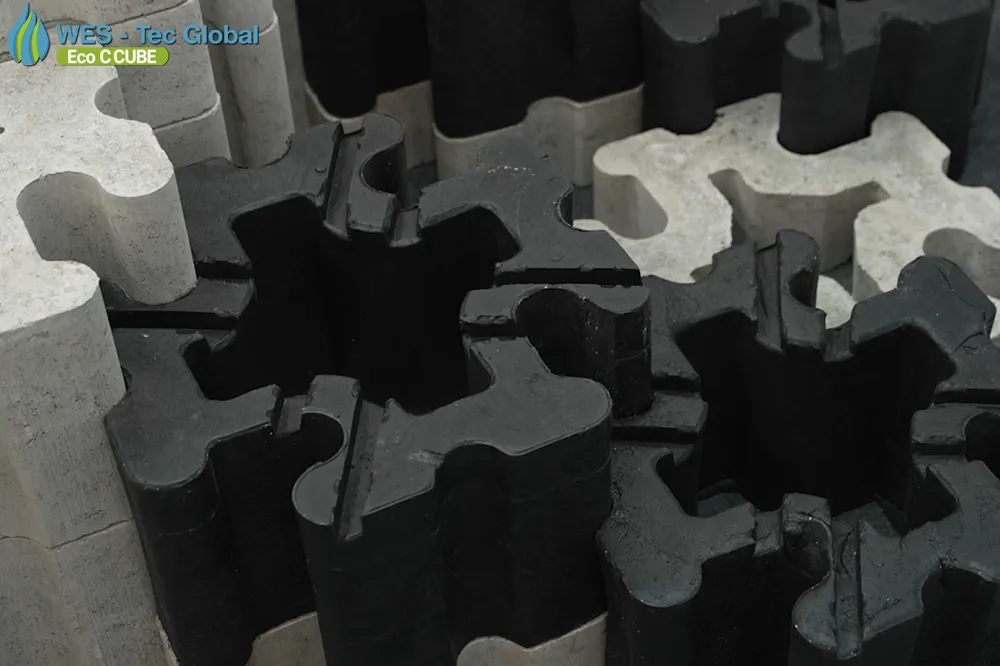
High-strength building blocks made by directly molding difficult-to-recycle plastic waste (fishing nets, buoys, agricultural vinyl, etc.) without separation or washing. Extruded and molded at low temperatures to maintain polymer strength, it achieves structural materials stronger than concrete and is an eco-friendly building material that reduces approximately 3 kg of CO₂ per 1 kg.
HonoreekoSustainability & Energy Transition로봇 자동화친환경 기술에너지 효율탄소 배출 감소ESG 경영지속가능한 생산
Eco-C CUBE
7
0
Westec-Global
One-Line Product Definition
Problem Definition
Difficult-to-recycle waste plastics: Waste fishing nets, Styrofoam buoys, and multi-layer vinyl packaging are heavily contaminated or made of mixed materials, making them unsuitable for existing recycling processes and mostly incinerated or landfilled. This leads to marine microplastic problems and severe environmental pollution such as dioxins during incineration. Separation and washing are costly and uneconomical, often treating them as waste that can never be recycled.
Environmental burden of concrete production: Concrete blocks and ready-mixed concrete are used in large quantities for social infrastructure construction, but cement production emits enormous amounts of CO₂. In addition, concrete has high compressive strength but weak tensile strength, leading to cracking problems. Furthermore, the depletion of raw materials such as natural sand and gravel has led to the need for alternative building materials.
Simultaneous problems of waste and building materials: There is a dual problem of mountains of unusable waste plastic on one side and the use of carbon-intensive building materials on the other. Approaching these separately is costly and environmentally burdensome, requiring a solution that integrates both problems.
Key Differentiators
Direct recycling without washing or separation: Eco-C CUBE extracts blocks by putting waste directly into the machine without washing or sorting. This so-called "New-Cycling" process processes even shells attached to fishing nets or soil on vinyl without pre-treatment. Existing process technology covers what was previously unrecyclable due to impurities, reducing processing costs and energy waste. This shortens the three stages of fishing net → plastic pellets → product to one stage of fishing net → product, which can be said to be an innovative process simplification.
High strength achieved by low-temperature extrusion: General recycling involves high-temperature melting, which damages the polymer chain and reduces mechanical strength. On the other hand, this process extrudes and molds at a low temperature that preserves the polymer structure as much as possible, resulting in blocks with higher tensile and compressive strength than concrete. According to a Yanko Design report, the blocks made have better tensile/compressive performance than concrete and are sufficient for structural use such as retaining walls on hillsides. This improvement in upcycling quality is a major differentiator compared to similar technologies.
Large 3D interlocking block design: The product is not a simple brick but a 3D assembly block that interlocks when stacked to increase structural stability. The blocks have empty space channels inside for drainage and are fixed by gravity and shape without cement during construction. This makes installation quick and easy, and allows for easy reassembly/recycling if necessary. Existing concrete retaining walls are permanently constructed with rebar and mortar, but Eco-C CUBE can be stacked and unstacked like Gundam blocks, making maintenance easy. This design innovation is highly regarded for its construction efficiency and eco-friendly water circulation (drainage through water holes).
Proven carbon reduction effect: LCA has verified that the product reduces approximately 2.99 kg CO₂ per 1 kg. This is the sum of the carbon emitted when waste is incinerated and the carbon saved by replacing concrete. It is highly reliable because it has been officially verified by the SDX Foundation, and it is easy to obtain carbon credits or eco-friendly certification with this data. There are many eco-friendly products, but clearly presenting the amount of CO₂ reduction in numerical terms is a major advantage. This can be used as ESG point proof data when applied to projects in the market.
Key Adopters
Civil engineering/construction companies (B2B): Construction companies looking for new materials for retaining walls, eco-friendly infrastructure, etc. are the main customers. In particular, application reviews are already underway for uses such as reinforcing road slopes, river embankments, and foundation blocks for solar panels. Construction companies can be proactive because using these blocks can shorten construction periods and reduce carbon emissions.
Public institutions/local governments (B2G): The Ministry of Oceans and Fisheries, which wants to solve the problem of waste fishing nets, and local governments with a large burden of waste landfill can utilize this technology. For example, a circular economy project can be implemented by using blocks made from fishing nets discarded by fishermen to reinforce breakwaters in fishing villages. It is already known that an association under the Korean Ministry of Environment is participating in joint development to prepare for public demand linkage.
Eco-friendly site developers: In businesses where an eco-friendly image is important, such as solar power plants, using Eco-C CUBE as a base block is advantageous for certification and promotion. Companies that promote RE100 and ESG management may also use it for their own site development.
Overseas infrastructure market: In the future, there is high potential demand in overseas countries with both marine waste problems and infrastructure demand, such as island nations (e.g., Maldives) and coastal countries (e.g., Indonesia). In developing countries, there is also cost competitiveness in that building materials can be made from cheap waste.
Scalability
As a global marine environment solution: This technology addresses environmental problems without borders. It fits well with the UN SDGs context of processing fishing net waste generated by international fisheries and using it again for social infrastructure construction. It can be expanded to support fishing villages in developing countries in conjunction with international organizations/environmental groups. In addition, as plastic regulations in each country are strengthened,Extended Producer Responsibility(EPR)It can be used as a way to utilize waste plastic collected by.
Diversification of product line: Currently, the blocks are mainly large blocks for civil engineering, but they can be expanded to building materials (bricks, interior boards, etc.) in the future. The area of application can be expanded by adjusting the color or texture to create landscape blocks or landscaping facilities. It has already been certified for its technology with the Edison Awards, and based on this, it can also seek entry into the private construction market.
Economic sustainability: Cost competitiveness is high by omitting the washing/sorting process from the production cost. However, since localized production is important to reduce transportation costs, a model of distributed production by building small-scale factories near waste generation sites is likely. This has the advantage of creating jobs in each region and forming a local circular economy.
Limitations and challenges: To commercialize it on a large scale as a building material, it must obtain building standard certification. There is the challenge of sufficiently proving reliability (durability, fire resistance, etc.) compared to concrete and changing the perception of the conservative construction site. In addition, securing uniformity of physical properties is key due to the characteristics of waste raw materials, but pilot results show that indicators such as strength are good, but long-term creep or weathering data needs to be accumulated. Nevertheless, since it is currently being promoted through a government-private partnership, a foundation for solving these challenges seems to have been laid.
Judges' Evaluation
Favorable reviews from the environmental and architectural communities: Selected as a CES 2026 Honoree in the Sustainability & Energy Transition category, it was praised as an *"innovation that solves the problems of plastic waste and construction materials at once."* Designboom, Yanko Design, and other design/architecture media reported this news and"Old fishing nets transformed into eco-friendly building blocks"praised the story. In particular,"I just pull out the block without washing it"They were impressed by the fact that they were able to implement it despite the technical difficulty.
Edison Awards background: The fact that it won the Silver Award at the 2025 Edison Awards was also mentioned, and experts say that this means that the industry also recognized its effectiveness. Judging from the award category (Advanced Infrastructure Solutions), it is interpreted that it received high scores in both engineering completeness and marketability.
Market expectations: Environmental NGOs and marine communities are expressing the opinion that *"I hope this solution will be distributed to fishing villages."* It is expected that it will be welcomed because if fishermen collect fishing nets and make blocks to build breakwaters, the local environment and safety will be improved at the same time. In the construction industry, *"If the strength and durability are certain, it is attractive as a concrete alternative,"* and they intend to use it first in eco-friendly certification projects. However, there is also a conservative outlook on general construction applications, and more structural calculation data accumulation and construction performance are needed.
Overestimation/underestimation: There are almost no opinions of underestimation regarding the technology itself, and everyone agrees on the innovation. However, there is a realistic argument that "price ultimately determines everything." Since concrete is so cheap, subsidies for waste disposal may have to be taken into account for this block to be economical. However, if carbon taxes are introduced recently, the advantage of being a low-carbon material may lead to price competitiveness. Overall, the critics highly appreciate the timeliness and innovation of the technology, while at the same time expressing caution about watching the mass production commercialization stage.
Analyst Insights
🔥 High marketability / Business connection possible: As a solution that transforms waste into resources and builds high-performance infrastructure, there is a great incentive for both public and private sectors to adopt it at a time when environmental regulations are being strengthened. Since it has already gone through the verification stage for both performance and eco-friendliness and is about to be commercialized, it is highly likely to settle in the market by catching two rabbits: the waste plastic problem and the carbon reduction of building materials.
The award list data is based on the official CES 2026 website, and detailed analysis content is produced by USLab.ai. For content modification requests or inquiries, please contact contact@uslab.ai. Free to use with source attribution (USLab.ai) (CC BY)
댓글 (0)
댓글을 불러오는 중...