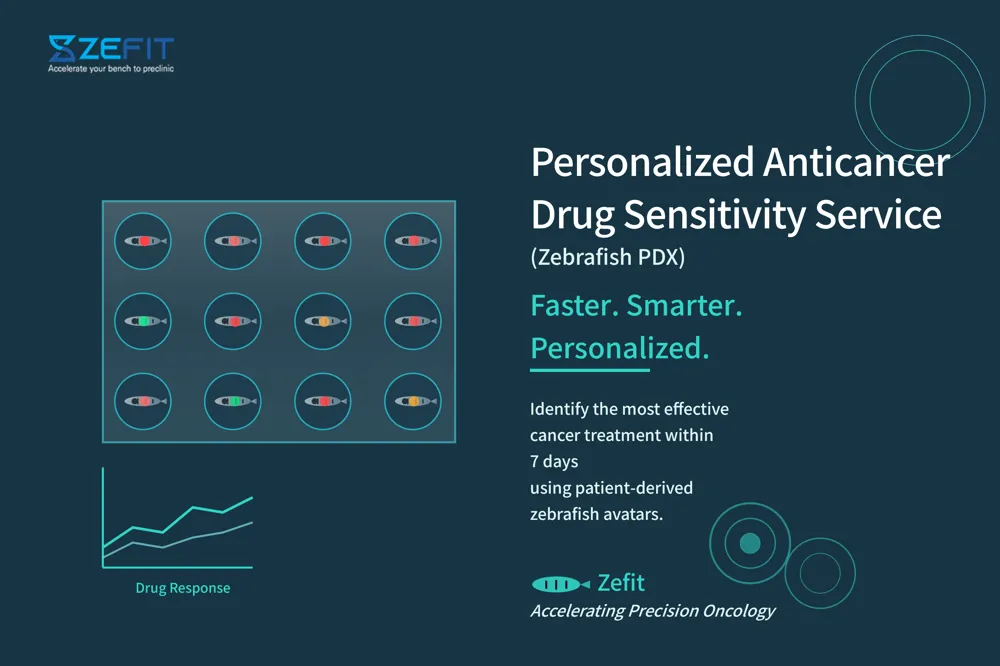
A service that finds the optimal anticancer drug using patient-derived avatars – A precision medicine platform that proposes personalized optimal treatment by rapidly testing the effects of multiple anticancer drugs through avatars created by transplanting patient tumor tissue into zebrafish.
HonoreekoProducts in Support of Human Security for All항암제 감수성개인 맞춤형 치료AI 기반 분석정밀 의료암세포 분석약물 반응 예측
개인 맞춤형 항암제 감수성 서비스
3
0
Zefit Inc.
One-Line Product Definition
Problem Definition
In anticancer treatment, drug efficacy varies from patient to patient, but there were limited ways to know in advance which anticancer drug would be optimal for each individual.
Existing methods of testing drug sensitivity involved cell culture oranimal experiments (mice), but these were time-consuming and did not reflect patient-specific characteristics, making them difficult to apply directly to actual treatment.
In addition, trial and error using multiple drugs on patients at the clinical stage was inevitable, leading to a high risk of side effects and wasted time. This service emerged from this background, aiming to find "the most effective drug for this patient" by testing the efficacy of multiple drugs with a patient-specific model before treatment."the most effective drug for this patient"aiming to find "the most effective drug for this patient" by testing the efficacy of multiple drugs with a patient-specific model before treatment.
Key Differentiators
Zefit's Onco-FIT platform is innovative in that it utilizes "patient avatars" created by transplanting patient tumor tissue or genetic information into zebrafish.patient avatarsZefit's Onco-FIT platform is innovative in that it utilizes "patient avatars" created by transplanting patient tumor tissue or genetic information into zebrafish.
Zebrafish are transparent and have similar biological responses to humans. When patient cancer tissue fragments are transplanted into them, a tumor environment similar to that of the patient is formed.
Onco-FIT can obtain data on which drugs are effective for a patient's tumor within a short period (within a few weeks) by administering multiple anticancer drugs to these avatars and observing the responses simultaneously. It precisely measures drug effects by combining AI image analysis and robotic automation, and suggests optimal drug combinations for each patient.
Compared to existing animal models, it is faster and cheaper, and its accuracy is increased by predictive AI linked to patient genetic information. In simple terms, it implements personalized treatment without trial and error by pre-testing drugs on "patient mini-me" fish.
Key Adopters
With a B2B2C nature, a model in which large hospitals and cancer centers adopt and provide it to patients as a service is highly likely. In other words,individual cancer patients (B2C)are the ultimate beneficiaries, andoncology hospitals (B2B)that treat them purchase/utilize the service.
In particular, it is currently collaborating with major domestic university hospitals such as Samsung Seoul Hospital for clinical PoC, and can be expanded to cancer centers worldwide in the future.
From an insurance/government (B2G) perspective, if this service is proven, it can be introduced into the public healthcare sector in connection with health insurance coverage or government precision medicine projects. It is expected to start in the form of a high-cost, self-funded service and gradually be incorporated into medical standards.
Scalability
The plan is to expand the area to rare diseases and genetic diseases in addition to cancer, and expansion R&D is already in progress.
The basic idea is a"patient-derived biological avatar platform,"so it can be applied to immune-oncology drug evaluation and prediction of individual side effects in the future.
In terms of regulations, there are hurdles such as medical device/clinical trial approval, but it is relatively easy because it is a non-invasive service (using only patient samples), and it is also recognized as an alternative model that complies with animal welfare regulations. However, clinical validation and improvement of doctors' perceptions are necessary as new protocols must be applied to the hospital setting.
Overall, it has the potential to expand into a global standard if successful, in line with the precision medicine trend.
Judges' Evaluation
It was recognized for both technological innovation and potential for human contribution by winning the CES 2026 Innovation Award (Human Security category).
The judges highly praised the convergence of AI, alternative animal models, and robotics technology, and gave it the compliment of being a "game changer that increases patient survival rates.""game changer that increases patient survival rates."The judges highly praised the convergence of AI, alternative animal models, and robotics technology, and gave it the compliment of being a "game changer that increases patient survival rates."
However, there is also a realistic criticism that it may take time to launch on the market due to the conservatism of the medical community. Although the technology readiness level is in the early stages as clinical POC is currently in progress, it seems that CES paid attention to it in advance due to the importance of the concept.
Domestic and foreign media welcome it as a "new horizon for patient-tailored treatment," but predict that additional capital and accumulation of clinical data are needed for commercialization.
Analyst Insights
🧪 R&D and concept verification stage – Although the potential for medical innovation is very high, it is still in the early stages of clinical validation and market adoption, requiring additional research and investment to prove the validity of the technology concept.
The award list data is based on the official CES 2026 website, and detailed analysis content is produced by USLab.ai. For content modification requests or inquiries, please contact contact@uslab.ai. Free to use with source attribution (USLab.ai) (CC BY)
댓글 (0)
댓글을 불러오는 중...