Strawberry Shilla Cake Economics: How Can Companies Survive the AI Era When FOMO Becomes a 'Festival'?
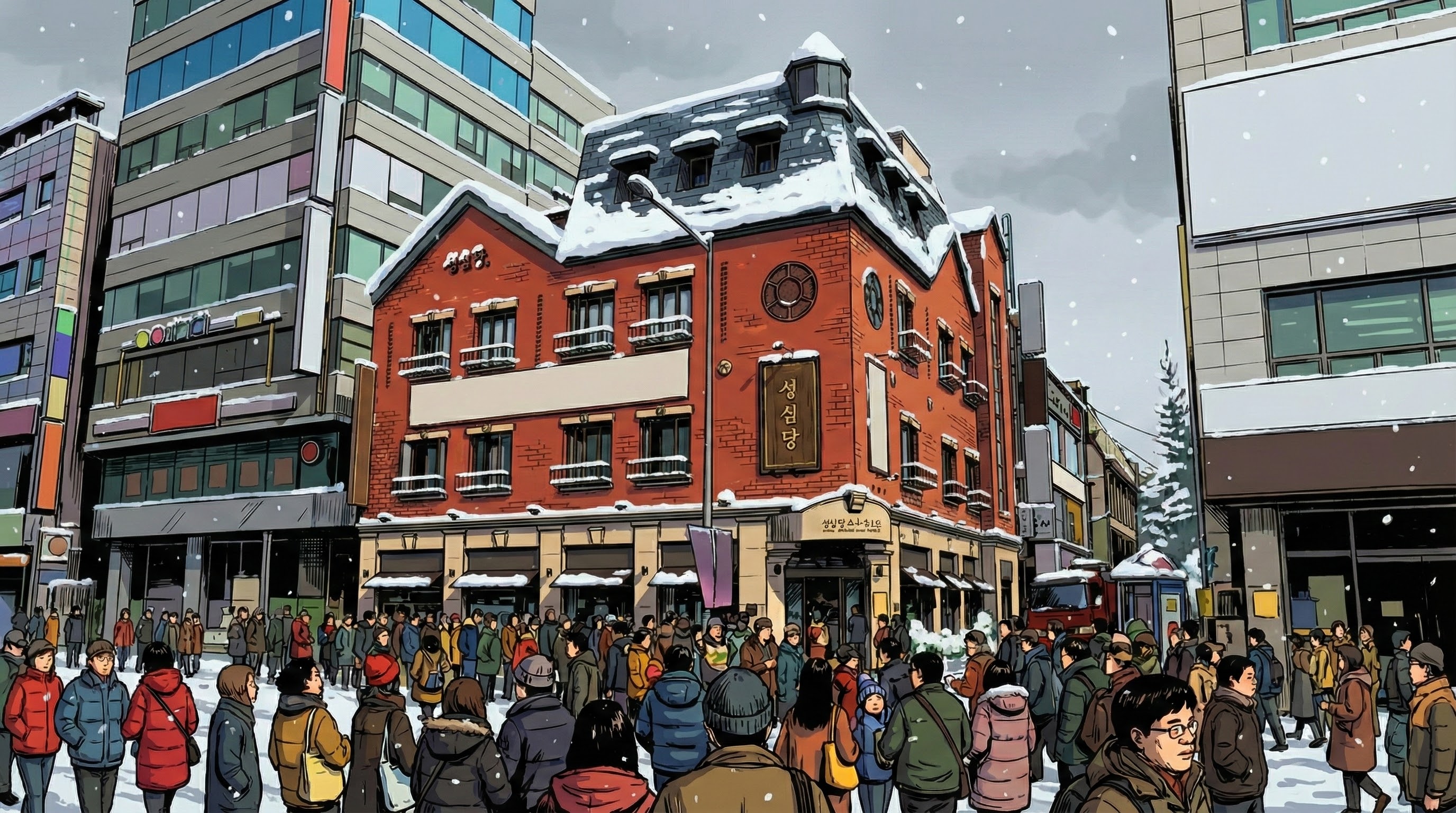
Winter in Daejeon's Eunhaeng-dong is a little special.
Not because the weather is special, but because people's expressions are. Standing in line in the early morning air to buy a single cake, faces calculating “Will I get one today?” at the end of a long queue. News reports show lines stretching over 200 meters and waits lasting for hours.
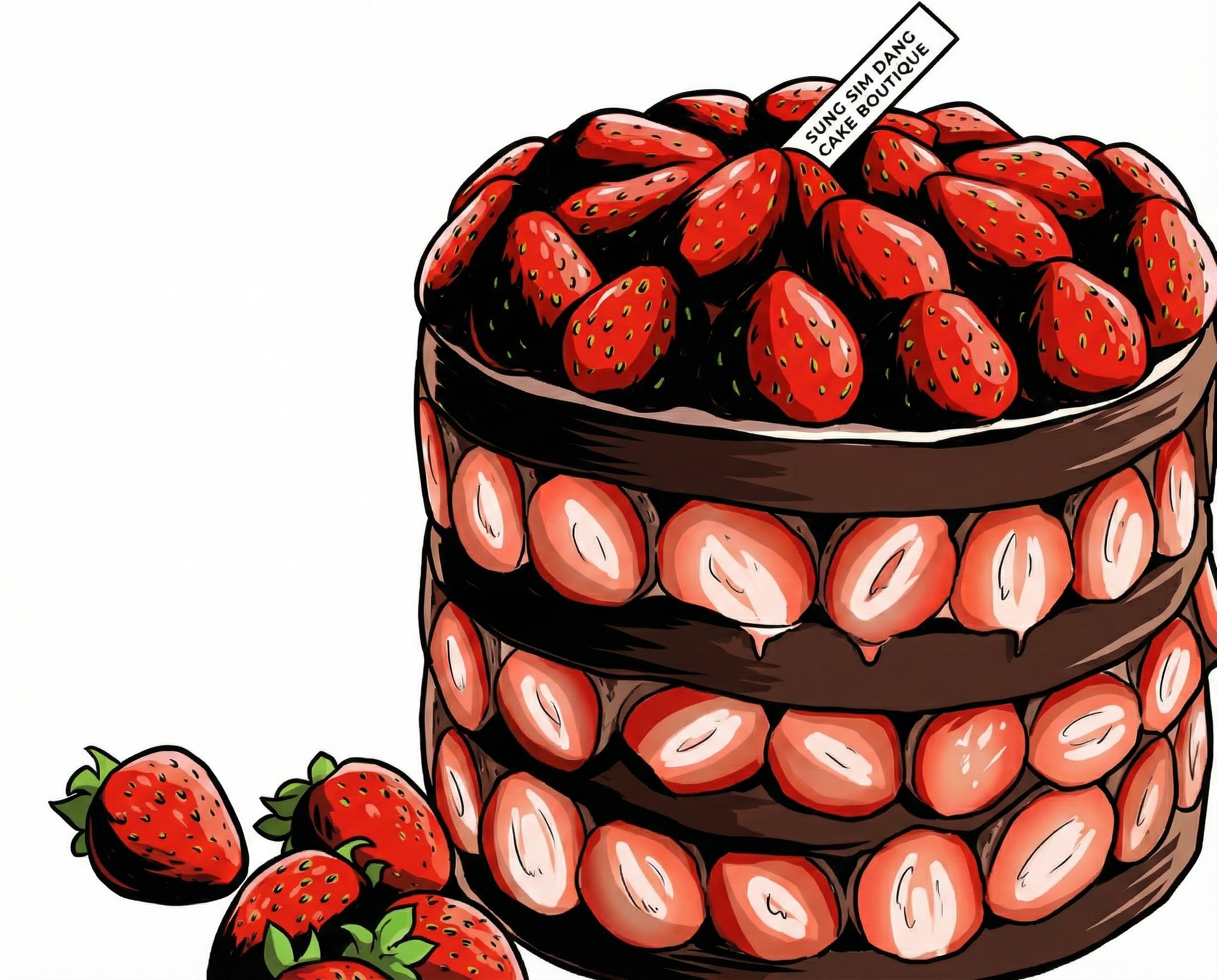
And at the end of that line is Sungsimdang's 'Strawberry Siru' cake. 2.3kg for 49,000 won.
Some say:
With that time and effort, I could just buy a hotel cake.
Logically, that's correct. But that statement doesn't fully explain the reality. Because what people are buying now isn't just a 'cake,' but the 'story' of getting the cake.
What the Strawberry Siru cake really sells is not 'taste' but 'victory'.
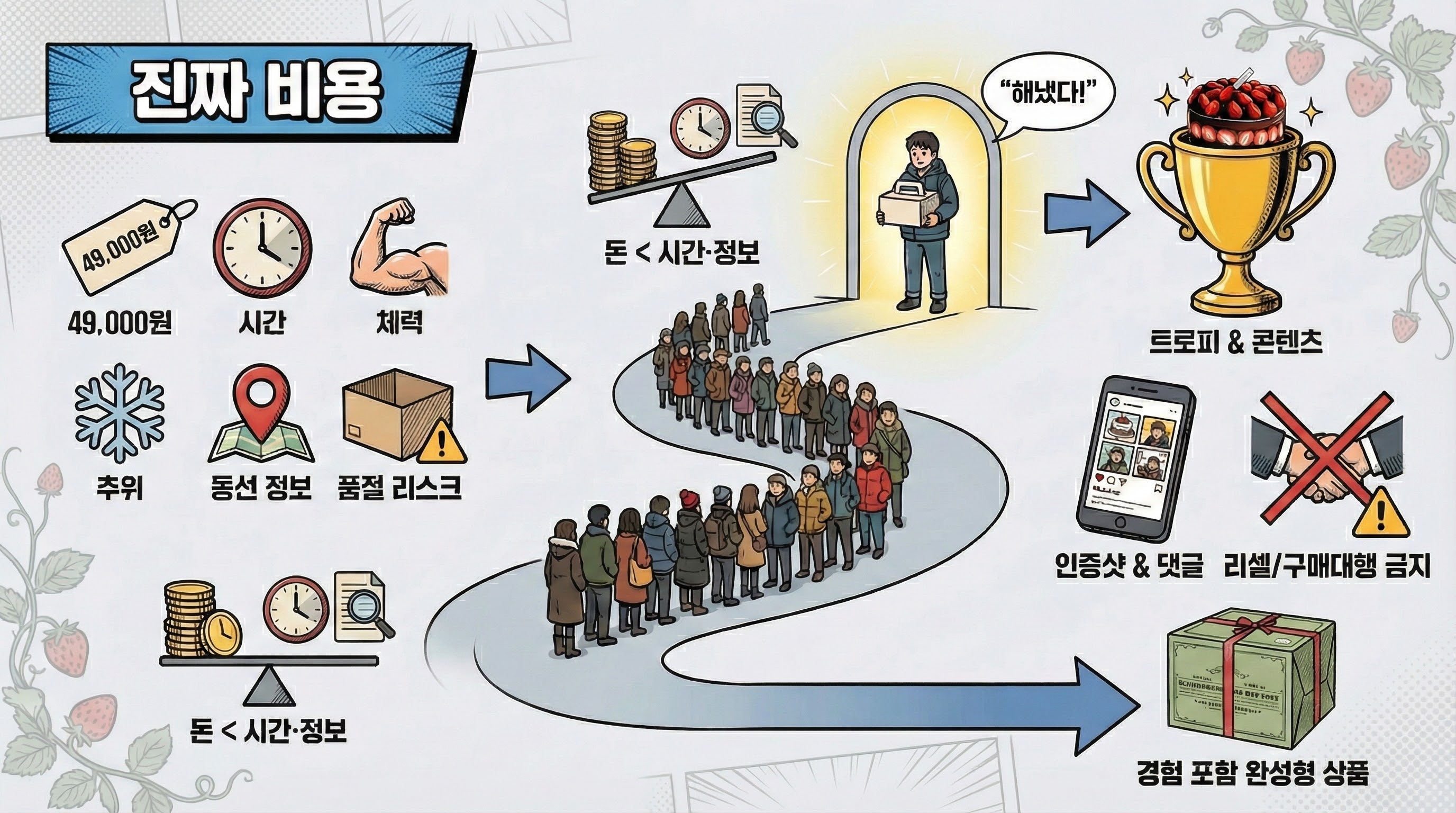
Calling Strawberry Siru a "value-for-money cake" misses the point. The price tag says 49,000 won, but the actual cost is much higher. Time, energy, cold weather, location information, and the risk of "failure if it's sold out."
It's strangely interesting. It's not something that can be easily achieved with a lot of money. Rather, the person with time, stamina, and good information wins. So, when people come out with the cake, they feel not like they "bought it" but like they "accomplished it."
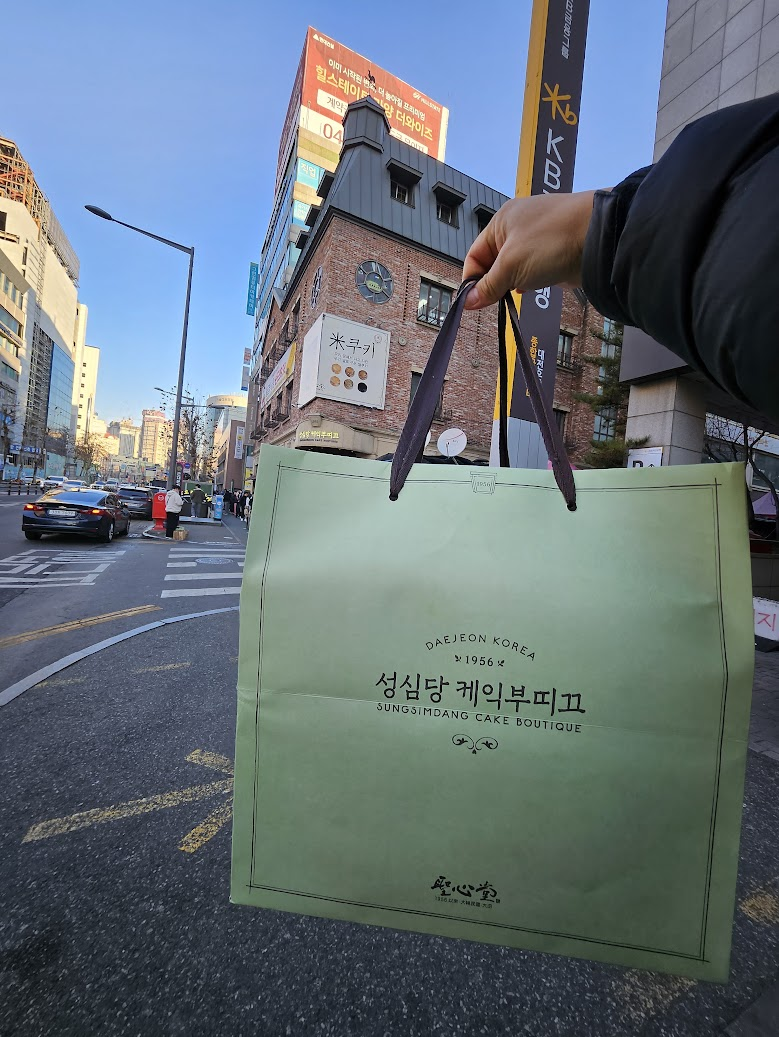
I also love the Sungsimdang cake mission!
So, the Strawberry Siru becomes a more powerful product the moment you carry it out than the moment you eat it. It becomes content even before you open the box at home. Photos are uploaded, comments are added, and questions like "What time did you go?" pile up. At this point, the cake is not a dessert but a trophy.
Where there's a trophy, a market always follows. In fact, Strawberry Siru cakes have been listed on used goods platforms at prices higher than the original, and Sungsimdang has issued a notice prohibiting purchasing agencies or third-party sales.
At this point, it becomes clear. Strawberry Siru is not just a "cake you buy in line," but a "product completed by including the experience of standing in line."
How does anxiety (FOMO) turn into a 'festival'?
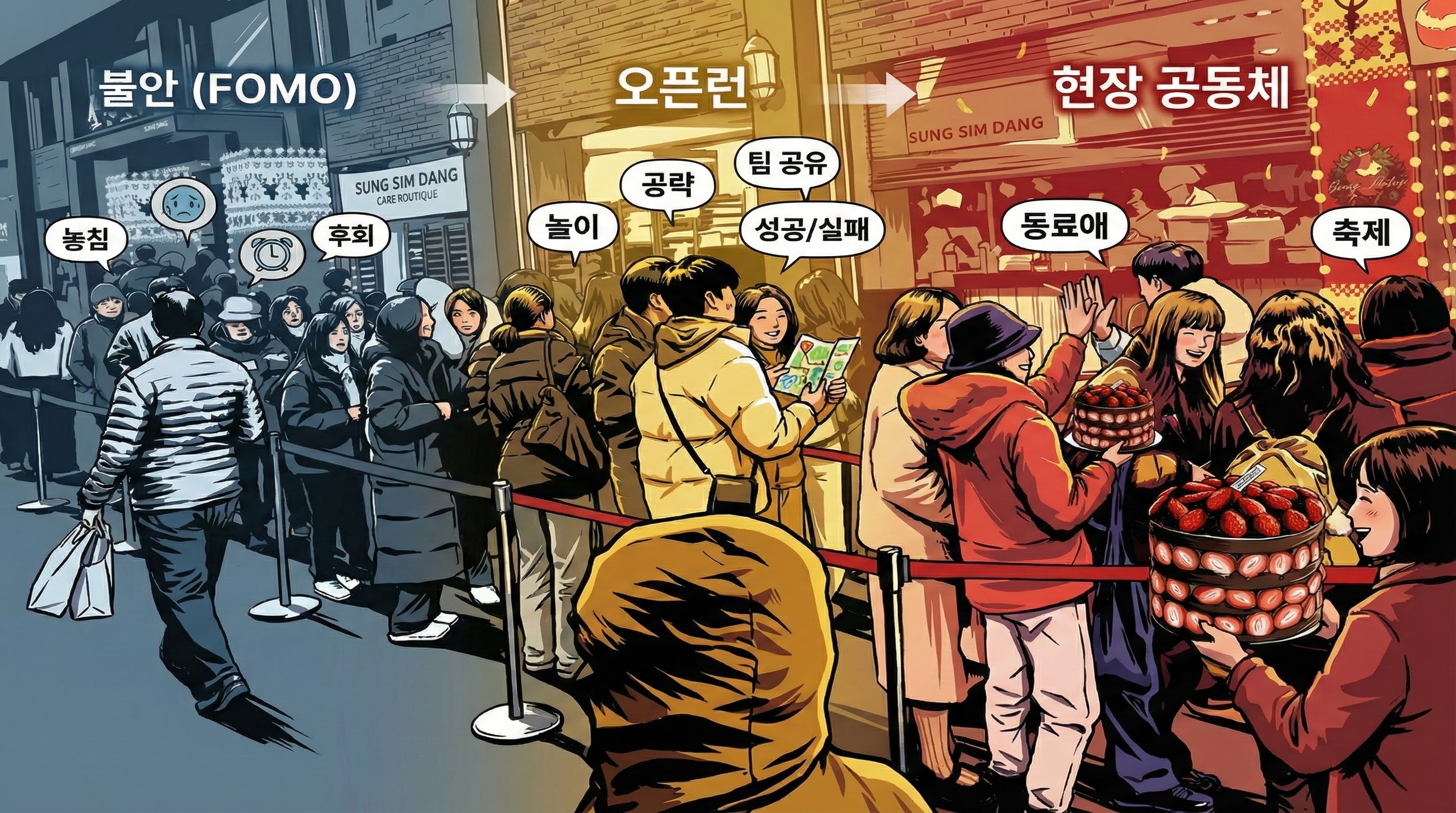
FOMO (Fear Of Missing Out): The anxiety of feeling left out, missing out on trends or valuable opportunities.
At first, it must have been anxiety. The fear of not being able to eat it, the regret of missing this season. But at some point, the open run becomes a game beyond anxiety. Strategies are created, tips are shared, and successes and failures become a story. The Strawberry Siru line is not just a wait, but a 'field community.' Because people with the same goal are standing in the same direction, they feel a strange sense of camaraderie.
It would be nice if this trend was a unique event for Sungsimdang, but it is actually part of a larger change. Kurly, like a symbol of digital commerce, is now calling people to the "field."
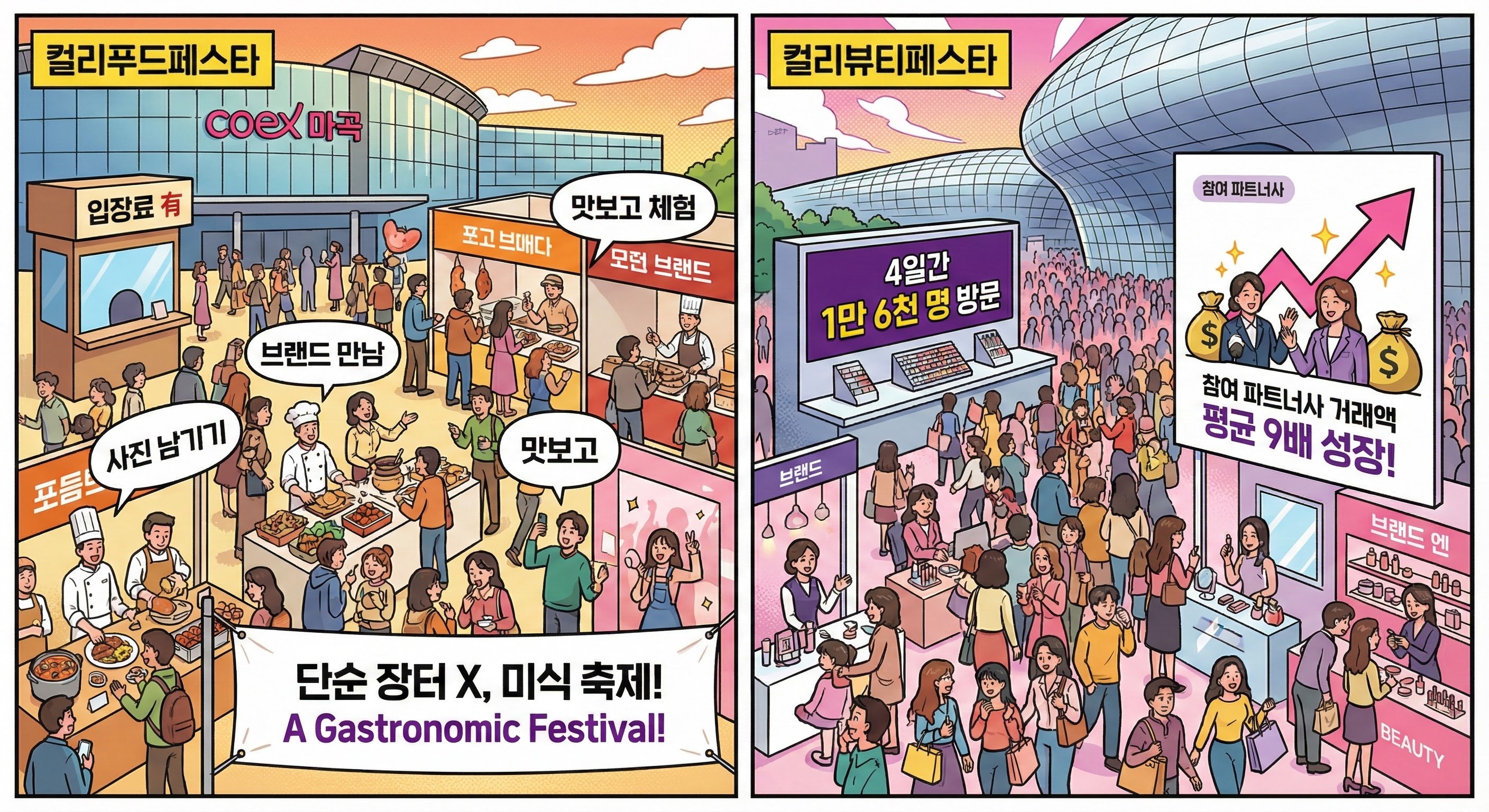
The Kurly Food Festa is held at COEX Magok and charges admission. It is designed not just as a market to display and sell products, but as a festival where brands and people meet, taste, experience, and take pictures.
The Beauty Festa was also held at the DDP, and along with the figure of 16,000 visitors over 4 days, it was also revealed that the transaction amount of participating partner companies grew by an average of 9 times compared to the previous year.
In an era where a single click can make something arrive by dawn tomorrow, why do people bother going to the site, walking, standing in line, and spending time? The answer is simple. Because there are senses and contexts that only occur outside the screen. The hustle and bustle, the noise, the smell, the density of the moment. AI can 'generate' it, but it is difficult to 'replace' it in the same way.
In the age of AI, the way for companies to survive is surprisingly simple.
Bringing up the AI story here may seem out of the blue, but I think this is the most natural point to move on to the AI story. What the Strawberry Siru and Festa showed was ultimately one thing.
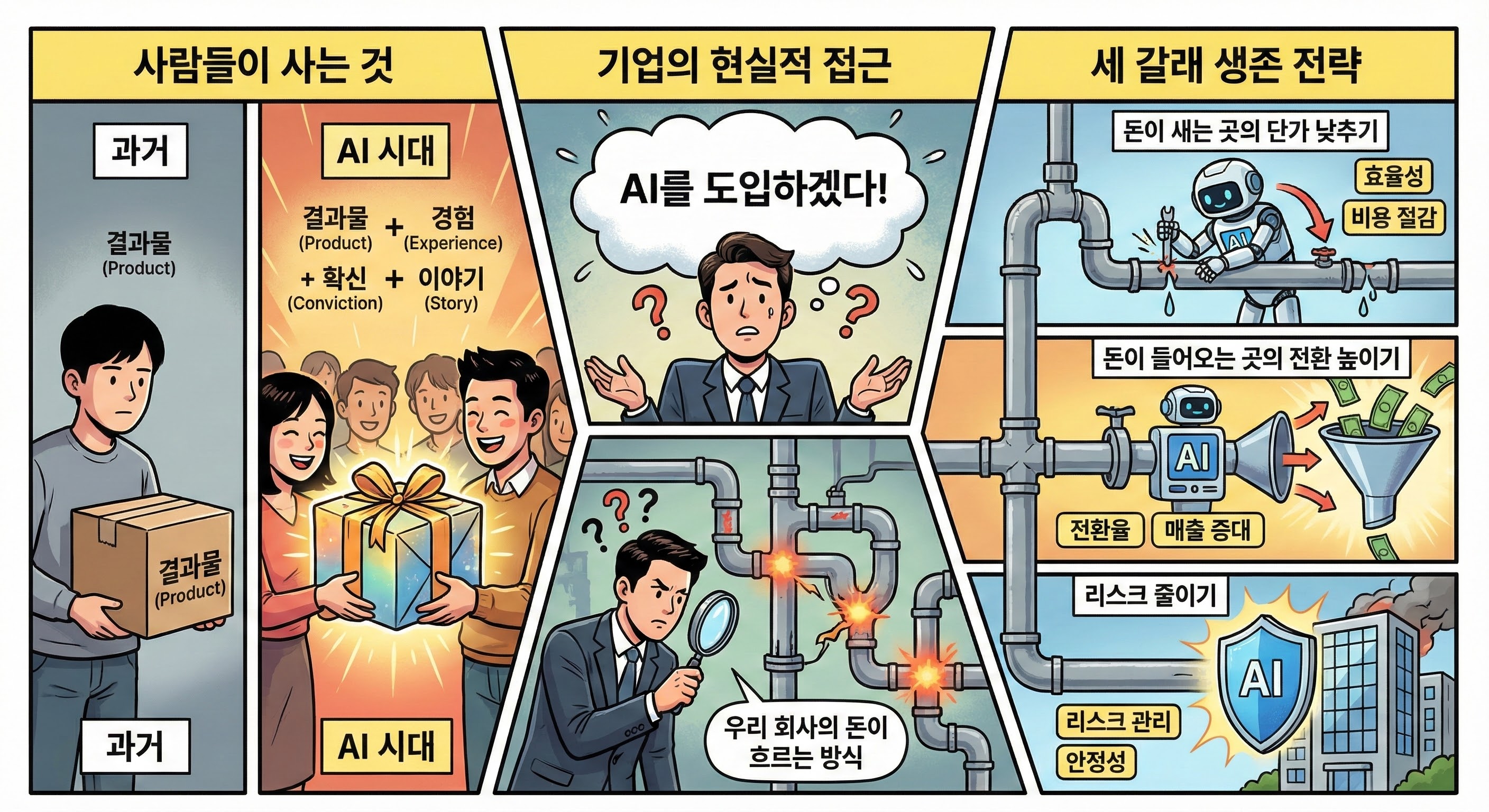
People don't just buy 'results'.
People buy 'experience,' 'certainty,' and 'story' all together.
The same goes for companies in the AI era. Saying "We will introduce AI" is too big. Realistically, the way for companies to survive is not a declaration of what they will do with AI, but,where the way our company's money flows can changeIt starts with seeing exactly.
It usually splits into three ways.
Lowering the unit price of where money is leaking,
Increasing the conversion of where money comes in,
And reducing the risk of the company collapsing when a problem occurs.
These three are not abstract and wonderful sentences, but actually the ways that companies have proven with money.
Case 1: Klarna — The moment the cost structure of the “customer center” changes
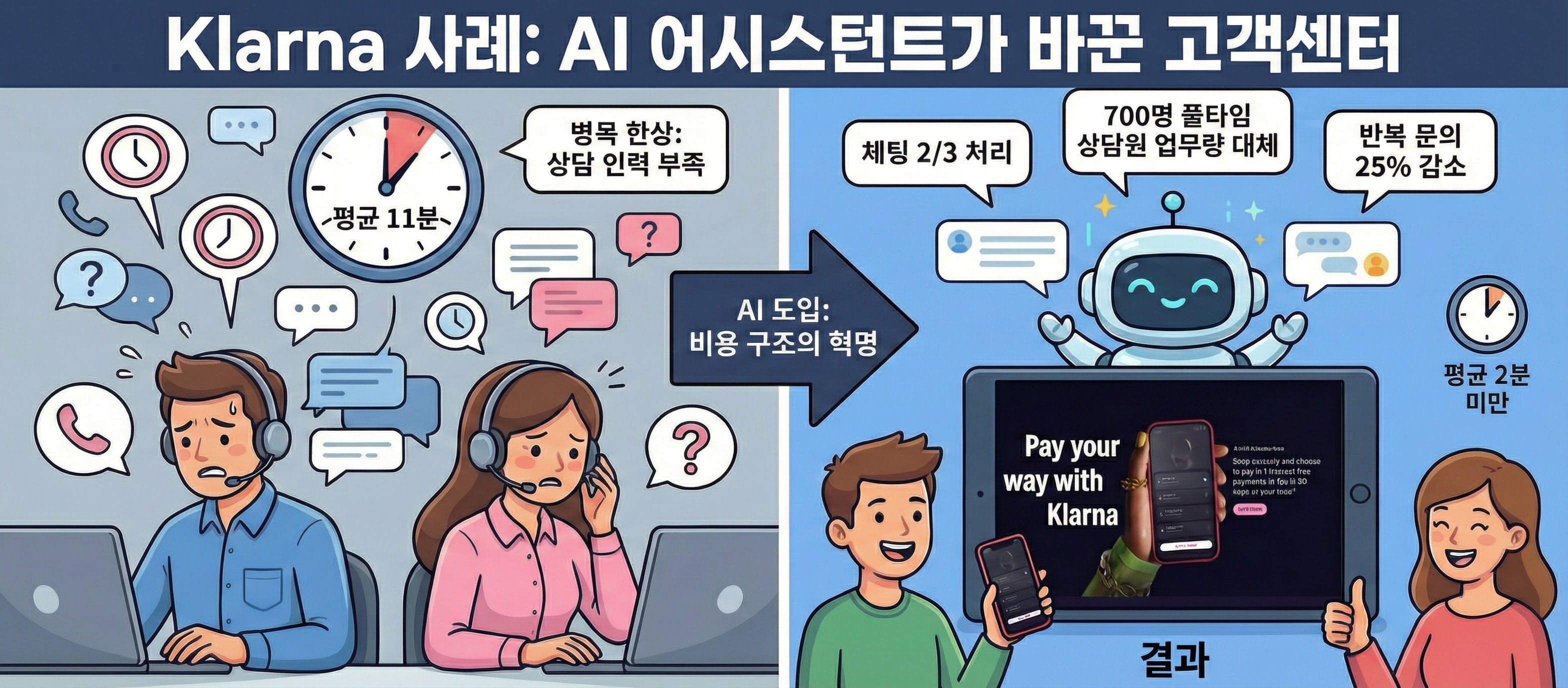
Fintech company Klarna introduced an AI assistant to handle 2/3 of customer service chats, which they announced was equivalent to the workload of 700 full-time counselors. The inquiry resolution time was reduced from 11 minutes to less than 2 minutes, and repetitive inquiries also decreased by 25%.
The reason this is important is not that "they created a chatbot," butthat AI ate up the bottleneck in the company structureThat is. There are companies that increase counseling staff as the number of customers increases, and there are companies that absorb the same customer increase with AI. Their futures are completely different.
Case 2: Duolingo — AI changes not the 'function' but the 'price tag'
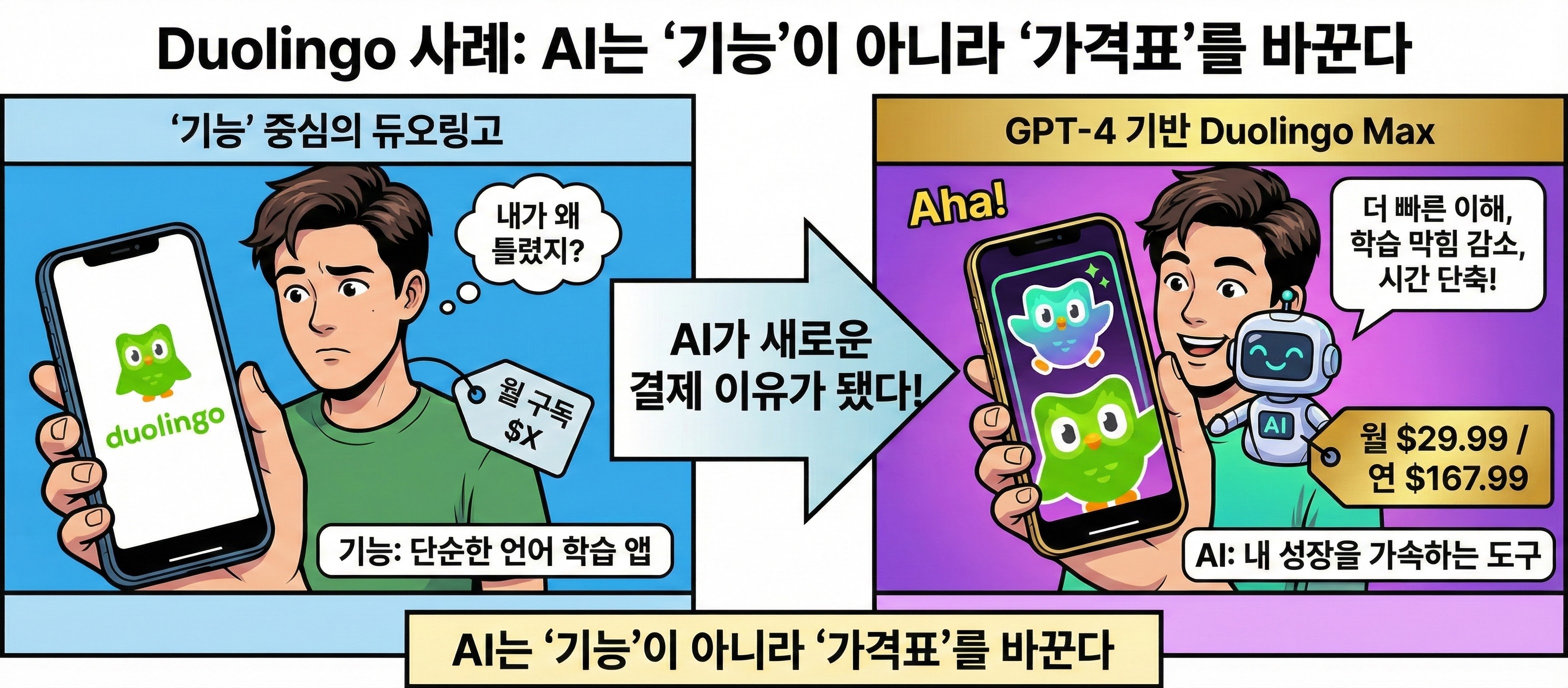
Duolingo has bundled GPT-4-based features to create a higher-level subscription called 'Duolingo Max'.
It was introduced in the launch report as $29.99 per month or $167.99 per year.
The key here is not that "AI was attached," butthat AI has become a new reason to payThat is. Customers were already learning languages, but with the introduction of AI, they can understand "why I was wrong" more quickly, reduce learning barriers, and shorten the time to results. At that moment, users feel that they are not simply using an app, but buying a 'tool to accelerate my growth.' That's why a more expensive plan is established.
Case 3: Intercom — They started getting paid not for 'subscription' but for 'performance'
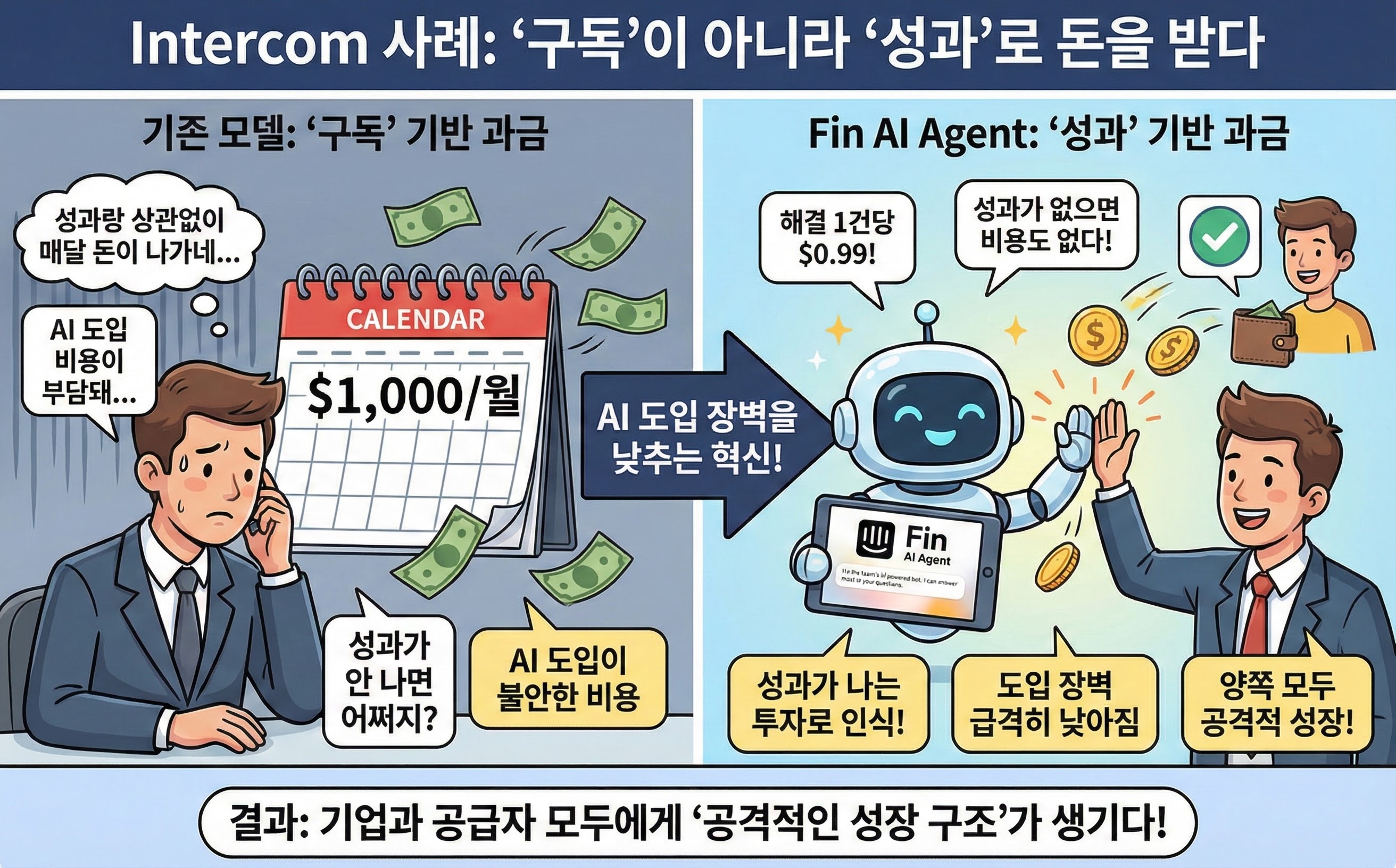
Intercom's Fin AI Agent promotes a performance-based billing model, such as $0.99 per resolution.
The reason this model is powerful is simple. From a company's perspective, it is structured so that "there is no cost if there is no performance." The moment AI adoption is recognized not as an 'anxious cost' but as a 'performance-generating investment,' the barrier to adoption is drastically lowered. And from the supplier's perspective, the possibility of expansion increases as performance increases, creating an aggressive growth structure for both sides.
In the end, the question comes back to one: What about our company?
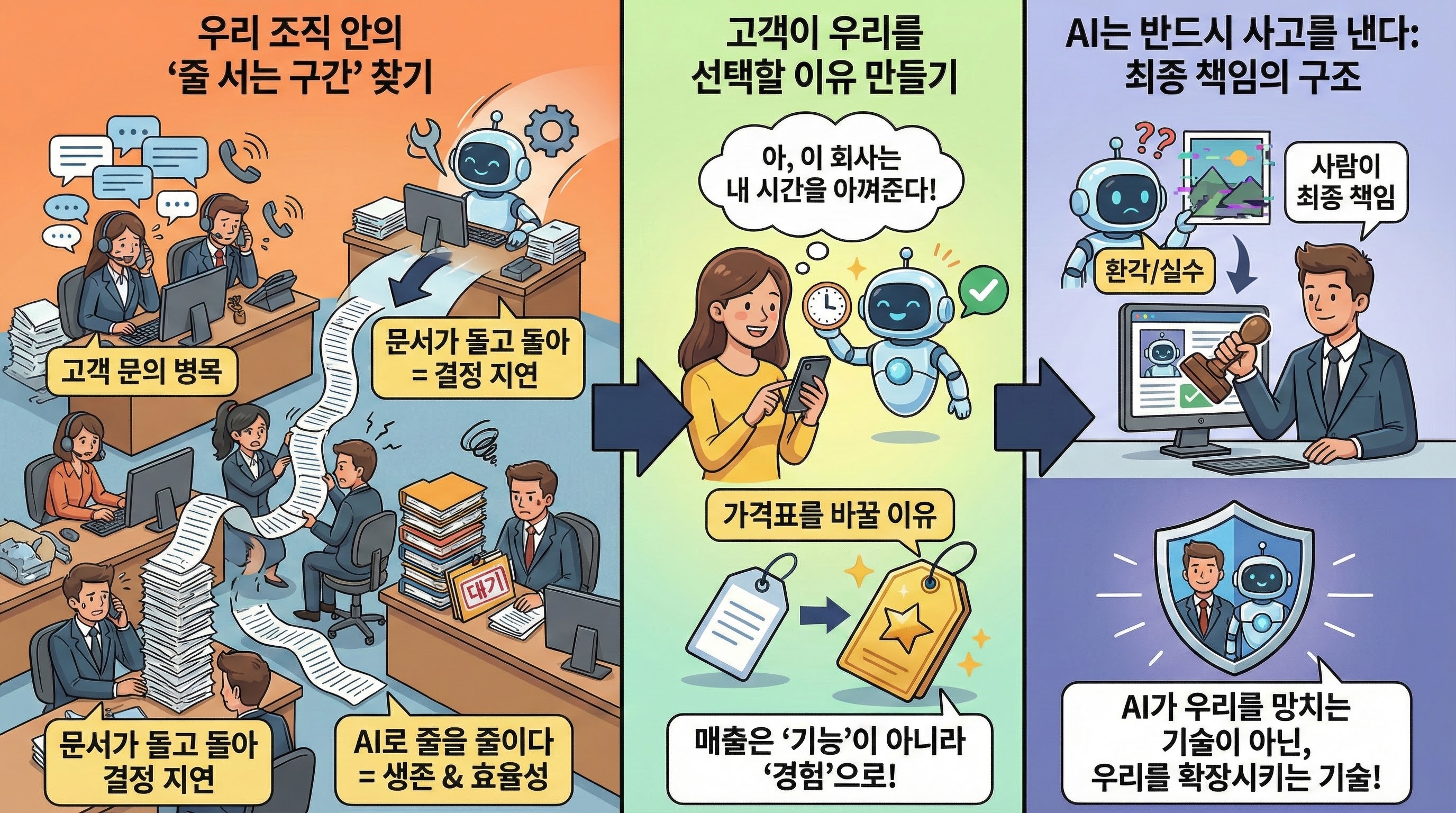
The key thing that the Strawberry Siru craze taught us was that people don't just buy results. The same goes for companies. Customers are not buying a single product, but the 'certainty' that the product creates. And that certainty is usually felt in a way that "reduces time, helps with selection, and reduces mistakes."
So, our company's AI strategy doesn't have to be grand. However, the order must be clear.
First, you need to find out where the 'queuing section' is in our organization. Whether it's a bottleneck due to accumulated customer inquiries, a place where decisions are delayed due to circulating documents, or a place where work is tied up in approval and inspection. The moment you shorten that line, the company does more work with the same manpower. That is survival.
Next, you need to look again at where the reason for customers to choose us comes from. If AI is introduced, there must be a point where customers feel, "Ah, this company saves me time." If you find that point, sales will increase not with function but with experience. Just as Duolingo changed its pricing plan, we can also create a 'reason to change the price tag'.
Finally, AI will definitely cause accidents. Hallucinations, mistakes, omissions. Therefore, we must design a structure that says, "AI does it, but humans have the final responsibility," rather than "AI does it." Only then will AI become a technology that expands us, not a technology that destroys us.
Conclusion: The business of the future is not 'what you sell' but 'what time you save'
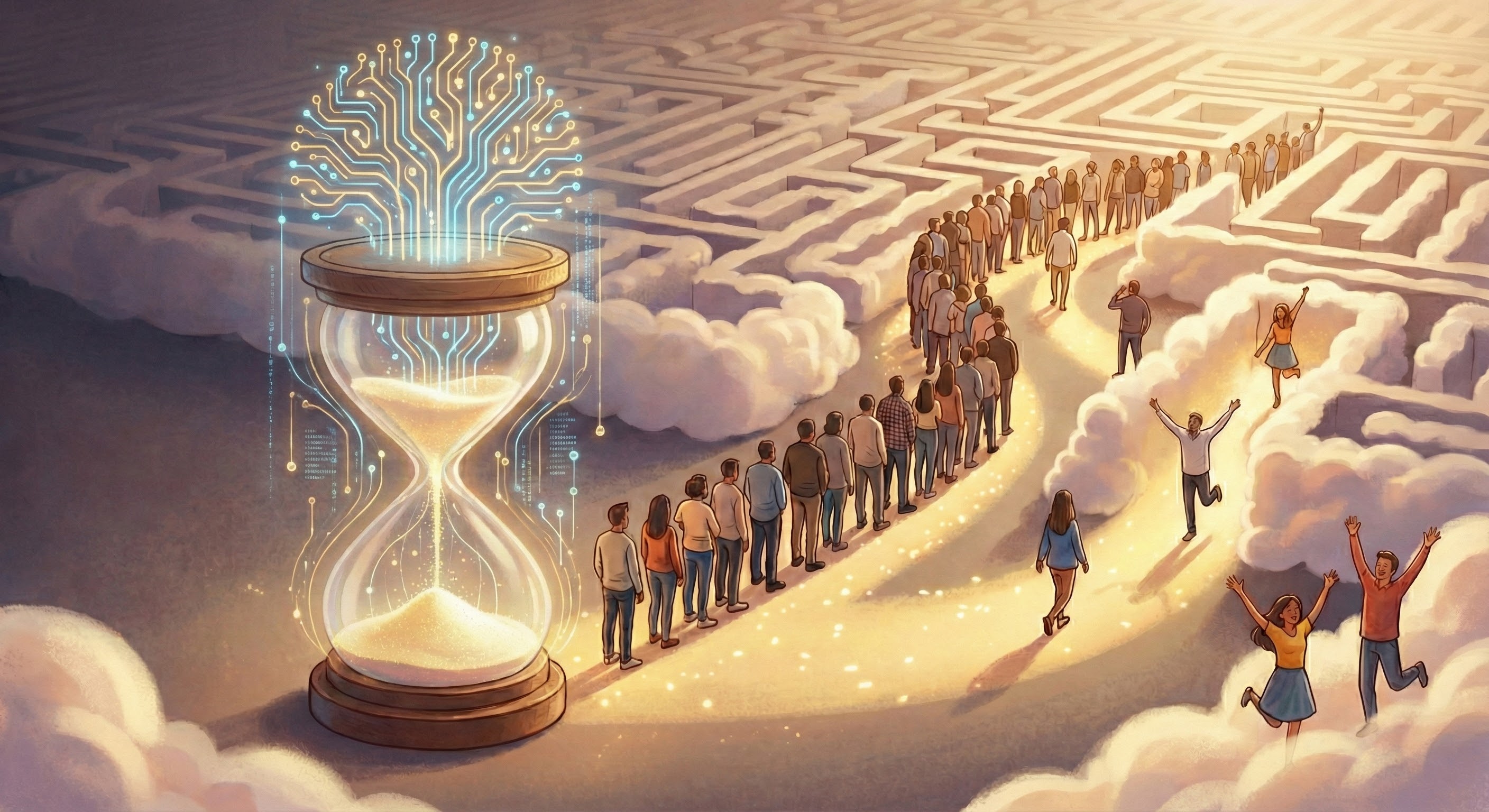
Sungsimdang Strawberry Siru sold not cake but 'time of acquisition'.
Kurly Festa sold not shopping but 'the scene of taste' as a ticket.
And companies in the AI era will ultimately survive by redesigning how they give back customers' time.
Technology will automate more and more.
But ironically, the more it does,
“a feeling of being truly comfortable”, “a feeling of being truly understood”, “a feeling of being truly faster”
People will look for more strongly.
AI is the most powerful tool for creating that sense.
The problem is not the tool, but with that toolwhat lines to eliminate, what certainty to create, and what stories to leave behindThat is.
Start with one question.
In our company, what are people queuing up for every day?