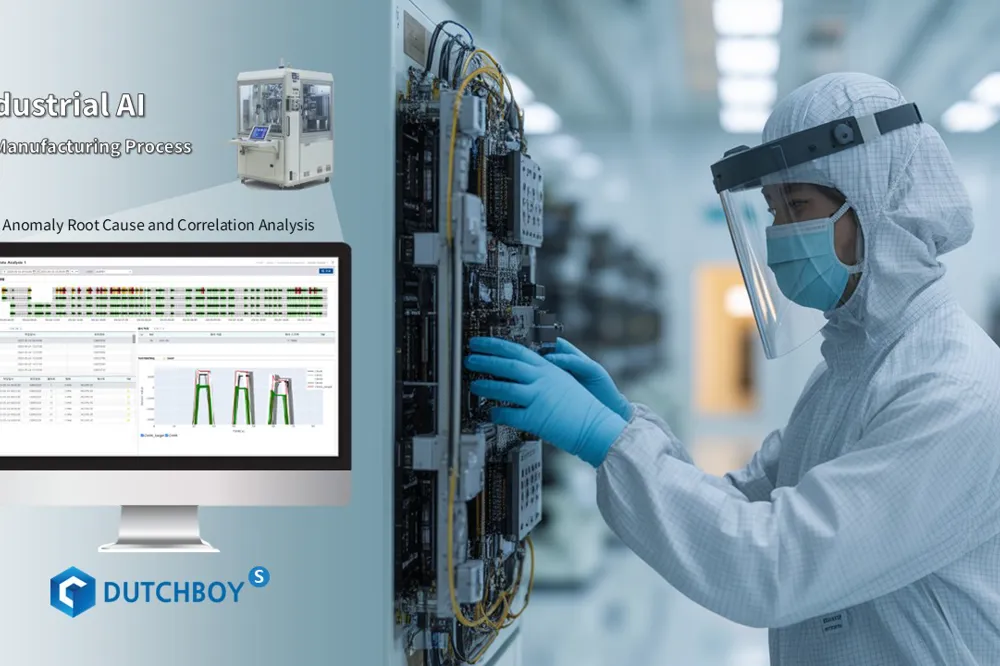
A real-time AI diagnostic platform directly attached to semiconductor manufacturing equipment (etching equipment). It analyzes approximately 200 sensor data points generated during the process using deep learning to automatically detect anomalies and suggest causes of defects, thereby supporting improved semiconductor yield and minimized equipment downtime.
HonoreekoArtificial Intelligence온-디바이스 AI반도체 식각 장비엣지 컴퓨팅AI 플랫폼실시간 최적화수율 향상
DutchBoy S : 반도체 식각 장비 온-디바이스 AI 플랫폼
166
0
AIBIZ Co., Ltd.
One-Line Product Definition
Problem Definition
Complexity and Defects in Semiconductor Processes: State-of-the-art semiconductor manufacturing consists of hundreds of process steps and numerous pieces of equipment, each equipped with hundreds of sensors measuring temperature, pressure, plasma state, etc. Even minor anomalies can cause defects in wafers, directly leading to yield reduction.
However, traditionally, identifying these process anomalies has relied on experienced engineers interpreting vast sensor logs. Due to human limitations, delays in detecting subtle patterns of anomalies and misestimation of defect causes occur, resulting in defective losses and line downtime issues.
Data Explosion and Real-Time Response Challenges: Semiconductor equipment sensor data accumulates at hundreds of points per second, becoming big data that is difficult to analyze in real-time for each piece of equipment. When yield problems occur, data is searched retroactively, but by then, many wafers have already become defective.
Even if a sensor alarm goes off during the process, it is difficult to understand the context of which sensor value is the real problem. Incorrectly stopping the process leads to production disruptions. Therefore, accurate real-time anomaly judgment and root cause diagnosis are difficult, leading to prolonged equipment downtime or repeated occurrence of the same defect with unknown causes.
Reliance on Engineer Expertise: Relying on the empirical knowledge of a few experienced process engineers leads to a break in know-how during shift changes or new personnel replacements. Additionally, it is difficult for a person to track all sensor interrelationships, which can lead to mistakes such as adjusting the wrong process conditions based on incorrect guesses. These human factors have emerged as challenges to overcome in the Industry 4.0 era.
Key Differentiators
Equipment-Mounted On-Device AI Platform: DutchBoy S is a small server form factor that attaches to the side of semiconductor etching equipment, characterized by its real-time data interface with process equipment. It performs deep learning analysis immediately on-site without cloud transmission, providing anomaly detection, alarms, and dashboard visualization in milliseconds. This on-device AI architecture allows on-site engineers to quickly understand and respond to abnormal situations without network delays.
Deep Learning-Based Correlation Analysis: AI based on process mechanism modeling comprehensively analyzes hundreds of sensor data points, identifying multi-dimensional correlations that are easily missed by human engineers. For example, it learns patterns that appear due to subtle combinations of changes in temperature, pressure, RF power, etc., and infers relationships such as "simultaneous fluctuation of X sensor and Y sensor → occurrence of a specific defect." This enables much more accurate anomaly detection than existing rule-based anomaly detection (which only alerts when thresholds are exceeded).
Automatic Defect Cause Diagnosis: In the past, when defects occurred on wafers, engineers had to search through various logs to trace the cause. DutchBoy S learns characteristic patterns for each defect type, and when an anomaly is detected, it presents potential cause sensors/process variables in order of priority.
For example, it informs "Subtle vibration of chamber pressure sensor #5 -> possibility of causing etching non-uniformity defect," helping engineers quickly find and address the problem area. It is like AI reproducing the intuition of a veteran engineer in real time.
Intuitive On-Site Dashboard: Analysis results are visualized in real-time on a dashboard screen installed on-site. Multi-dimensional sensor correlation graphs, anomaly occurrence times, and expected defect types are displayed in an easy-to-understand manner, and warnings are immediately displayed on-site when anomalies occur.
This visual feedback greatly helps engineers quickly understand and respond to problem situations. It significantly increases the speed of decision-making compared to the traditional method of humans interpreting text logs or complex graphs, reducing equipment downtime.
Application Scalability and Learning Improvement: The DutchBoy S platform is designed to be scalable to various process equipment such as deposition and lithography in addition to semiconductor etching. Even if the number or type of sensors changes, it can be addressed by training modular AI models.
In addition, the AI model iscontinuously learningwith data accumulated during use, optimizing it for a specific fab (factory) or recipe. Its superior accuracy and insight over time compared to humans is a key advantage. This feature means that it can be customized and applied not only to semiconductors but also to continuous process industries such as secondary batteries and petrochemicals.
Key Adopters
Semiconductor Manufacturers (Fabs, B2B): Major wafer fabs such as Samsung Electronics and TSMC, foundry companies such as DB HiTek, or memory manufacturing lines such as SK Hynix are key customers. Even a 0.1% improvement in yield can result in tens of billions in profit differences, so they are likely to be proactive in adopting solutions like DutchBoy S. It is already known that PoC (proof of concept) is in progress with some Korean material/equipment partners.
Semiconductor Equipment Manufacturers (B2B Partnerships): Equipment companies such as TEL and Lam Research, which manufacture etching equipment, may bundle this AI platform as added value to their equipment. In fact, AIBIZ is expanding its technology to the oil refining industry in partnership with LG CNS, etc., and is expected to seek OEM partnerships with semiconductor equipment companies. For equipment companies, incorporating this AI diagnostic function will be a differentiating point for customers.
Other Advanced Manufacturing Plants: AIBIZ is already applying solutions to battery factories, solar panel lines, etc., so secondary battery manufacturers and display panel companies will be secondary demand. However, since the DutchBoy S product name itself is customized for semiconductor etching, semiconductor industry customers are the main focus here.
Scalability
Expansion to Various Manufacturing Processes: The DutchBoy platform is already expanding its application areas to the battery, solar, and oil refining industries. Since the essence of sensor signal interpretation is the same, it can grow into an anomaly detection solution for the entire industry by retraining models for each type of equipment. In particular, if it successfully completes PoC for domestic large enterprise manufacturing lines and secures global references, it can also enter the overseas smart factory market.
Potential to Remain a Niche: On the other hand, it is expected to be mainly used in industries where yield improvement is of great value in ultra-precision processes such as semiconductors. In general manufacturing (e.g., general electronic component assembly, etc.), there are not many sensors and quality problems are relatively simple, so there is little need to use such advanced AI. Therefore, this product is expected to focus on a specific niche of high value-added advanced manufacturing. However, the market size within that field is sufficiently large (considering the number of advanced semiconductor/battery factories worldwide) at hundreds of billions of won.
Technology and Human Resource Expansion: Initial customization costs may be incurred due to different process conditions for each customer, but AIBIZ is responding to this with accumulated domain datasets and expert personnel. In the future, if more process knowledge is accumulated, productization and standardization will become possible, making scale-up easier. It is currently known as an organization with less than 50 people, and in order to expand business rapidly, it is necessary to recruit professional personnel and attract investment in parallel.
Overseas Market Entry: Semiconductor factories are distributed in the Americas, East Asia, etc., and are conservative industries, so building local trust is important to enter overseas fabs. Global promotion has begun, such as going to overseas stages such as TechCrunch Disrupt with KOTRA or government support. If we make a name for ourselves as "Made in Korea" process AI through these efforts and secure overseas references in cooperation with local partners (e.g., equipment companies), scalability will be greatly increased.
Judges' Evaluation
Recognition of Innovation as Industrial AI: Selected as a CES 2026 Artificial Intelligence Honoree, it was evaluated as "an excellent example of AI utilization specialized for manufacturing sites." Tech media outlets introduced DutchBoy S and praised it as *"a solution that will increase productivity by applying AI to areas that used to rely on human hands, such as semiconductors."* Business Wire and others cited AIBIZ as a Korean startup at TechCrunch Disrupt 2024 and introduced DutchBoy as a *"real-time anomaly detection and root cause tracking AI platform."*
Interest in Empirical Data: Industry experts agree on the need for the concept, but pay attention to actual performance data. According to AIBIZ, some manufacturing lines have seen results such as a 70% reduction in defect detection time and a 2%p improvement in yield after the introduction of DutchBoy (confidential PoC results). As these specific indicators accumulate, market confidence is expected to increase further. An official from the initial introduction factory said that they were satisfied, saying that it was *"the effect of always having one experienced engineer attached,"* and it is known that the on-site evaluation is also favorable.
Completeness and Development Status: The product has already undergone Fab field testing and is in the stabilization stage, and a demo was also presented at the CES main exhibition. However, some evaluations say that "it is still at the level of an engineer assistance tool, and does not have complete automatic control." In other words, AI detects and informs anomalies, but it does not adjust the equipment itself, so caution is advised against over-packaging the fact that the final judgment is up to the person.
On the other hand,"a new era of data-driven decision making"is the mainstream positive view, and there are many voices of encouragement that Korean B2B AI solutions have been recognized on the global stage.
Analyst Insights
📌 Solution Limited to a Specific Niche: This product accurately targets a narrow but critical problem of quality and yield management in advanced manufacturing lines. Although it is far from general consumers, it has high potential to become an essential tool for high value-added industries such as semiconductors/batteries. It is a solution for a small number of process experts rather than the general public, and is expected to create high business value in the niche market.
The award list data is based on the official CES 2026 website, and detailed analysis content is produced by USLab.ai. For content modification requests or inquiries, please contact [email protected]. Free to use with source attribution (USLab.ai) (CC BY)
댓글 (0)
댓글을 불러오는 중...