An AI autonomous robot companion to replace guide dogs for the visually impaired – provides safe route guidance by recognizing the surrounding environment in real time.
HonoreekoArtificial Intelligence인공지능자율 주행보행 보조시각 장애인센서 융합GPS
베디베어: 시각 장애인을 위한 “TRUE” 자율 주행 도우미
170
0
AidALL Inc.
One-Line Product Definition
Problem Definition
For the 300 million visually impaired people worldwide, independent mobility in daily life is a significant challenge. They must rely on white canes or guide dogs, but white canes can only detect obstacles immediately ahead, and guide dogs involve high training costs and care burdens.
Technologies such as GPS-based apps also have limitations indoors, and the lack of accurate real-time guidance in complex urban environments poses risks. Existing assistive devices have limitations in preventing collisions and recognizing environments such as stairs, which do not fully guarantee the independent right to mobility for the visually impaired.
Key Differentiators
Onboard AI Vision: The robot's own AI performs real-time surrounding environment recognition and route planning without relying on the cloud or GPS, ensuring reliability even in offline environments. This is superior to existing smart navigation devices in that it operates even in GPS dead zones or communication outages.
Neuromorphic AI Architecture: The self-developed Self-Referenced Control (SRC) technology, corresponding to an artificial cerebellum, is innovative in that it implements low-power, real-time response. It solves the classical latency and power consumption problems of large-scale deep learning models, enabling immediate obstacle avoidance and route correction.
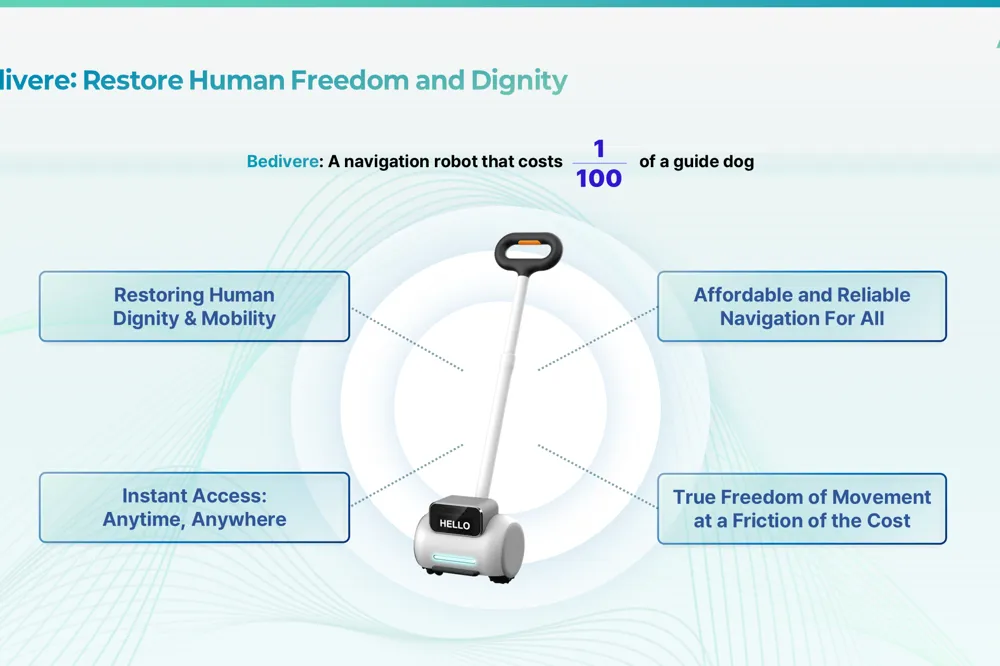
Guide Dog Alternative: Bedivere is a practical alternative to guide dogs, which require high costs and long training periods, in that it requires no training, has low maintenance costs, and can be used immediately at any time. In addition, it is lightweight and easy to operate, so anyone can use it right away.
Multi-Sensor Fusion: By fusing various sensor data such as cameras and LiDAR, it recognizes indoor and outdoor obstacles, terrain, and signals in three dimensions. For example, it generates and guides real-time safe routes even on crowded sidewalks or in complex indoor environments.
Key Adopters
Visually impaired individuals (B2C) – For daily walking and outings
Welfare organizations and government (B2G) – Distribution through support centers for the visually impaired and local government welfare projects
Special education institutions – Support for visually impaired students' movement within the campus
Organizations related to the visually impaired such as Siloam – Use of rental/support programs for members
Scalability
This is a field with very high global demand. There is a wide range of potential users worldwide, and it can be applied in any country due to the low language barrier. However, regulations on sidewalk traffic in each country as an autonomous robot should be considered.
Currently, it is specialized in assisting the mobility of the visually impaired, but the technology can be expanded to other autonomous robot fields such as walking assistance for the elderly and logistics robots. Real-time environment recognition and autonomous control technology can be applied to service robots in general.
Having been recognized for its social value by winning the CES Innovation Award in the Human Security for All (HS4A) category, there is also room for growth through government or NGO support projects.
Judges' Evaluation
Winning Innovation Awards in two categories (AI and HS4A) at CES simultaneously has attracted attention and has been evaluated as "having both technological innovation and solving universal human problems." Visitors who experienced it on-site said, "Guidance accuracy at the level of a guide dog," "Very intuitive operation"were well-received (Source: On-site interview).
The level of technological completeness is high, such as the application of its own neuromorphic chip, but continuous testing is needed for durability in real urban environments and response to exceptional situations. However, the prototype demonstration showed smooth real-time obstacle avoidance and route guidance, and the reaction was that the level of completion was better than expected.
From a market perspective, the social value is high, so there is a high possibility of government support, and the reaction from actual users is also positive. However, price accessibility and the establishment of a post-sales support network are pointed out as challenges. Overall, innovation is very high, but as it is the early stages of commercialization, the atmosphere is to wait and see whether it will settle in the market.
Analyst Insights
⚠️ The technology is groundbreaking, but the commercial success as an assistive technology device is in the market verification stage
The award list data is based on the official CES 2026 website, and detailed analysis content is produced by USLab.ai. For content modification requests or inquiries, please contact [email protected]. Free to use with source attribution (USLab.ai) (CC BY)
댓글 (0)
댓글을 불러오는 중...