The world's first sound-based invisible touch technology featuring a surface friction sound-based invisible touch interface that transforms everyday object surfaces like desks and walls into control panels using only finger gestures.
Best of InnovationkoSmart Communities비접촉 인터페이스IoT5GAI사용자 경험(UX)스마트 제어
SWAVI Invisible Touch Controller
115
0
COMMONLINK Inc.
One-Line Product Definition
Problem Definition
Current device operation relies on visible interfaces like buttons and touchscreens. This limits device aesthetics, exposed buttons are susceptible to wear and contamination, and fingerprints pose security vulnerabilities.
For example, in smart homes, switches must be installed on every wall, and in medical and industrial settings, operation with gloved hands is difficult or raises hygiene concerns. Voice recognition is also limited due to privacy and noise issues.
In other words, there has been a demand for hidden input methods that appear only when needed, but implementation has been difficult. In particular, there is a lack of technology that can accurately recognize input while using ordinary surfaces as they are.
SWAVI, against this backdrop,"Let's input from anywhere with an invisible UI."was developed with the problem in mind to solve the space and design constraints, durability, and security issues of existing methods.
Key Differentiators
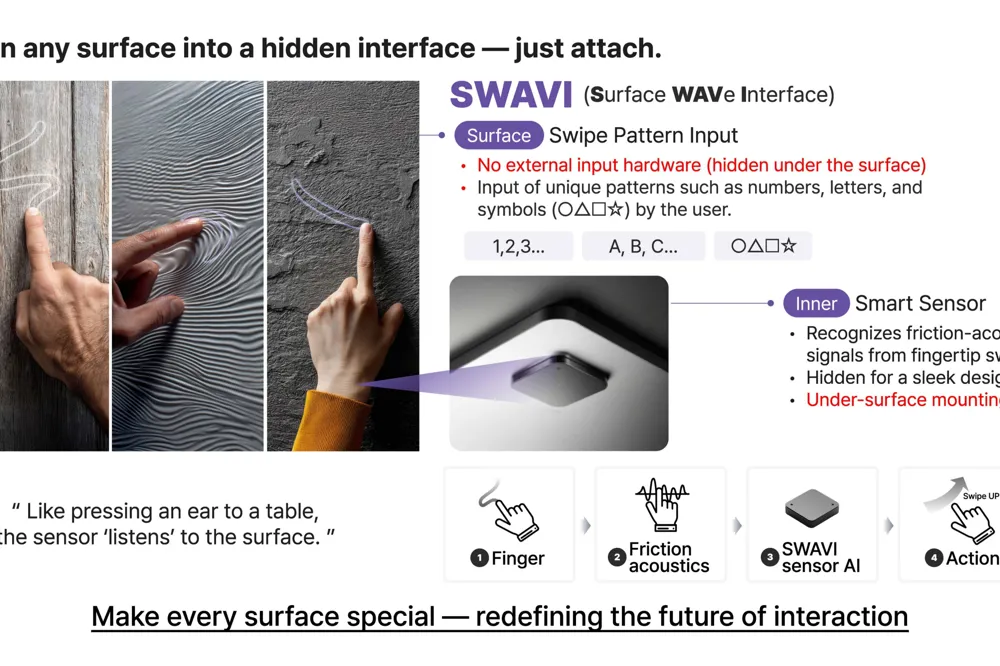
SWAVI is a unique technology that recognizes letter or symbol input by sensing the friction sound of a finger brushing against a surface with a sensor. By attaching a single sensor to an ordinary desk or wall, the entire surface is transformed into a discreet touchpad, allowing users to draw desired patterns on the surface without the need for a separate screen or buttons.
In particular, it is highly secure because no traces remain after input, and it is clearly distinguished from existing touchscreens/keypads in that it is hidden under the surface and has no physical wear. In addition, since it operates with a sensor + AI, it can be executed with just a smartphone browser, providing the convenience of immediate use without app installation or login.
Competing technologies include ultrasonic sensors or camera gesture recognition, but SWAVI operates without interference from light or line of sight because it is based on friction sound, and it is also energy efficient.
As a result, SWAVI can turn any material surface into an interface and is resistant to moisture and external exposure, providing practical differentiation that can be used indoors and outdoors. It is an abbreviation for COMMONLINK's proprietary Surface WAVe Interface and is a technology that is challenging commercialization for the first time in the world in Korea.
Key Benefits
This technology is expected to be sold in the form of a B2B embedded solution. Manufacturers that need hidden controls in smart homes or car interiors are the main customers.
For example, premium home appliance companies can adopt SWAVI sensors to add input functions without compromising the product's surface design, and automobiles can provide touch operation while keeping the dashboard or center console sleek. It can also be introduced in cases where button exposure needs to be minimized, such as security keypads (financial terminals, etc.) or military equipment.
Initially, COMMONLINK supplies sensors in B2B2C, and this technology is installed in finished products and goes to consumers. In the future, it may also be sold as a B2B solution package such as smart office desks or IoT switch panels.
The final cost is paid by the company, but the benefits go to the user (individual/driver, etc.).
Scalability
The SWAVI sensor's expansion hinges on the difficulty of product integration rather than specific national regulations. It is known as a small piezo-based sensor, so it is necessary to tune it to fit various sizes/materials of surfaces.
However, conceptually, almost all flat surfaces (desks, windows, appliance exteriors, etc.) are targets, so the market size is extensive. In particular, it can appeal to home appliance powerhouses such as Korea and Japan, and the German automotive industry in line with the smart home/smart car trend, and since the technology has already been matured with support from domestic institutions, there is also the possibility of overseas expansion.
However, since it must be integrated into the product design of individual companies, collaboration with top-tier companies in each industry is essential, which may take time. In terms of regulations, there are few separate certification issues because it is acoustic vibration rather than using radio waves.
In summary, the idea is universal and can have ripple effects in various industries, but actual commercialization requires time and effort, such as customization for each use and a shift in market perception.
Judges' Evaluation
The CES judging panel evaluated SWAVI as *
Regarding the technology demo, it was reported that the precision of friction sound recognition and the low false recognition rate were impressive, and it became a hot topic as a screenless UI along with "AR without a headset."
However, in terms of completeness, there were also indications that additional verification was needed for "recognition rate in noisy environments" and "simultaneous use by multiple users." The market expectation is that there is a niche but definite demand.
Smart home experts praised it as a technology that fits the trend of minimalist design, while conservative consumers also expressed doubts about "whether they would trust an invisible interface."
Overall, the novelty of the technology concept is highly evaluated, but opinions are divided on the user experience after commercialization.
Analyst Insights
⚠️ Impressive technology but market uncertainty (innovative technology in terms of design and security, but market success remains to be seen due to many variables in industry adoption and consumer acceptance)
The award list data is based on the official CES 2026 website, and detailed analysis content is produced by USLab.ai. For content modification requests or inquiries, please contact [email protected]. Free to use with source attribution (USLab.ai) (CC BY)
댓글 (0)
댓글을 불러오는 중...