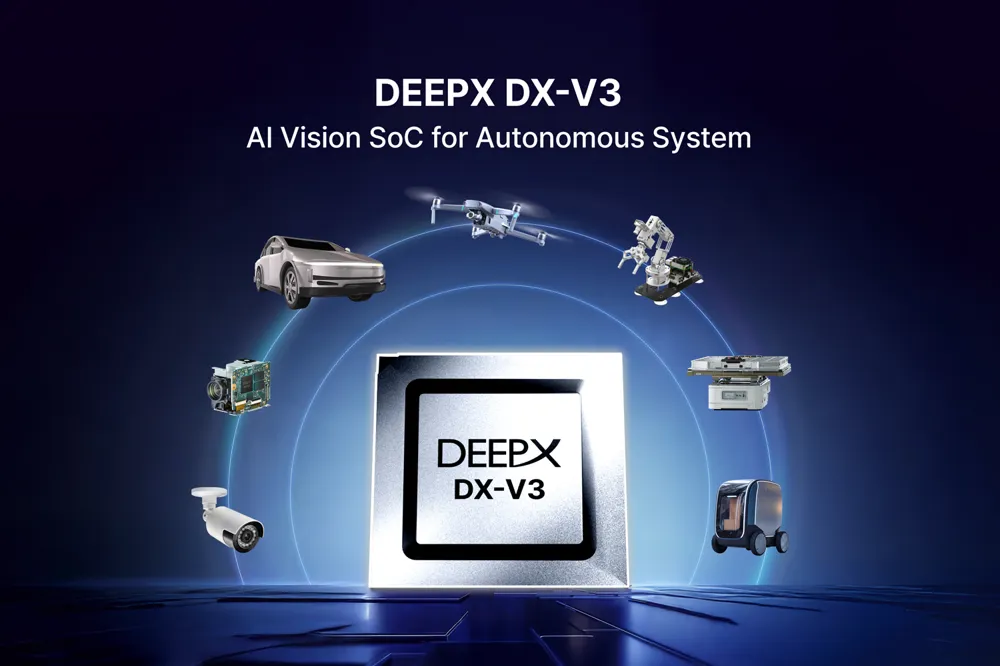
Ultra-low power vision AI SoC (System-on-Chip). Integrates 13TOPS AI computation, 12-channel camera input processing, and sensor fusion functions into a single chip, operating at 5W power consumption. It enables robots and autonomous driving devices to perform real-time 360° recognition and judgment without cloud connection, serving as the brain of edge autonomous systems.
HonoreekoComputer Hardware & ComponentsAI Vision SoC엣지 컴퓨팅실시간 인식저전력 설계자율 시스템센서 융합
DX-V3
60
0
DEEPX
One-Line Product Definition
Problem Definition
Limitations of Edge Autonomous Devices: Autonomous driving robots and smart cars are equipped with multiple cameras and sensors to recognize the surrounding environment. However, the computing power of AI chips that can be mounted in the device is limited, so they can barely process images from 2 to 4 cameras, or they have to rely on the cloud for more data. This poses a risk in the event of communication delays or disconnections, making real-time response difficult.
Power and Space Constraints: Battery-powered devices such as mobile robots and drones have limited power. To perform high-level computations, GPUs or FPGAs had to be used, which consumed tens of Watts and generated a lot of heat, causing battery drain and heat dissipation problems. In addition, the size and weight put a burden on the device, acting as a barrier to increasing the number of mounted sensors/computations. As a result, the improvement of robot's cognitive ability has been slow due to power/weight issues.
Complex System Configuration: Since functions such as sensor image processing, AI inference, and location estimation are implemented on separate chips and boards, there are problems with an increase in the number of parts and integration difficulty. Communication delays between multiple parts can also occur, leading to data synchronization errors. Small and medium-sized robot companies are experiencing difficulties in designing such system architectures, resulting in increased development costs.
Customer Experience and Safety Issues: If edge recognition is insufficient, obstacle detection is delayed, causing the robot to collide, or it moves too conservatively, reducing work efficiency. From the user's perspective,"It's supposed to be autonomous, but it's frustrating."This has become a factor that makes them feel uneasy or anxious. Without sufficient camera visibility and quick recognition, it is difficult for self-driving cars to cope with unexpected situations, increasing the risk of accidents.
Key Differentiators
Industry's Highest Level of Computation/Camera Integration: The DX-V3 SoC implements 13 TOPS of AI inference performance and simultaneous input of up to 12 cameras on a single chip. Existing edge SoCs typically only supported around 2~4 TOPS and 4 cameras, but the DX-V3 provides 4~6 times the performance and 3 times more sensor input expansion for the same power consumption. This allows robots or vehicles to perform all-around (360°) situation awareness with low power consumption, and enables them to understand the surrounding environment without blind spots.
Ultra-Low Power Design (Around 5W): Compared to competing chips with similar performance that consume 15~30W, the DX-V3 operates at approximately 5W, significantly reducing the battery burden. This is made possible by DEEPX's high-efficiency NPU architecture and chip design optimization, which allows it to operate without a fan or active cooling, making it easy to embed in small devices. 5W is equivalent to the power of a smartphone SoC, so heat problems are negligible and it can be installed in enclosed robots.
All-in-One Function (Vision + Sensor Fusion + Control): In addition to the AI computation core, it also incorporates video signal processing (ISP), IMU, and other sensor data fusion engines to perform integrated sensor data processing without the help of an external microcontroller. For example, camera images and LiDAR/Radar sensor information are time-synchronized and combined inside the chip, and location/map information is generated along with object recognition results. When multiple functions are processed simultaneously on one chip like this, delays and errors are reduced, and the overall system configuration becomes simpler and more robust. In other words, one DX-V3 replaces what 2~3 chips used to do, making robot design easier and reducing BOM costs.
Immediate Autonomous Response Capability: Since high performance is used locally, robots/vehicles perform judgment and control based only on sensor information without cloud assistance. For example, when a sudden obstacle is detected, it is possible to classify and calculate an avoidance path within 0.01 seconds, improving the speed of response to emergency situations. In addition, it moves with its own judgment even if the network is disconnected, increasing safety and reliability. As such, the implementation of Edge Autonomy is the greatest value of DX-V3, which increases the availability and service quality of various autonomous driving devices.
Easy to Apply with Small Form Factor: The DX-V3 is provided in a BGA package of several tens of mm in size, so it can be mounted without space limitations from small devices such as drones to large industrial equipment. In addition, thanks to its power efficiency, PCB wiring and power supply design are simple, allowing developers to quickly commercialize products. For example, a delivery robot company can use this chip to relatively easily implement the function of attaching 8 cameras to the robot's head and recognizing people/objects 360 degrees. This ease of application is of great help to startups and SMEs in implementing advanced AI on their own.
Key Adopters
Service Robot Developers (B2B): Companies that make indoor delivery robots, security robots, and guide robots are the main customers. They are sensitive to battery resources and BOM costs, so they have no choice but to want the DX-V3, which secures performance without using GPUs or multiple chips. For example, if a warehouse robot startup in the United States or an indoor autonomous driving robot company in Korea adopts it, they can increase the performance and price competitiveness of their devices at the same time.
Future Mobility Companies (B2B): It can also be applied to vehicle-type platforms such as autonomous driving shuttles and industrial unmanned carts (AGV). Although automotive-grade safety certifications (such as ASIL) are future tasks, it can be used immediately for low-speed autonomous driving carts. These companies can seek cost reduction with DX-V3 instead of expensive solutions such as NVIDIA Drive.
Smart Camera/IoT Device Manufacturers: Companies that develop edge AI cameras such as 360-degree CCTV or AIoT cameras are also targets. Since DX-V3 supports multi-camera/multi-modal processing, it can create products such as AI vision sensor hubs. In this market, Google Coral or Hailo chips are used, but DX-V3 has a performance advantage and can be an alternative.
Defense/Drone Sector: Military/industrial drone companies that want to mount multiple cameras and AI on small drones may also be interested. Previously, it was limited due to weight and power issues, but DX-V3 makes it possible to implement lightweight AI drones. However, this is a special case, and robot platform companies are expected to be the main customers in the early stages.
Scalability
Expansion to Edge AI in General: DX-V3 technology can be spread to all edge devices that require real-time multi-sensor AI, such as AR/VR devices and smart factory equipment, in addition to robots. According to DEEPX's announcement, the strategy is to encompass everything from IoT to vehicles under the "Physical AI" vision, and DX-V3 was released as the core of that lineup. Based on this, if demand is confirmed,higher-level models (DX-V4, etc.)orlower-level models (DX-V2)can also be expanded to broaden market coverage.
Ecosystem Construction: The developer ecosystem is important for the success of SoC, and DEEPX is providing SDK and toolchain, reference boards, etc. to secure customers. If DX-V3 is installed on a famous robot platform (e.g., major ROS-based robots), it can spread quickly to related companies. It is currently known that PoCs are in progress with major domestic companies (Hyundai Robotics, etc.), and scale-up will be accelerated when one or two anchor references are secured.
Competition and Differentiation: There are strong players in the market such as NVIDIA Jetson Orin and Qualcomm RB5, so it will be difficult if DX-V3 cannot differentiate itself with performance/efficiency advantages. Fortunately, the currently released figures show superior power efficiency compared to the same class, giving it a competitive advantage. However, software support and customer support network may be weaknesses as it is a startup, so this needs to be supplemented. For example, a strategy of providing reference designs in collaboration with global partners (US AV companies, etc.) is required.
Market Demand Aspect: Edge AI demand continues to grow due to the autonomous driving boom, and the demand for power optimization is also increasing. Reducing robot power consumption is also being highlighted in terms of ESG management, so there is good reason to adopt chips like DX-V3. However, if the macro economy slows down and investment in robot companies shrinks, the increase in demand may temporarily stall. However, the direction of technological development is clearly"more sensors, lower power",so the mid- to long-term scalability can be considered high.
Judges' Evaluation
Acclaim at CES: DX-V3 won the CES 2026 Computer Hardware & Components Innovation Award, contributing to DEEPX's achievement of winning two awards. The judges commented that it "transplanted cloud-level AI capabilities to edge devices," and DEEPX set a record of winning consecutive CES Innovation Awards. Tech media also introduced DX-V3 as *"a chip that further evolved the brain of robots"*, and it is virtually regarded as a Jetson rival.
Expert Opinion: A semiconductor industry expert gave meaning, saying, *"DEEPX has finally released an SoC-level solution."* While the previous DX-M1 was an independent NPU, the DX-V3 has increased its marketability by integrating peripheral circuits. Robotics engineers paid attention to the 12-channel input and low latency,welcoming it, saying, "The robot's ability to understand the environment will be dramatically improved."In particular, an autonomous driving startup official expressed interest, saying, "It is a chip that is close to the requirements we had in mind."
Future Outlook: Some IT media are highlighting DEEPX with the title *"Korean startup challenging NVIDIA's dominance"*, and are paying attention to whether DX-V3 will be a variable in the edge AI market landscape. Currently, since DEEPX is a startup, it is important to prove itself through actual customer cases rather than over-advertising. However, as partner collaboration results are already emerging, such as the Sixfab case, there is an atmosphere that the undervalued domestic AI chip technology is gradually being recognized. In general, the market and critics positively evaluate DX-V3 as"a powerful product that competes on performance",and are now hoping that it will be applied to actual robots and achieve results.
Analyst Insights
🔥 High Marketability / Business Connection Possible: It is a solution that will break through the performance limitations of edge autonomous devices with a low-power, high-performance chip. Coupled with the strong needs in the robot and mobility fields, if DEEPX secures appropriate partnerships, it has a high potential to become a hit product that will work in overseas markets as well. Although there is a risk in the company size compared to technological competitiveness, it is expected that it will lead to commercialization and business results if the current trend continues.
The award list data is based on the official CES 2026 website, and detailed analysis content is produced by USLab.ai. For content modification requests or inquiries, please contact [email protected]. Free to use with source attribution (USLab.ai) (CC BY)
댓글 (0)
댓글을 불러오는 중...