DX-H1 V-NPU
DEEPX
DX-H1 V-NPU (DEEPX)
Basic Information
Company Name: DEEPX
Company Website: (Not in DB)
Korean Company: Global (DB: is_korean_company = false)
Original CES Link:https://www.ces.tech/ces-innovation-awards/2026/dx-h1-v-npu/
One-Line Product Definition: DX-H1 V-NPU
Problem Definition
High computational burden of video surveillance: Real-time analysis of thousands of CCTV cameras in large buildings or cities requires dozens to hundreds of GPUs and consumes more than several kW of power. For example, recognizing objects in video from 1000 cameras requires more than 40 GPUs, consuming about 9.2kW of power, which is only possible with the infrastructure of a large enterprise data center. Small and medium-sized businesses or institutions with small budgets could not afford to adopt such AI, and still rely on human hands for CCTV monitoring.
Energy costs and heat generation: Cooling facilities are needed to cool the heat emitted by dozens of GPUs, and electricity bills are also considerable. Many companies are worried, saying, **"We can't afford the power budget if we put in AI analysis."** In addition, there are infrastructure capacity issues such as power grids and UPS, making AI expansion difficult without expanding the computer room. From a sustainability perspective, operating a large number of GPUs is also cited as a factor in increasing carbon emissions.
Limited access to video analysis: Currently, video AI is mainly built by large smart cities or public institutions, and is difficult for general companies and stores to access. For example, even if a mid-sized manufacturer wants to add AI anomaly detection to factory CCTV, they cannot afford it due to the cost of configuring a dedicated server and the lack of specialized personnel. The AI technology gap is widening the digital divide between large companies/institutions and general businesses.
Limitations in the use of video data: Even those with GPU farms compromise by analyzing only some important cameras or intermittent analysis due to cost. This prevents them from fully utilizing the vast amount of CCTV data, missing opportunities for security incident prevention, customer analysis, and more. In addition, even if they build it, the operating costs are high, making it difficult to maintain for a long period of time.
Key Differentiators
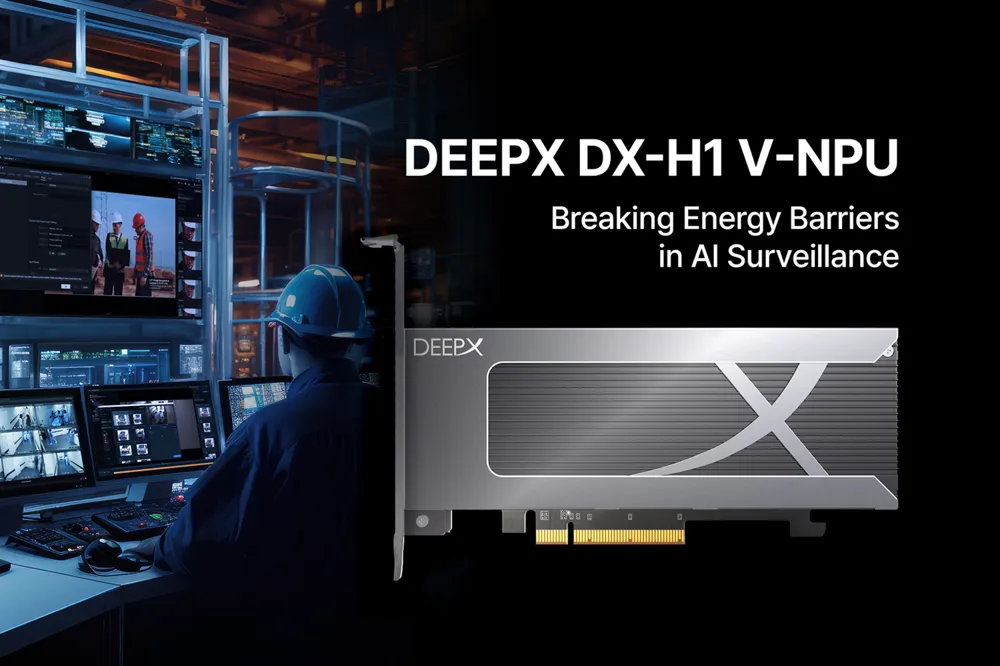
More than 90% power saving for the same throughput: The DX-H1 V-NPU card delivers 16 TOPS of AI inference performance (estimated) per card, while consuming very little power, at3035W. In fact, it performed 1000-channel video analysis with **16 V-NPUs (560W)**, which previously required **40 GPUs (9200W)**, reducing system power by more than 90%. This means that the same task was processed with 1/16 of the hardware, significantly reducing electricity and equipment costs, and can be run in a small server chassis. It is considered a game changer, with some saying, **"Now even mid-sized companies can have AI CCTV."
Scale affordable even for mid-sized organizations: Thanks to its high efficiency, AI video analysis servers can be built without a dedicated data center. For example, what used to require multiple large server racks and tens of kVA of power can now be handled by 1-2 PC servers. This small form factor/low power consumption means it can be installed and operated in general offices and stores. In other words, it enables the expansion of AI video solutions.
Built-in advanced features such as natural language video search: In addition to simple object detection, it supports NLV (Natural Language Video Search) functions such as "Find someone wearing a red shirt." This is a technology that runs multiple AI models on the V-NPU to quickly find the target that a person wants, allowing operators to effectively utilize video data. For example, in the event of an incident, it implements high-difficulty functions that were only possible with GPUs at low power, such as querying a specific person/vehicle from a video DB in text. This high-density AI processing capability is a differentiating point compared to competing solutions.
Economical and eco-friendly alternative to GPUs: V-NPU helps implement eco-friendly video AI by significantly reducing carbon emissions and operating costs per task. The high power efficiency reduces heat generation and saves on cooling costs, and the price per card is expected to be lower than that of GPUs. Therefore, from a company's perspective, the **ROI (Return On Investment)** is improved, which increases the incentive to implement video AI investments that they have hesitated to make. This is why it is being called "a catalyst for the popularization of AI CCTV."
Strengths of technical implementation: DEEPX's NPU achieves high efficiency with its own neural network acceleration technology, such as sparse operation optimization. In addition, by integrating video codec decoding/encoding acceleration, one card handles end-to-end processing from video stream input to inference and result re-encoding. This enables complete VMS (Video Management System) integration without additional CPU load. If physical security system companies adopt this card, the system configuration is simple and stable.
Key Buyers
Physical security system integrators (B2B): Security companies that install/operate CCTV can purchase this card and include it in their own solutions. For example, S1, ADT Caps, etc. provide video AI analysis services to customers, and may prefer this equipment because it is cheaper and consumes less electricity than existing GPU servers. Global IT distributors such as Macnica are also reportedly paying attention to this product.
Smart city/public safety net (B2G): There is a great demand for mass CCTV AI analysis in the public sector, such as urban control centers and traffic management. Since power consumption leads to a tax burden, the highly efficient V-NPU is attractive. In particular, it is a realistically feasible solution for local governments with insufficient power infrastructure or educational institutions with limited budgets.
Small and medium-sized private companies (B2B): Large mart chains, factories, etc. can also consider it for their own security/analysis purposes. For example, AI anomaly detection can be introduced with only one DX-H1 in a factory with 100 CCTV cameras where a GPU server is excessive. In the area of retail store analysis (identifying customer traffic patterns, etc.), they may be interested in analyzing data from each store with an inexpensive AI server.
Data center/cloud operators: Even when providing Video Analytics services in the cloud, V-NPU can be selected as equipment due to its power/cost advantages compared to GPUs. However, since it is currently positioned as an edge device, sales are expected to focus on on-site construction.
Scalability
Expansion to various video AI markets: Currently, the main target is fixed CCTV analysis, but the technology itself can be applied to video inference in general. In the future, it can be expanded to vehicle DVRs, drone/robot camera stream analysis, etc. DEEPX is already targeting various Edge AI markets such as logistics robots and home appliances, so V-NPU also has the potential to expand its application areas.
Entry into the global market: Video security demand is high worldwide, so there is high overseas marketability. DEEPX has gained international recognition by winning the CES Innovation Award, and is attracting attention at security exhibitions in the United States and Europe. Overseas supply is possible if various safety/standard certifications such as the US UL certification are secured, and it is already known that a sales agency contract in the Americas is being pursued. It is expected to be particularly competitive in areas with poor power conditions such as the Middle East and Southeast Asia.
Limitations and challenges: Unlike the existing GPU ecosystem, software compatibility is important because dedicated SDK and model porting are required. DEEPX is investing in development convenience such as TensorRT-compatible conversion tools, but conservative customers tend to prefer proven NVIDIA solutions. Therefore, reference construction and partner collaboration are essential to overcome the barrier of *"good performance but unfamiliar"*. In addition, mass production supply capacity (TSMC consignment production, etc.) must be supported when product demand increases, and preparations for this must be made in parallel to avoid hindering expansion.
Judges' Evaluation
CES Innovation Award & Industry Response: DEEPX won the CES 2026 Innovation Award in the Embedded Technologies category with DX-H1, once again demonstrating its prominence in the AI chip field. In particular, it is evaluated that this product well demonstrates DEEPX's vision of **"physical AI infrastructure that extends AI to the physical world."** Officials from global distribution companies such as Macnica also congratulated the product's award, saying it was **"a good example of embedded technology innovation."**
Praise for performance/efficiency: Related articles quoted the figures of DX-H1 and praised it, saying that it *"consumes surprisingly little power for GPU-level performance."* It is a tempting news for demanders who have given up video AI due to power problems. In addition, there are expert opinions that "it has overcome hardware limitations" regarding the news of advanced function support such as natural language search. Media such as PCWorld also showed considerable interest when solutions equipped with this product were demonstrated during CES.
Market expectations and variables: Along with the expectation of **"driving the popularization of Edge AI,"** there is also mention of responses from large companies such as NVIDIA. NVIDIA is also strengthening its low-power edge chips (Jetson series, etc.), and it is pointed out that competition is expected to intensify if DEEPX does not speed up. However, as DEEPX has won the CES Innovation Award for three consecutive years, proving its technology, market confidence is increasing. Some say, "I was surprised that there is such a high-efficiency AI chip in Korea," and hope to build trust by disclosing more actual commercial project results.
Over/underestimated factors: In general, while acknowledging technical excellence, there is a realistic assessment that marketability depends on how many partnerships are secured. In other words, the company is small compared to the technology, and building a sales network is a challenge. However, judging from the fact that DEEPX chips have already been included in partner products such as Sixfab and won the Best of Innovation Award, the positive view that the ecosystem is also progressing smoothly is gaining strength.
Analyst Insights
🔥 High marketability / Business connection possible: As a solution that can solve the explosively increasing demand for video AI without power and cost barriers, it is attracting immediate attention in security/industrial sites. DEEPX's technology has already been verified and is entering the commercialization stage through partners, so it has high business potential to greatly expand the niche edge vision AI market.
The award list data is based on the official CES 2026 website, and detailed analysis content is produced by USLab.ai. For content modification requests or inquiries, please contact [email protected]. Free to use with source attribution (USLab.ai) (CC BY)