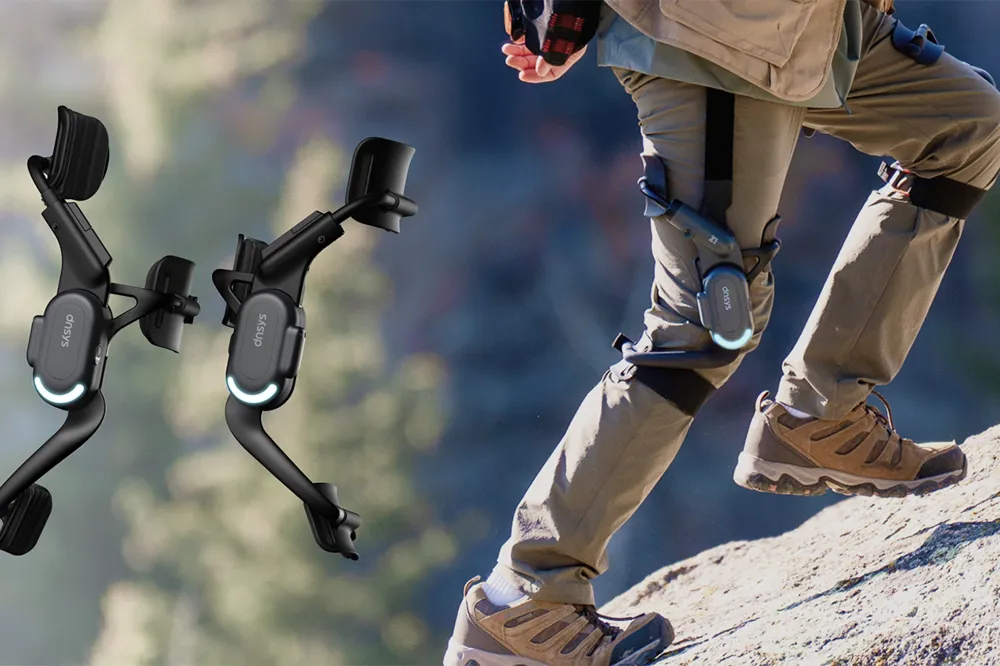
The world's lightest AI-powered knee-assisting exoskeleton. With two motor joints, it enhances leg strength by 50% during walking, reduces knee load by 150kg (twice the body weight), and provides 20kg of assistance when lifting heavy objects. This wearable robot helps protect knee joints and improve mobility in daily life and work environments.
HonoreeDigital Health로봇 기술듀얼 조인트HESS에너지 효율자동화지속 가능성
Dnsys Z1 듀얼 조인트
79
0
Dnsys Innovation Co., Ltd
One-Line Product Definition
Problem Definition
People with weakened knee strength and joint function due to aging or arthritis have difficulty climbing stairs or walking for extended periods, and in severe cases, their daily mobility is restricted. In industrial settings, repetitive handling of heavy objects increases the burden on the musculoskeletal system, leading to frequent worker injuries.
Traditionally, there have been manual aids such as canes and knee braces, or full-body exoskeletons (wearable robots) for rehabilitation. However, general exoskeletons are heavy and encase the entire waist and legs, making them difficult to wear daily, and they are extremely expensive, costing tens of thousands of dollars. Lightweight aids provide minimal support and do not adequately assist the elderly or workers.
In short, there was a lack of appropriate technology that is lightweight and provides meaningful power assistance for comfortable use in daily life. There were also very few assistive devices focused on the knee joint on the market, and even those available were limited in effectiveness due to their manual spring-based design.
Key Differentiators
Dnsys Z1 is the world's lightest knee-only wearable robot (weighing less than approximately 2kg on each side). Users can wear it all day long, as the total weight is only about 4kg even when attached to both legs. Through AI control, the built-in sensors analyze the user's walking speed, leg angle, and muscle load in real-time, and the motor instantly provides adaptive torque.
For example, when the user climbs stairs, the motor assists more than half of the force needed to lift the knees, and when lifting heavy objects, it assists up to 20kg of lifting force, greatly reducing the burden on the thighs and knees. When walking on flat ground, it supports up to 150kg of the body weight, making the knee joints feel comfortable as if the body weight has been halved.
This adaptive assistance smoothly transitions between preset modes (walking, climbing, lifting, etc.) and AI's automatic recognition. It also instantaneously increases torque depending on the situation to prevent injuries from leg twisting or slipping. The Z1 has a slim and ergonomic design that can be worn under clothing, and the cushioning pads improve comfort.
The batteries are replaceable and last for several hours on a single charge (up to 2-3 hours of continuous operation, supporting daily activities depending on usage patterns). Energy regenerative braking technology, which reduces the frequency of motor use, enhances efficiency. Dnsys has previously launched the X1 hip-assisting exoskeleton, selling over 10,000 units, giving them accumulated know-how in weight reduction and usability, which is also a strength.
In addition, the limited-edition "Death Stranding 2" design, in collaboration with the famous game company Kojima Prod., has garnered attention in the gaming community. This attempt to increase product awareness and public familiarity aims to reduce the aversion to exoskeletons. In summary, the Dnsys Z1 has pioneered a completely different horizon from existing competing products in that it is an exoskeleton that is affordable ($699), lightweight (around 2kg per unit), and highly effective (muscle strength +50%, load -50%) and user-centered.
Key Adopters
Individual consumers (B2C) with weak joint healthare important customers. For example, middle-aged and elderly people with knee arthritis or those who enjoy outdoor activities such as hiking but feel knee strain can purchase it at their own expense.
In addition, workers such as logistics center employees and construction site workers can wear it to protect their musculoskeletal systems, or their affiliated companies canpurchase in bulk (B2B) for industrial safety purposesand provide it to the field. In fact, Dnsys has sold its existing X1 product extensively in the Asian market forrecreational activities (hiking, cycling)and Z1 is also targeting trekking enthusiasts and elderly hikers.
There is also potential demand in the field of rehabilitation medicine. Hospitals can use Z1 instead of large rehabilitation robots for patient rehabilitation training, or patients can rent/wear it in the early stages of returning to daily life after surgery. In this case, it is possible to enter viainsurance/medical device routes (B2G/B2B)but currently it is being sold without medical certification by positioning it as ahealth aid device (wellness).
Having raised millions of dollars on crowdfunding platforms such as Kickstarter and secured global supporters, primary distribution is active in the form of D2C overseas direct purchases. In the future, offline expansion can be pursued through sports equipment distribution networks or assistive device retailers for the elderly.
In addition, the market base is expected to expand further as special sectors such as the military and police may consider adopting it to reduce the load burden on soldiers (B2G).
Scalability
Dnsys Z1 has the first-mover advantage as the world's first commercial knee-assisting exoskeleton. As the mobility aid market is rapidly growing due to the aging population, it can be spotlighted as a means to replace and supplement existing canes and electric scooters.
Considering the precedent of the X1 hip product selling over 10,000 units within one year of its launch, a sales volume of tens of thousands of units for Z1 seems like a realistic goal. The price is also less than 1/10 of that of existing exoskeletons ($699), making it highly accessible to consumers, and it has reduced prejudice by appealing to younger generations through game collaborations.
Technically, Dnsys was founded by engineers from DJI and Segway, giving it strengths in both hardware manufacturing capabilities and AI algorithms, and it has already built barriers to entry with over 20 patents. Of course, there are also challenges.
As it is a product in an unfamiliar category, consumer education and awareness improvement are necessary, and some raise the question, "Will people really wear this in everyday life?" Therefore, user reviews and word-of-mouth are important, and Dnsys is actively promoting through YouTube reviewers, SNS, etc.
Safety verification is also key. Although Z1 does not have medical device approval, it ensures safety based on numerous in-house tests and experience in developing CFDA (China Food and Drug Administration) medical-certified models. Regulations may vary by region, with certification issues for industrial workers wearing it, but there are no clear regulations for wearable robots yet, so there are no major obstacles to market entry.
Rather, several national governments are considering exoskeleton subsidies to reduce worker injuries, so the government procurement market may open up in the future. Overall, Dnsys Z1 is evaluated as a product that will usher in the era of personal wearable robots, and its market expansion potential is quite large. High sales growth is expected depending on future product lineup expansion (e.g., upper limb assistance) and securing international distribution partners.
Judges' Evaluation
Winning three awards at CES 2026 Innovation Awards (Digital Health, Robotics, and Sports categories), the Z1 knee exoskeleton has been recognized for its versatility. Media and industry experts call the Z1 "the strongest wearable assistive device available," and particularly praised the fact that it is the only exoskeleton that can be used by everyone from the elderly to workers.
Major global device review outlets have also rushed to publish experience reviews, with predominantly positive responses such as "I felt like a superhero in minutes" or "My knees felt lighter and I was able to run up the stairs." Actual wearing demos were also conducted at the CES exhibition booth, which received very positive responses from the field, and gaming and animation fans also commented, "Finally, a real-life power suit has arrived."
However, there are also cautious views. Some medical experts advised that "if overweight or arthritis patients use it for a long period of time,decreased reliance on muscle strength (muscle atrophy)should be noted," and among the general public, there were also opinions that "it remains to be seen whether the design is stylish enough for many people to wear under everyday clothes."
However, the overall evaluation is overwhelmingly positive in terms of innovation. The game industry collaboration also received favorable reviews as "a startup with not only product functionality but also branding sense." In summary,"wearable robot technology has become a reality"There is high expectation for market success with the praise, and it has even been evaluated as "the most SF-like but practical product at CES."
Analyst Insights
⚠️ The technology is excellent, but the market reaction remains to be seen – As the world's first everyday exoskeleton, it has high technological and design completeness, and has the potential to show great ripple effects, but the tasks of confirming public acceptance of wearable robots and forming user habits remain.
The award list data is based on the official CES 2026 website, and detailed analysis content is produced by USLab.ai. For content modification requests or inquiries, please contact [email protected]. Free to use with source attribution (USLab.ai) (CC BY)
댓글 (0)
댓글을 불러오는 중...