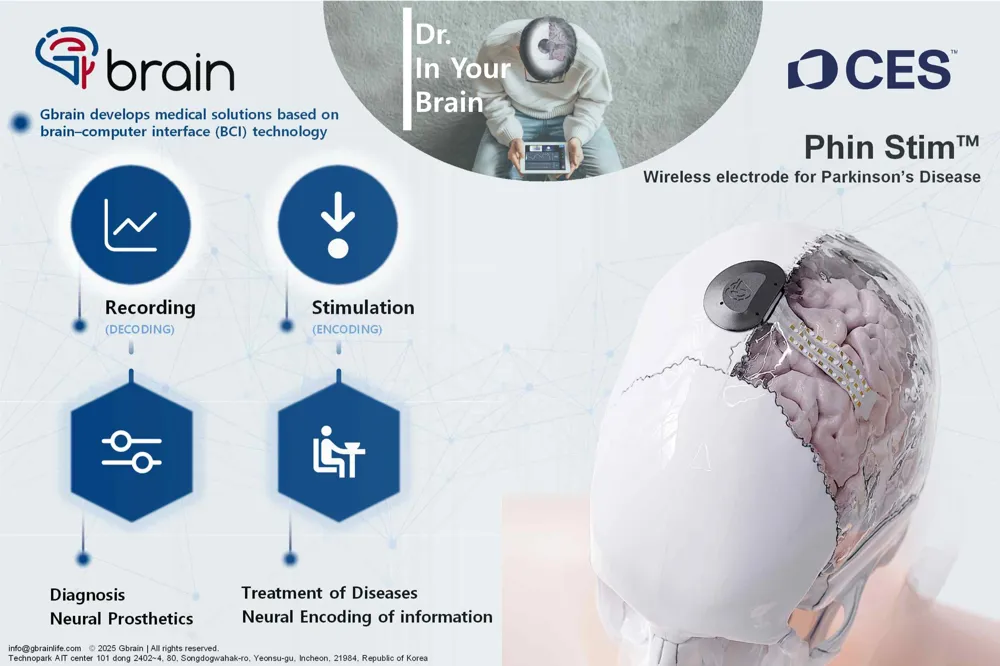
An ultra-thin flexible electrode is implanted in the motor area of the brain of a Parkinson's disease patient to monitor brainwaves in real-time. An AI algorithm then delivers customized electrical stimulation tailored to tremors and bradykinesia,This is a fully implantable wireless neurostimulation system (electronic medicine). .
HonoreekoDigital HealthAI 기반 치료IoT 의료기기디지털 헬스원격 의료파킨슨병 치료개인 맞춤형 치료
Phin Stim™ 파킨슨병 치료기
68
0
Gbrain
One-Line Product Definition
Problem Definition
Parkinson's disease is a progressive condition where the effects of medication gradually diminish and side effects accumulate. Many patients experience tremors or motor function decline that doesn't respond to medication. For these individuals,Deep Brain Stimulation (DBS)is an alternative brain surgery. However, it is a high-risk procedure that involves opening the skull and inserting electrodes deep into the brain, causing many patients to hesitate due to fear or financial burden.
Additionally, DBS involves electrode wires passing through the brain and a battery pack implanted in the chest, which carries risks of infection and the need for periodic battery replacement surgeries.
Therefore, there was a clinical concern: *"If medication doesn't work, is major brain surgery the only option?"* Gbrain researched less invasive treatments that are effective without deeply penetrating the brain. Phin Stim is an alternative developed to overcome theselimitations of DBS (invasiveness and fixed stimulation)and offers a new, less burdensome treatment option for Parkinson's patients.
Key Differentiators
Unlike conventional DBS, Phin Stim inserts an ultra-thin film electrode onto the surface of the brain (motor cortex). It significantly reduces risk by only creating a small hole in the skull and sliding the film in, avoiding deep insertion of electrodes into the brain. The thin electrode minimizes brain tissue damage and inflammatory response, and it is easy to remove or replace later.
Additionally, this system has no internal battery and is powered wirelessly. When the patient wears a band-shaped wireless charging device on their head, power is supplied to the implanted device through the skin, and data is also transmitted wirelessly, eliminating the need for wires or ports penetrating the skull. This reduces the risk of infection and increases the convenience of the patient's daily life.
The most innovative aspect is real-time brainwave monitoring and AI-based personalized stimulation. When the sensor implanted in the brain detects abnormal brain signals from the patient (such as patterns indicating the onset of tremors), an AI algorithm immediately calculates appropriate electrical stimulation parameters to stimulate the corresponding brain area, thereby alleviating symptoms. This is called closed-loop adaptive stimulation. Because the device automatically responds to changes in the patient's condition, the stimulation effect is maximized and side effects (such as overstimulation) are reduced. Furthermore, it is designed to help reorganize brain neural circuits (inducing neuroplasticity) through continuous brain stimulation, thereby improving motor function in the long term.
In summary, Phin Stim is a next-generation electronic medicine platform that combines less invasiveness, wireless technology, and intelligence, representing an innovation that sets it apart from existing brain stimulation treatments.
Key Benefits
The cost will be covered by the health insurance system or the patient. Phin Stim is a B2B (hospital) medical device that doctors must implant through surgery, so the hospital purchases/introduces the device and performs the procedure on the patient. Therefore, if health insurance applies, the government/insurance corporation (B2G) will bear the cost, and if it does not apply, the patient (B2C) will bear the cost out of pocket.
Currently, only a small percentage of Parkinson's patients are candidates for DBS, but if Phin Stim is commercialized, the market may expand as patients who were hesitant about surgery may newly consider treatment. Specialized brain disease hospitals or university hospitals are expected to be the initial adopters, and neurosurgeons can be said to be the functional buyers of this product.
From Gbrain's perspective, after obtaining domestic and international regulatory approvals, it will conduct B2B marketing targeting hospitals that want to replace/supplement deep brain stimulation, and patients will receive the service at the discretion of their doctor. In summary,healthcare providers (B2B)and the insurance system share the purchase cost, and the patient indirectly benefits.
Scalability
This technology platform can be applied to the treatment of epilepsy in addition to Parkinson's disease, and in the future, it can beexpanded to Brain-Computer Interface (BCI)and developed into an implant for controlling digital devices. In fact, Gbrain has a vision to integrate BCI functionality in the future, using Phin Stim's brainwave sensing capabilities to allow users to control digital devices with just their thoughts.
Also, while it currently uses motor cortex stimulation, next-generation versions can be applied to other brain regions to expand the portfolio to electronic medicines for mental/cognitive disorders such as depression and dementia. The fully wireless implant hardware is a platform technology that can be applied to various diseases in collaboration with other startups/research institutions.
In terms of regulation, it is a high-risk medical device that will require significant time and cost for clinical trials and approval, but preclinical data is already being accumulated with government support in Korea and other countries. Gbrain has received consecutive Innovation Awards at CES 2025 and 2026, gaining international attention, which has increased the possibility of partnerships or investment attraction with global pharmaceutical/medical device companies. Since the Parkinson's patient market is huge, with millions of patients, it has the potential to become a global medical solution if successful clinical results are achieved.
Judges' Evaluation
"Opened a new era of brain-implanted electronic medicine" – The CES Innovation Awards Committee and neurologists evaluate Phin Stim in this way. At the time of winning the CES Innovation Award last year (2025), it was noted as a *"paradigm shift in the treatment of Parkinson's and epilepsy,"* but this year it received rave reviews comparable to Best of Innovation with a more advanced prototype. In particular, the American brain science community is anticipating clinical results, saying that *"it would be a game-changer if the effects of deep brain stimulation could be achieved less invasively."
Patient community media such as EpilepsyU also introduced it as *"an innovative brain implant has been released,"* saying that it is giving hope to patients with intractable epilepsy as well as Parkinson's disease. In terms of technological completeness, Gbrain's originality is recognized in ultra-thin electrode manufacturing and wireless power transmission technology, and the AI adaptive stimulation concept is evaluated as being in line with the times.
Of course, since it is a medical device, there is also a cautious view that *"actual effectiveness and safety must be proven through human clinical data."* Also, since it is expected to take several years or more to commercialize, patients are eagerly waiting, so there is currently a coexistence of anticipation and caution. However, overall, Phin Stim is praised as a *"bold challenge in a meaningful direction"* and is being accepted as an innovation that everyone hopes will succeed, rather than an overestimation.
Analyst Insights
🧪 R&D and concept verification stage – It is an advanced brain science R&D product with great potential to change the landscape of Parkinson's disease treatment, but it still has to overcome the mountains of clinical verification and licensing, so it is a stage that requires cautious expectations until commercialization.
Product demo video: Epilepsy Foundation – Gbrain PhinStim Interview (YouTube) (Video of researchers explaining at the CES 2026 booth)
The award list data is based on the official CES 2026 website, and detailed analysis content is produced by USLab.ai. For content modification requests or inquiries, please contact [email protected]. Free to use with source attribution (USLab.ai) (CC BY)
댓글 (0)
댓글을 불러오는 중...