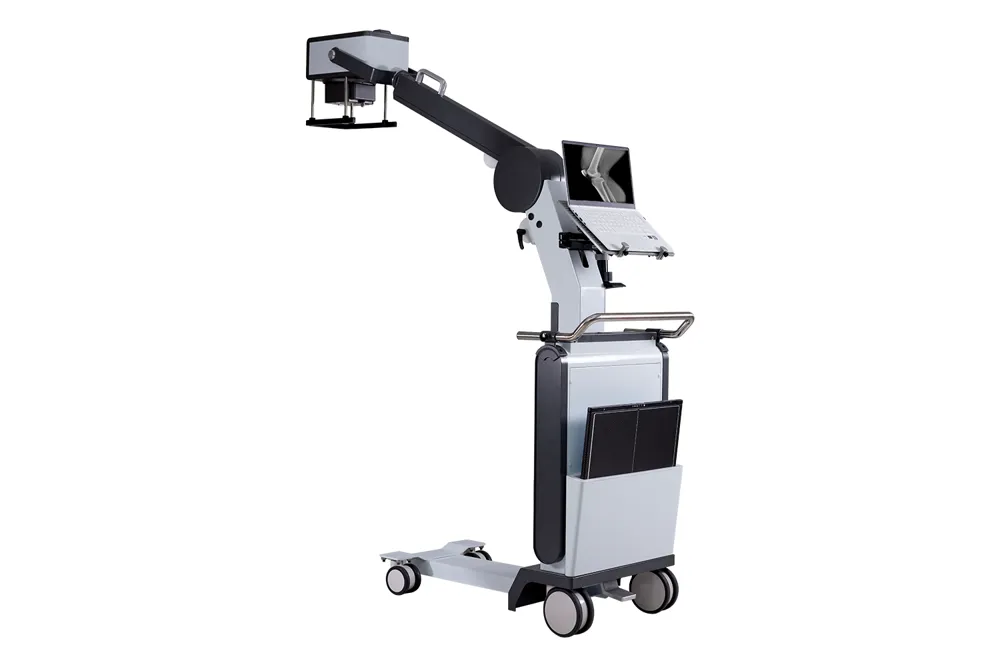
AI-integrated portable X-ray equipment for hospital emergency rooms, trauma sites, and telemedicine – A solution that dramatically reduces radiation exposure and reading time by allowing users to specify the examination area with touch gestures and providing AI readings within 3 seconds.
HonoreekoProducts in Support of Human Security for All이동형 엑스레이AI 진단방사선량 최소화스마트 콜리메이터영상처리 기술원격 의료
XBILE (엑스바일)
3
0
GEMSS Healthcare
One-Line Product Definition
Problem Definition
Traditional X-ray imaging requires radiologists to manually adjust the collimator (irradiation area diaphragm), and reading the images takes time, making rapid diagnosis difficult in emergency situations. Furthermore, portable X-ray equipment still weighs well over 100 kg, limiting mobility, and the problem of unnecessary peripheral radiation exposure during imaging persists.
Ultimately, there was a need for "lightweight, smart, and safe X-rays" in emergency or mobile medical situations, but existing solutions were limited by heavy equipment and reliance on skilled personnel.
Key Differentiators
XBILE has revolutionized the imaging procedure with smart drawing & targeting technology. By simply drawing the area to be diagnosed on the live X-ray image with a finger, the intelligent collimator instantly adjusts the radiation field to that area, blocking unnecessary peripheral exposure [36]. This minimizes patient exposure while enabling accurate imaging.
In addition, built-in high-performance AI detects abnormalities with 96% accuracy within 3 seconds of imaging, helping medical staff make quick decisions [37]. For example, in an emergency, AI can immediately indicate whether there is a fracture or pneumothorax, so treatment is not delayed even in the absence of a specialist.
From a mechanical perspective, its lightweight design of less than 98 kg (much lighter than comparable equipment) allows one person to push and move it between ambulances or hospital wards, and the 3.5-hour fast-charging battery allows it to be used outdoors or in disaster sites [38][39]. In other words, it is superior to similar equipment in that it has portability + immediacy + precision.
Key Adopters
Focusing on B2B, the main buyers are general hospital emergency rooms, radiology departments of small and medium-sized hospitals, military surgeons/medical units, and ambulance operators. In particular, emergency medical institutions will consider this equipment for diagnosis within the golden time, and it is also useful in local hospitals or mobile screening centers that conduct telemedicine.
In addition, disaster response agencies (such as fire departments) can introduce it for disaster sites. Individual consumers will not purchase it directly, and public health (B2G) can also purchase it to bridge the medical gap (e.g., payment to health centers in remote islands and mountainous areas).
Scalability
As a medical device, it must obtain approval from each country (FDA, CE, etc.), but the market potential is great due to the increasing demand for digital health and telemedicine. As GEMSS has already exported imaging equipment to about 50 countries at home and abroad, global expansion is also expected [40][41].
This technology can be applied to other imaging equipment such as portable CT or dental X-rays in the future, and AI reading software can also be expanded to cloud services. In addition, it is evaluated as a technology related to the UN's Human Security for All (HS4A) initiative, and there is room for it to be used for health support in developing countries [42][43].
As the scope of remote reading is widened in line with the trend of deregulation, a new market will open where AI and machines are paired to diagnose even in places where there are no doctors.
Judges' Evaluation
Selected as an Innovation Award related to the theme of "Human Security for All" at CES 2026, highlighting that the technology contributes to the safety and health promotion of mankind [42][43]. Experts praised it as "equipment that breaks down the barriers of time and space that hindered on-site diagnosis" and highly praised the automation of collimation with simple touch operation [36].
In particular, a medical imaging expert commented, "Increasing the speed of diagnosis while reducing radiation exposure is a win-win for patient safety and efficiency." However, there are also realistic concerns that legal liability issues for AI diagnosis and collaboration protocols with specialists in the medical field must be established for actual commercialization to be smooth.
Currently, the technology demo through CES is successful, and domestic and foreign health media are also expressing expectations, saying that it is a "solution that will change the emergency medical paradigm" [41]. Market verification depends on the speed of adoption in the medical community, but there is little disagreement about innovation.
Analyst Insights
⚠️ Impressive technology but market uncertainty – It is an innovative device that can change the landscape of the medical field, but regulatory approval and trust building must precede in the conservative medical industry, so commercialization and sales performance are expected to take time.
The award list data is based on the official CES 2026 website, and detailed analysis content is produced by USLab.ai. For content modification requests or inquiries, please contact contact@uslab.ai. Free to use with source attribution (USLab.ai) (CC BY)
댓글 (0)
댓글을 불러오는 중...