GENKS CO., LTD.'s GENKS Water Purification System is an eco-friendly water purification solution that uses AI-powered solar robots to remove harmful algae and restore ecosystems.
HonoreeSustainability & Energy Transition정수 시스템휴대용모바일수질 관리필터 기술위생
GENKS Water Purification System
0
0
GENKS CO., LTD.
One-Line Product Definition
Problem Definition
When algal blooms such as green tides and red tides occur in lakes or reservoirs, serious problems arise, including mass fish deaths, foul odors, and increased water treatment costs.
Existing water quality improvement methods have relied on the input of chemical agents (such as copper sulfate) or dredging and sludge removal, but the former has a toxic effect on the ecosystem, and the latter requires heavy equipment, resulting in enormous costs and time. In addition, these are only temporary measures, and pollution recurs after a certain period, creating a vicious cycle.
In other words, there is a need for an eco-friendly and sustainable water purification solution, but there is a lack of suitable technology. Local governments and other water quality managers are struggling with budget shortages and high long-term maintenance costs.
Key Differentiators
The GENKS system is innovative in that it improves water quality using only natural materials and AI control, without toxic substances or heavy equipment.
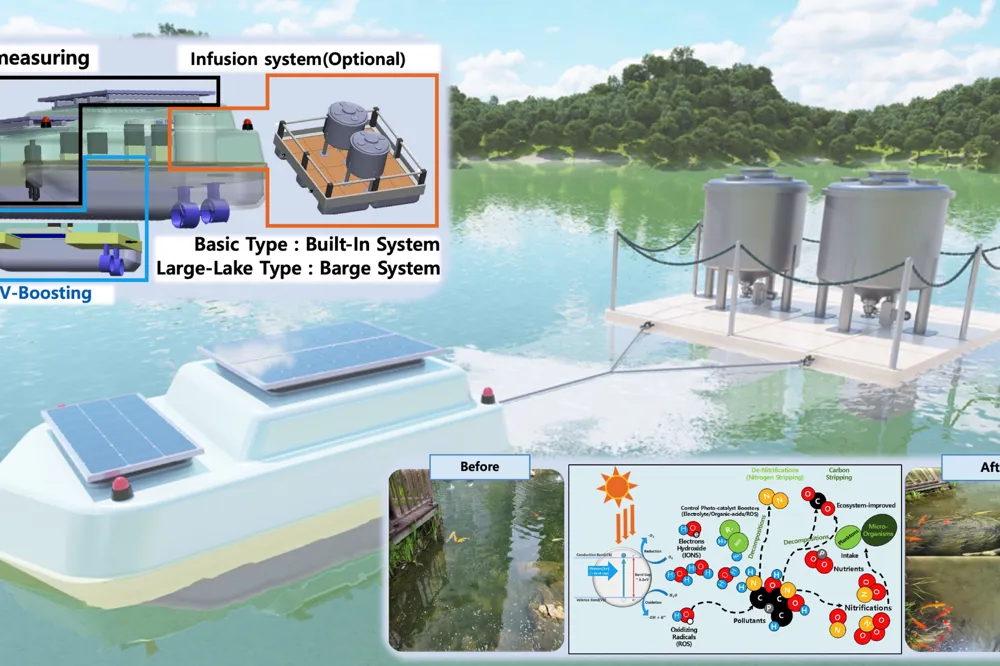
The core purification mechanism is a calcium-based photocatalyst obtained from discarded oyster shells, which decomposes harmful algae and organic pollutants in water when exposed to sunlight, but does not cause secondary pollution. The solar-powered unmanned robot equipped with this eco-friendly purifier travels around the reservoir, spraying and mixing the purifier, and measuring water quality data in real time with built-in sensors.
The digital twin AI uses the data collected in this way to map the pollution distribution and the robot's path and throughput toPrecision Control (Surgical-Grade Purification)resulting in 60% higher processing efficiency. As a result, the aquatic ecosystem (fish, aquatic plants) is revived without separate dredging,"Water Purification + Ecosystem Restoration"achieving both goals. In addition, AI optimization reduces purifier and energy waste, lowering the treatment cost per ton to $0.8, which is 1/3 of the traditional method ($2–3).
Key Adopters
Government and local governments (B2G)are the main customers, and it is expected that the Environmental Protection Agency, which is responsible for lake and river management, will introduce it at the city and county level.
Also,Reservoir or fish farm operators (B2B)are also targets. For example, in fish farms, this system can be used to purify water, reducing fish deaths and the use of antibiotics. Public institutions such as the Korea National Park Service and the Korea Water Resources Corporation can also use it to manage lakes in natural recreation areas and improve water quality in water source protection areas.
Currently, it is being piloted in several local governments in Korea to verify its algae control effect, and it is expected to be exported to overseas markets where water pollution is serious, such as Southeast Asia, in the future.
Scalability
This solution isModular (Robot Unit Expansion)so it can be applied to suit the size of everything from large lakes to small ponds, making it widely applicable worldwide.
In the future, it will be possible to expand its functions to overall water resource management, such as river flow control and flood forecasting, by advancing the AI model.
In terms of regulations, an environmental impact assessment must be conducted on the environmental input of the purifier and the operation of the robot, but it is expected to be approved without any problems after proving its non-toxicity. In addition, the use of solar energy results in low carbon emissions, which may promote the distribution of environmental policy subsidies from various governments.
However, in the conservative public procurement market, accumulating empirical data and securing a budget are key, and it is expected that references will increase in the future as the CES award has secured technological reliability.
Judges' Evaluation
The environmental field expert evaluation team described the GENKS system as a "game changer for sustainable water quality management." It is said that the Innovation Award was unanimously awarded by the judges for achieving ecosystem restoration without toxic chemicals and greatly improving economic efficiency.
The domestic media also reported that "This technology, which made the explosion risk 0, also captivated CES," calling it a remarkable achievement as a domestic environmental venture. Regarding the completeness of the technology, it is said that it has already gained trust by showing visible results in field application tests.
However, along with the criticism that "there are still realistic barriers such as government budget allocation and bureaucratic passage," how to scale up in competition with large water treatment companies is mentioned as a future task. Overall, it is highly evaluated in terms of innovation and public interest, but it is evaluated that policy support is key to the actual market impact.
Analyst Insights
🔥 High Marketability (Global demand for eco-friendly water purification is high, and widespread adoption is expected in the public and private sectors).
The award list data is based on the official CES 2026 website, and detailed analysis content is produced by USLab.ai. For content modification requests or inquiries, please contact contact@uslab.ai. Free to use with source attribution (USLab.ai) (CC BY)
댓글 (0)
댓글을 불러오는 중...