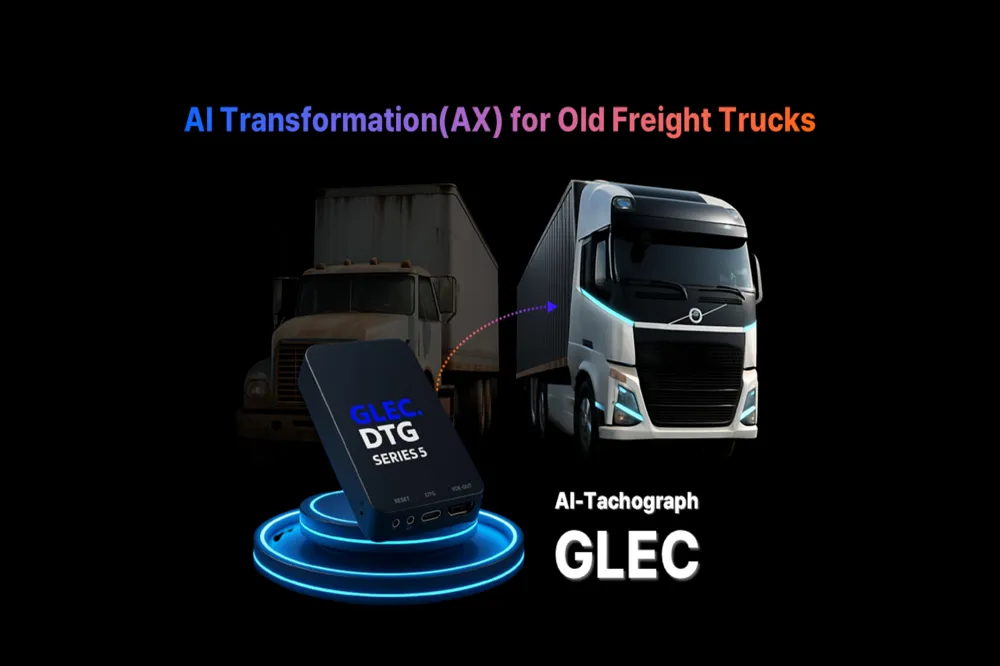
"AI Digital Tachograph for Trucks" – A next-generation digital tachograph installed in large trucks to collect and analyze driving data in real-time, providing driver fatigue warnings and carbon emission monitoring.
HonoreekoSupply & LogisticsAIADAS타코그래프운전 분석사고 예방안전 운전
글렉 AI 타코그래프
26
0
GLEC Inc.
One-Line Product Definition
Problem Definition
The logistics industry has been recording driving hours with driving recorders (DTG), but existing devices only collect data and are insufficient for accident prevention or carbon management. In particular, major accidents due to drowsy driving occur every year, but it is difficult to prevent accidents due to the lack of a real-time warning system.
In addition, there were limitations in carbon management and regulatory compliance at the transportation company level because the carbon emissions of each truck could not be accurately calculated. Furthermore, small self-employed trucks were reluctant to share data, making it difficult to collect driving data in the first place.
GLEC AI Tachograph was developed to solve these problems with AI and IoT, reduce safety accidents and carbon emissions, and help data-driven logistics operations.
Key Differentiators
GLEC AI Tachograph isthe world's first driving recorder with a built-in hyperscale AI model (20 billion parameter LLM)in a vehicle terminal. CAN communication data (vehicle speed, engine information), GPS routes, real-time traffic conditions, etc. are integrated usingits own Vehicle Context Protocol (VCP),and AI trained on past accident-prone area patterns is run in real-time to provide drivers with voice and visual warnings in dangerous situations.
Test results show that this reduces the risk of accidents by 20-40% by detecting drowsiness and fatigue. At the same time, it automatically calculates carbon emissions per mileage according to the ISO 14083 international standard, and supports regulatory reports and carbon credit issuance by uploading to the cloud.
With built-in LTE communication, driving data is automatically collected even if the driver does not cooperate, and the operator can monitor the safety, fuel efficiency, and carbon information of all vehicles on a real-time dashboard and make data-driven decisions. In short, it is an integrated solution that simultaneously implements legal driving records + AI safety system + carbon management in one device.
Key Adopters
The main customers are B2B logistics transportation companies and vehicle control solution companies. For example, this device can be installed in vehicle units of large logistics companies to reduce accidents and respond to carbon regulations.
Also,it is possible to collaborate with truck manufacturers (complete vehicle companies)to install it as standard equipment in new cars, or for insurance companies to encourage customers to install it as a risk reduction device.Individual truck drivers (B2C)are likely to be introduced through the company because of the initial cost burden of direct purchase.
In the government (B2G), this AI tachograph can be certified and adopted in the mandatory policy for truck driving recorders and subsidized. In overseas markets,it can be entered through partnerships with logistics IT solution companies (B2B2B),or international transportation companies can introduce it for carbon management purposes.
Scalability
This product is in line with the global trends of safety (accident reduction) and environment (carbon reduction), so there is a large market. In particular, demand is expected to surge due to the mandatory digital tachograph and 강화된 carbon emission regulations in the EU and other regions.
In terms of technology, additional services such as predictive logistics and optimal route recommendation can be expanded in the future with the collected big data. In addition, the solution can be converted to adjacent fields such as passenger transportation such as buses and construction machinery management.
Regulations are largely limited to compliance certification with the Traffic Safety Act, and rather, it can benefit from the government's carbon reduction support policies. Currently, it is also pursuing Smart Freight Centre certification for the first time in Korea in accordance with the ISO 14083 standard, thereby securing global reliability.
Overall, the conservative logistics industry is at a point where data-based innovation is inevitable, so if the market is preempted as a first mover, it is worth aiming for industry standardization.
Judges' Evaluation
"Leading Digital Transformation in the Logistics Industry"It was recognized with the CES 2026 Innovation Award (Supply Chain & Logistics). The judges gave high scores to the engineering achievement of mounting the AI model on the vehicle terminal and the practicality of achieving both safety and environment.
"AI Brain Implanted in Old-fashioned Trucks","Opened the Era of Carbon Management with Trucks"There were favorable reviews, and the fact that a startup caused innovation in a conservative area such as logistics was also viewed positively. Domestic and foreign media repeatedly cited the "20-40% accident reduction" figure and emphasized the technical effect, and 주목했다 it as an essential tool for ESG management.
On the other hand, some expertsmentioned "the possibility of being ultimately absorbed into autonomous driving"and asked questions about the long-term roadmap. However, for now, the evaluation of the 평단의 is very favorable as a timely problem-solving innovation.
Analyst Insights
🔥 High Marketability – In the logistics industry, where regulatory compliance and cost reduction are essential, there is a clear demand for safety + carbon solutions, and as the first product to 선점 international standards, the possibility of global commercialization is also high.
The award list data is based on the official CES 2026 website, and detailed analysis content is produced by USLab.ai. For content modification requests or inquiries, please contact [email protected]. Free to use with source attribution (USLab.ai) (CC BY)
댓글 (0)
댓글을 불러오는 중...