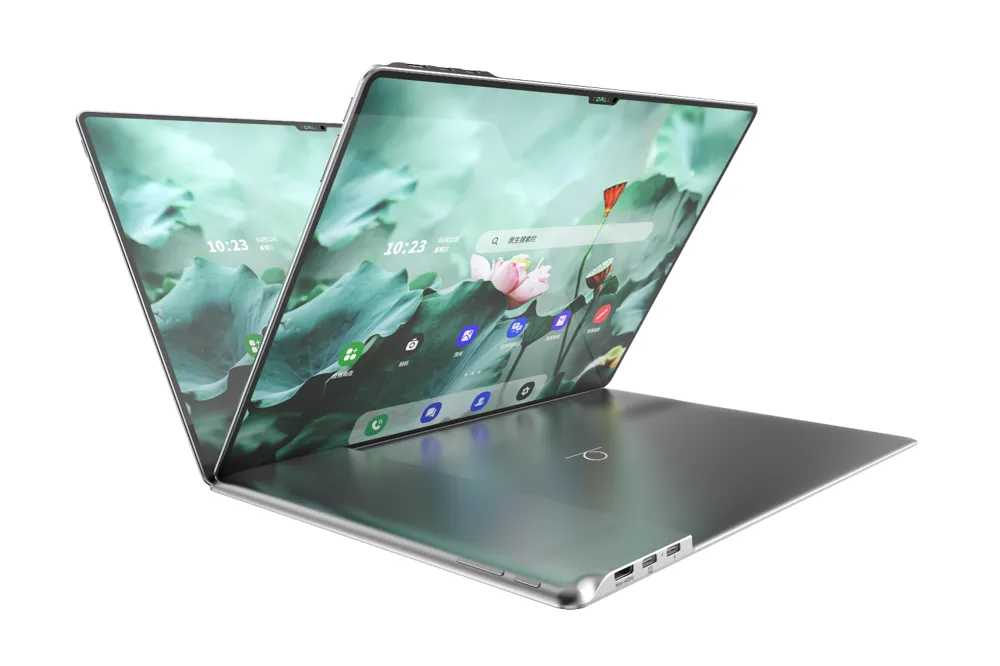
An Android tablet featuring a 13.2-inch flexible AMOLED display and an ultra-slim 3.1mm body,with a weight as light as a sketchbook (approximately 400g)and providing a smooth writing experience, yet powerful enough to be used as a PC monitor, making it the world's thinnest tablet.
HonoreeMobile Devices무선 통신산업 자동화효율성 증대사용자 경험디지털 전환데이터 분석
Paper
42
0
Haining Toall Technology Co.,Ltd
One-Line Product Definition
Problem Definition
While portability is crucial for tablets, increasing screen sizes often lead to greater thickness and weight, making them cumbersome for extended use. Digital drawing and design professionals, in particular, have been seeking a large-screen device as light as a paper sketchbook, but existing tablets weigh hundreds of grams and cause wrist fatigue. Furthermore, even high-performance tablets like the iPad, with a thickness of around 5mm, fall short of delivering a "paper-like feel," limiting the realization of analog sensibilities.
The desire for "a lightweight digital canvas that feels like carrying a notebook" has been technically challenging. The Paper tablet emerged to address this thirst for reduced weight and thickness, and to realize the free drawing experience desired by digital creators.
In summary,"Thin and light for portability and prolonged use"is the result of pursuing this obvious requirement to the extreme.
Key Differentiators
The most significant differentiator of the Paper tablet is its astonishing thinness and lightness. At 3.1mm thick, it is the thinnest tablet available, approximately 60% the thickness of the latest iPad Pro (5.1mm). Weighing around 400g, it is also significantly lighter than devices with comparable screen sizes, reducing strain even when held for extended drawing sessions.
To achieve this extreme form factor, a unique design was adopted, making the port area slightly thicker – the main body is ultra-slim, while the USB-C×2 and mini HDMI ports are concentrated on a protruding rear section to ensure structural stability.
In terms of specifications, the 13-inch AMOLED display supports 120Hz mirroring for smooth visuals, and high-end specs such as 8GB/16GB RAM and 256GB/512GB storage make it a capable Android tablet. Although powered by a proprietary ultra-thin battery and circuitry, battery life is limited to around 3 hours, a trade-off. Instead, a dedicated keyboard case with an additional battery is included for several more hours of use, or it can be designed for charging while in use.
In conclusion,"Sacrificing some battery for extreme thinness"is the bold choice that gives Paper its differentiating factor: the experience of holding actual paper.
Key Adopters
Paper primarily targets digital artists, illustrators, and designers –creative professionals (prosumers).Payments will likely be made directly by these individuals or by their studios/companies for necessary personnel (B2C and some B2B).
Among general consumers, students who value tablet writing feel or note-taking enthusiasts are secondary targets. However, given the estimated price of $1,500 and short battery life, sales are expected to focus on professionals/enthusiasts for the time being.
As it is not a mass-market product, B2B bulk purchases or B2G procurement are unrealistic; individual purchases will be the main channel. In other words, the key adopters are creative professionals who are already considering high-end drawing devices (such as Wacom Cintiq) and decide to purchase it.
Scalability
The Paper tablet appears to be a limited, concept-driven product for now, but its technology can be applied to various devices in the future. Ultra-slim AMOLED and ultra-thin battery technology can be used to innovate the thickness of laptops or foldable devices, and Toall has the potential to grow into a brand of digital tools for artists, starting with Paper.
However, the product's own scalability is limited as an all-day tablet for general consumers due to battery constraints. Unless battery life is improved, it will remain a device for studio sessions as it is now.
In terms of the market, a strategy targeting a niche market rather than mass sales is expected. It will likely launch in countries with many creators, such as the United States, and then release a second-generation product based on feedback. As it has pioneered a new segment with little direct competition, gradual improvements through evaluation/R&D stages could provide an opportunity for general tablets to evolve into ultra-thin designs in the future.
In summary, while currently limited to creative-specific devices, its technological impact has the potential to extend to other mobile devices.
Judges' Evaluation
Experts who experienced the Paper tablet at CES were amazed, saying, *"It's unbelievable that such a thin device actually works."* Major IT media outlets like Tom's Guide praised Paper as a technological innovation, commenting that *"it makes the iPad Pro feel thick."* The unique feel resulting from the 3.1mm thickness (like holding paper) was well-received by digital artists, with the evaluation that it is *"optimal for long drawing sessions."
However, all reviewers pointed out the 3-hour battery limit, understanding it as *"a device for focused sessions, sacrificing battery for portability."* Market expectations are realistically lower than the level of innovation.
In other words, there is no disagreement that Paper has presented the direction of next-generation tablets, but there is also a skeptical view of *"how many will actually be sold at this price right now."* Overall, it is evaluated as *"definitely innovative but still niche-professional,"* positioned somewhere between a technology demo and a commercial product.
Analyst Insights
📌 A solution limited to a specific niche – Despite the technological achievement of being the world's thinnest tablet, the product shines in limited uses such as digital art/design due to battery life, making it more of a concept validation than a popular hit.
The award list data is based on the official CES 2026 website, and detailed analysis content is produced by USLab.ai. For content modification requests or inquiries, please contact [email protected]. Free to use with source attribution (USLab.ai) (CC BY)
댓글 (0)
댓글을 불러오는 중...