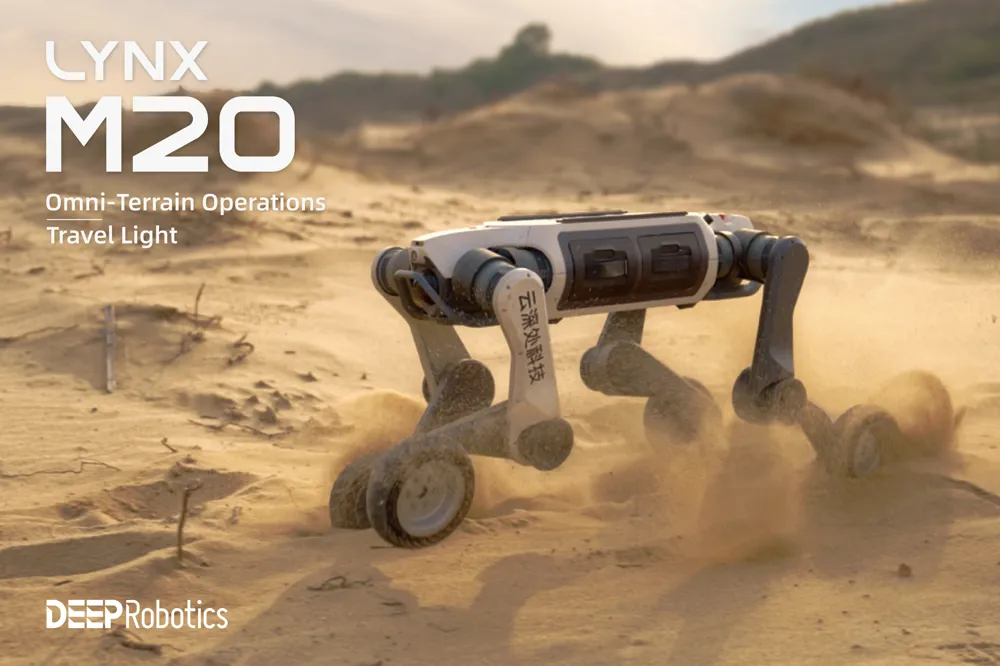
The world's first medium-sized wheel-leg hybrid robot, an industrial quadruped robot with high-speed driving (up to 5m/s) and powerful loading and climbing capabilities in complex terrain and hazardous environments.
HonoreeRobotics로봇공학자율 이동스마트 시티지속가능성GhostPass CityFlow안전 기술
Lynx M20 Pro
48
0
Hang Zhou YunShenChu (Deep Robotics)
One-Line Product Definition
Problem Definition
There is a need for robots to work in environments where humans are at risk, such as industrial facilities and disaster sites. However, existing robots have limitations: wheeled robots struggle to climb obstacles, and legged robots are slow, limiting their mobility. Additionally, limited battery life and payload capacity make it difficult to perform long-duration missions, and reliability in extreme environments (high altitudes, extreme temperatures, etc.) is also a concern. While quadruped robots like those from Boston Dynamics are agile, they are not as fast as wheeled robots, and existing medium-sized robots are bulky and lack maneuverability. In other words, there has been a trade-off between speed and terrain adaptability.
Key Differentiators
Lynx M20 Pro combines the functionality of legged robots with wheels, allowing it to utilize both walking and wheeled locomotion. Its in-house developed high-output joints and IP66-rated dustproof and waterproof design ensure durability in harsh environments. In terms of performance, it can travel at a very fast speed of up to 5 m/s for a robot, and demonstrates excellent climbing ability, such as climbing 25cm stairs and overcoming 80cm high single obstacles. It can also climb a 45° slope and travel 12km for 2.5 hours with a maximum load of 15kg, demonstrating excellent continuous driving performance. It successfully carried out an oxygen tank transport mission in the unmanned Hoh Xil plateau for the first time in the world, proving its reliability in harsh real-world environments. This is an example of field-proven robustness and usefulness compared to competing robots. In summary, it is a differentiated robot with the speed of wheels, the terrain adaptability of legs, and industrial-grade loading capacity.
Key Adopters
The main target is the B2B industrial sector. For example, companies involved in power facility inspection (power plant, transmission line patrol), factory/warehouse automatic patrol, and mine and plant safety inspection may consider adopting it. It can also be used by fire and disaster relief agencies (B2G) for search and rescue and material transportation in disaster areas, and can be adopted in the field of scientific exploration (polar/alpine research, etc.). The B2C market is limited as it is not intended for general consumers, and additional demand is expected in special industries (B2G) such as the defense sector. Currently, pilot applications are underway, mainly with companies and public institutions.
Scalability
This robot is IP66-rated for dust and water resistance, so it has few restrictions in outdoor environments, and it is designed to operate in extreme temperatures from -20°C to +45°C, so it can be deployed in a variety of environments (data on cryogenic/high-temperature environments are estimated based on the product manual). In terms of regulations, only industrial robot safety standards need to be met, and only FCC/CE radio wave certification related to autonomous driving is required. Industrial/market scalability is high, and it can pioneer ground mission areas that are difficult to perform with existing vehicles or drones. In the future, the application range can be expanded to military reconnaissance, agriculture (patrolling large farmlands), and logistics (last 1km delivery), and if the platform is opened and third-party sensors or operating arms are attached, it can be used for multipurpose purposes. However, since it is an expensive piece of equipment, the initial market will be limited to niche (specialty industries), but the market is expected to expand as performance is continuously proven.
Judges' Evaluation
In the CES Innovation Awards judging, the Lynx M20 Pro was evaluated as a new evolution in robotics. The hybrid design of vehicle and robot, which combines adaptability to extreme environments and travel speed, was mentioned as a unique technology. In particular, the successful case of actual highland missions showed that it was a practical technology, not just a prototype, and received high scores. In terms of completeness, the fact that it secured practical operating hours such as 2.5 hours of autonomous driving was also impressive. Regarding market expectations, it was assessed as being ready for immediate industrial use, and was considered a hidden powerhouse rather than being underestimated. However, it was also pointed out that the commercialization price and the convenience of the operating software need to be verified in the future. Overall, it was cited as an award-winning work with excellent technical innovation and real-world applicability.
Analyst Insights
The technology is very impressive, but the market is limited to a specific niche. The Lynx M20 Pro is an aggregation of advanced robotics and demonstrates the highest level of performance currently possible.
The award list data is based on the official CES 2026 website, and detailed analysis content is produced by USLab.ai. For content modification requests or inquiries, please contact [email protected]. Free to use with source attribution (USLab.ai) (CC BY)
댓글 (0)
댓글을 불러오는 중...