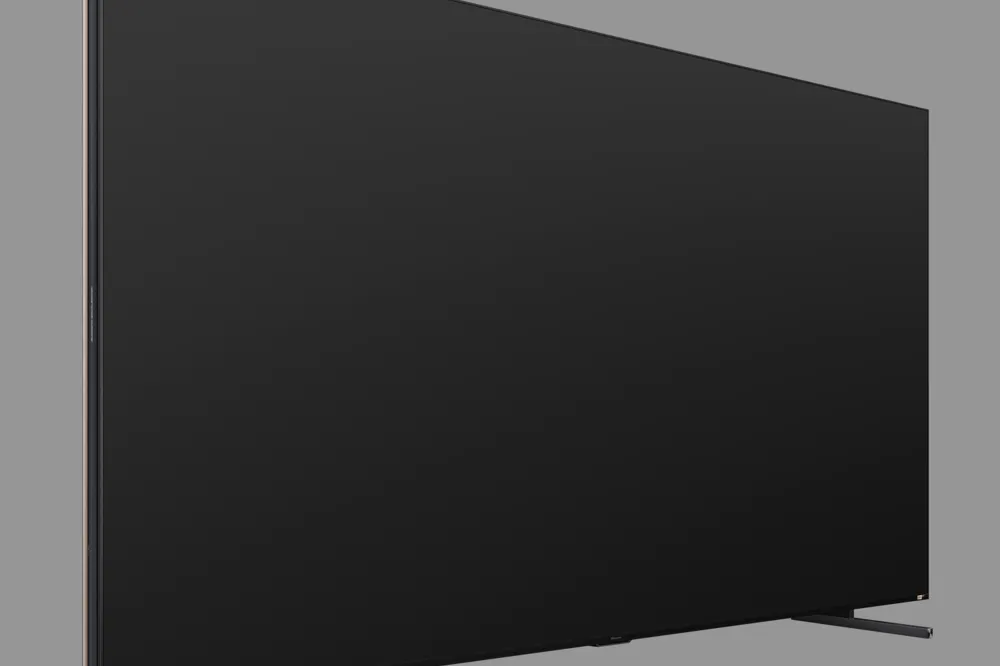
This 116-inch four-primary-color MiniLED TV overcomes the color and contrast limitations of existing LCD TVs to deliver more natural-looking images for ultra-large premium home entertainment [17][18].
HonoreeVideo Displays초대형 디스플레이고화질HDR비디오 처리 기술상업용 디스플레이홈 엔터테인먼트
116UXS
3
0
Hisense Visual Technology Co., Ltd.
One-Line Product Definition
Problem Definition
• Background Problem: General large-screen TVs (LCD-based) have problems such as decreased brightness uniformity as the screen size increases, contrast ratio limitations due to limited local dimming zones, and a lack of realism due to color reproduction limitations. In particular, existing LCD TVs use only white LEDs (or a mixture of blue and yellow) for the backlight, resulting in poor accuracy in some subtle color оттен expressions and gradations, and colors tend to be unnaturally oversaturated in bright HDR scenes [19]. This has caused inconveniences such as loss of detail in dark shadows and insufficient expression of natural colors such as skin tones [20].
• Limitations of Existing Methods: Existing high-end TVs have attempted to widen the color gamut through quantum dots, etc., but this is fundamentally limited to correction within the RGB three-primary-color system. In addition, even with local dimming MiniLED TVs, the number of dimming zones, even in the thousands, is insufficient to perfectly control contrast on screens larger than 100 inches, and it is difficult to maintain color accuracy while producing extreme brightness (thousands of nits or more) when implementing HDR.
The first-generation Hisense 116UX (2025 model) introduced an innovative RGB backlight, but it was not perfect, as minor color uniformity errors and backlight halo artifacts were observed [21]. In short, the problem to be solved was how to simultaneously achieve movie-like natural colors and high contrast ratios on large-screen LCD TVs.
Key Differentiators
• RGB+X Four-Primary-Color Backlight: The 116UXS differentiates itself from existing LCD TVs with its next-generation RGB-X MiniLED backlight. This four-color backlight architecture adds a cyan LED chip to the existing red, green, and blue (RGB) LED lighting, greatly improving the expressiveness of the cyan spectral region to which human vision is most sensitive [22][23]. As a result, this TV achieves a color space coverage of 110% of the BT.2020 color gamut and delivers more natural and smoother gradations and shadow details [18][23].
Thanks to the added cyan channel, color depth is maintained without oversaturation even in bright scenes, and subtle shade differences are expressed even in dark scenes, resulting in the overall evaluation that the video is “film-like, close to analog, and vivid” [20][19].
• Ultra-High Contrast Ratio Hardware Specifications: This product implements tens of thousands of local dimming zones (exact number of zones not disclosed, on the order of “tens of thousands”) on the largest existing 116-inch 8K LCD panel, enabling precise contrast control across the entire screen [24][25]. As a result, it is capable of ultra-high luminance HDR expression with a maximum peak brightness of 5,000 nits, while precisely controlling subtle contrast differences throughout the screen to minimize blooming and contrast jumping phenomena seen in existing LCDs [26][27].
This level of performance is extremely rare in the current market, allowing it to reproduce even the subtle tones and color nuances that existing LCD TVs have struggled with [27]. In addition, a 6.2.2-channel Dolby Atmos speaker system in collaboration with Devialet is built into the TV, providing magnificent sound suitable for a large screen without a separate soundbar [28][29]. The slim bezel and 39.9mm-thick slim design enhance immersion [30], and the Hi-View AI processor intelligently controls video and lighting to maintain color accuracy even during fast screen transitions [31].
In summary, the 116UXS is a flagship TV that shows a significant performance advantage in all aspects of color gamut, brightness, and contrast control compared to existing TVs.
• Note: Hisense is also pursuing a strategy of extending this innovation to smaller models. In other words, the RGB+cyan backlight technology (RGB MiniLED Evo) completed in the 116UXS is also applied to the 55-100 inch UR9 and UR8 series, and a roadmap has been announced to popularize the color accuracy and color separation that was only possible in the flagship [32][33]. This is a move towards improving the color quality of the entire lineup, not just differentiating a single product, and is a strategy to gain a clear advantage in color expression compared to competing TVs in the same class.
Key Adopters
• Adopters: The 116UXS is primarily aimed at customers who want to build a high-end home theater. As a B2C ultra-premium product, it is priced beyond the reach of most ordinary households, so it is realistically limited to wealthy individuals, AV enthusiasts, and high-end interior design needs. (The previous generation model, the 116UX, was priced at approximately $25,000 (early to mid 30 million KRW) at the time of its release [34].)
Corporations and public institutions may use it as a display for conference rooms, but since they are more likely to choose alternatives such as a projector + sound system for the same price, the main target is the individual market.
• B2C/B2B/B2G Classification: It is a B2C product and belongs to the luxury home category. For B2B use, it is not common except for limited cases such as installation in some luxury hotel suites, design studios, or broadcasting stations' special monitors. Government/public (B2G) is not applicable.
In short, it is a TV targeting the B2C ultra-luxury segment.
Scalability
• Specific Environment/Country Restrictions: The product itself is a global model that can be sold worldwide (the previous generation 116UX was also sold in North America, etc.). It is expected to meet the radio wave certification and power supply standards of major countries including Korea, so there will be no special regional restrictions.
However, due to its physical size and weight (estimated to be over 100 kg), the installation space and operating conditions are limited. It is excessive for general apartments or living rooms and requires a dedicated remodeled room or a place with a sufficiently wide wall. In addition, the power consumption is expected to be considerable due to the brightness of 5,000 nits, but the specific figures have not been disclosed.
There are no legal regulations at this time, but if energy efficiency regulations are strengthened in the future, such ultra-high luminance TVs may be affected.
• Expansion to Other Industries/Markets: The RGB+cyan backlight technology and high-density local dimming technology applied to the 116UXS can be sufficiently expanded to other models and markets. In fact, Hisense has announced that it will expand this technology to general premium TV series (UR9/UR8, etc.) under 100 inches [33], which means that improved color expression technology can be enjoyed even in smaller TVs within a few years.
Therefore, there is a high possibility that similar multi-color backlight technology will be adopted in high-end 75-inch to 85-inch TVs for home use in the near future. Furthermore, this approach can be applied to areas where precise color expression is important, such as professional reference monitors and medical displays.
• Expansion Limitations: However, looking at the 116UXS itself, sales will be limited due to the price and size of the product. In terms of scaling up, even if it is technically possible to make a larger LCD TV than this, demand is scarce, so 116 inches is likely to be the upper limit. Instead, expansion is expected to occur in the direction of technology dissemination in terms of scaling down.
Since competitors other than Hisense are also researching technologies to increase the number of miniLED local dimming zones and improve LCD image quality with dual-cell or RGB backlights, there is a possibility that it will spread throughout the industry. In short, the technology of this product may be expanded to lower models and other brands within the next 2-3 years, but the product itself is expected to be limited to a very small market at this time.
Judges' Evaluation
• CES Awards and Industry Evaluation: The Hisense 116UXS was selected as a CES 2026 Innovation Award (Honoree in the Video Displays category) and recognized for its technological advancements [35][36]. It has been praised as “achieving professional-grade accuracy in the home living room” and “redefining display color science” [37], and in particular, the bold introduction of a four-primary-color system for color reproduction along with the 163MX has attracted attention as it was included in the “Best of CES” list [12].
Experts positively evaluate Hisense's move to fundamentally improve the limitations of existing TVs, and expect that improved color accuracy and smooth gradation expression will be an “upgrade that general consumers can immediately experience.”
• Technical Completeness: Critics who directly experienced the first-generation model (2025 116UX) pointed out some color uniformity issues and insufficient backlight control, saying, “The first-generation product showed amazing color and brightness, but did not achieve perfect control” [21]. The second-generation 116UXS has evolved one step further with the RGB MiniLED Evo system to improve these shortcomings, and is being evaluated as a “natural step to precisely refine rough potential” [38].
In particular, it is expected that the addition of cyan will improve the color instability seen in the first generation, and experts analyze that the improved processor performance is likely to reduce local dimming artifacts. Initial reactions to the exhibited demo were also positive, with comments such as “dazzlingly bright yet stable color expression,” but there is also cautious optimism that verification is needed in an actual viewing environment [13].
• Market Expectations: The market's expectations for this product are limited compared to technical interest. Although it is technically an industry-leading specification, in terms of sales, the price of around $30k and the size of over 100 inches are expected to limit the number of actual buyers to a very small number of wealthy people. Therefore, the prevailing view is that “it received a lot of spotlight at the CES exhibition, but it will remain a symbolic flagship in the actual market.”
However, as Hisense has announced that it plans to quickly spread the technology to lower models [32], the industry is paying attention to the increase in the competitiveness of the entire lineup that this product will derive, rather than the product itself. This is because even if consumers cannot buy the 116UXS right away, they can expect similar color improvement in the 85-inch successor products to be released within 1-2 years.
Meanwhile, some AV media have commented that it is overhyped, citing the fact that the latest standards such as Dolby Vision 2 are supported, but their use is limited due to the lack of content, and that the excessively large screen is unrealistic for ordinary households.
• Overestimated/Underestimated Factors: The overestimated aspect is that the glamorous awards at CES make it seem as if this technology will immediately shake up the commercial TV market. However, in reality, this product will only be sold to a very small number of people, and there is a sober criticism that even if the addition of cyan improves the color, the perceived improvement may be limited because content production/transmission is tailored to the Rec.2020 standard.
Conversely, an underestimated factor is that Hisense is commercializing LCD backlight innovation faster than its competitors [32][39]. While Samsung, LG, etc. are also researching similar technologies but have not yet put them into commercial products, there is an opinion that Hisense's execution power in implementing new color display technologies for two consecutive years has not received sufficient recognition and market verification.
In short, there is an irony that it is technically undeniably impressive, but the opportunity to prove its value in the market is limited.
• Overall Review: Overall, it is summarized as “very positive based on the CES showcase, but the actual marketability is unknown.” Technology enthusiasts are cheering for innovation, while the mainstream market is taking a wait-and-see approach. Professional magazines such as What Hi-Fi? expressed cautious optimism, saying, “Everything looks great and improved on paper, but we will reserve judgment until we see the actual product” [13].
Analyst Insights
⚠️ Impressive technology but market uncertainty – While the expansion of the performance horizon of large TVs is commendable, commercial success is uncertain due to the realistic limitations of ultra-high price and ultra-large size. Hisense's rapid technology dissemination strategy will determine its success or failure.
The award list data is based on the official CES 2026 website, and detailed analysis content is produced by USLab.ai. For content modification requests or inquiries, please contact contact@uslab.ai. Free to use with source attribution (USLab.ai) (CC BY)
댓글 (0)
댓글을 불러오는 중...