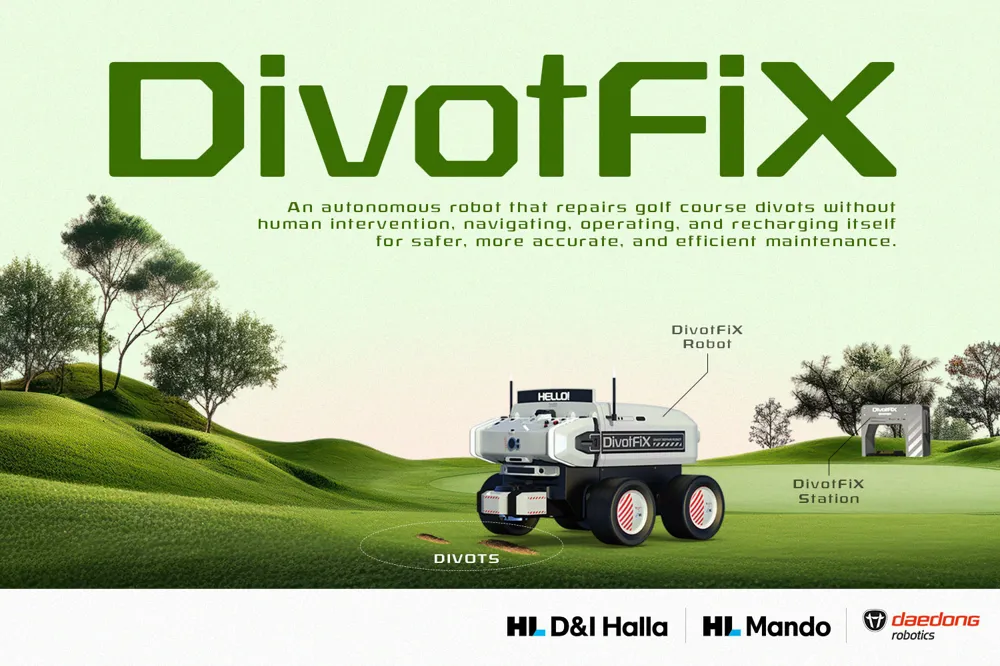
An autonomous robot solution for golf course operators that automatically repairs fairway turf divot damage, reducing labor risks and course damage.
HonoreekoRobotics로봇 기술AI 비전 센서엣지 컴퓨팅자율 시스템안전성 향상지속 가능성
디봇픽스(DivotFiX)
8
0
HL D&I Halla
One-Line Product Definition
Problem Definition
Divots that occur when players or users take shots on the golf coursedivots (turf displacement marks)lead to deterioration of course quality and turf dieback, requiring prompt repair. Currently, course maintenance personnel manually fill them with sand and seeds, which is labor-intensive and exposes personnel to the risk of being hit by golf balls while working on the field. In particular, people have to work even in the heat of summer or cold early morning climates, and it is difficult to constantly patrol the wide course, which can lead to turf damage due to neglected divots. In other words, there was a shortage of manpower and safety issues in divot repair.
In addition, the quality of manual work is inconsistent, which can lead to uneven turf or an increased risk of turf diseases (such as bentgrass blight) if not repaired in a timely manner. There were no previous cases of automating this problem, so there was great room for improvement in efficiency.
Key Differentiators
DivotFiX automatically recognizes divot locations by combining AI, LiDAR, and vision sensors, and the robot drives itself on the fairway. It accurately identifies damaged areas by linking with drone mapping data without the need for people to find them one by one (※ HL is also developing technology to identify divot locations with drones), and precisely applies the required amount of sand to the location with a robotic arm before pressing it down with a tamping device. After work, it returns to the charging and sand refill station to recharge and can work unmanned at night or early in the morning.
The sensors detect people and golf carts to avoid collisions, so it operates safely without interfering with play. The introduction of this robot makes employees safer without the risk of golf balls or exposure to heat waves or cold snaps, and repairs divots with consistent quality throughout the year, improving turf condition and reducing maintenance costs. Above all, it is the world's first case of divot repair automation, giving it a market-leading position compared to similar products.
Key Adopters
Golf course operating companies (B2B)and golf course management service companies are the main customers. Resorts and country clubs with golf courses can purchase directly, orGreenkeepers (course managers)can use the robot service. Also,local governments or public institutions (B2G)There is also room for introduction in public golf courses managed by.
It is not a product for individual golfers to buy, and it is likely to be sold at a high price in business-to-business transactions or provided as an equipment rental service. Initially, it is expected to be introduced mainly in large golf courses in Korea and major golf industries such as the United States and Japan.
Scalability
The current product is optimized for the specific purpose of repairing turf divots on golf courses, so its scope of application is limited. However, by expanding the concept, it can be derived into turf repair for sports fields that use turf (soccer fields, baseball fields, etc.), teeing ground maintenance, and bunker sand leveling robots.
Technically, the core is autonomous driving and precise spraying, so there is room for deployment in other industries such as agricultural robots and construction soil restoration. However, it is environmentally dependent, so it is necessary to prepare for weather effects so that it can operate in the open air, and there are market deviations depending on the golf course culture of each country (e.g., low necessity in small golf courses).
There are no special restrictions in terms of regulations, but the golf course must verify on-site harmony with existing personnel and algorithm optimization for each turf variety. As HL has already announced its vision for other robot businesses (logistics, etc.), it is expected to seek business expansion into the sports/leisure robot field, starting with this robot.
Judges' Evaluation
This product received great attention by winning two awards at the CES 2026 Innovation Awards (Robotics and Mobility) at the same time. In terms of technical completeness, professional companies such as HL Mando and Daedong Robotics collaborated to demonstrate a prototype, and actual pilot applications have shown results such as a twofold increase in yield, which is evaluated as highly realistic.
Market expectations are also positive, with many seeing it as "opening a new chapter in the golf industry." Considering the shortage of labor and the demand for automation, we believe that the potential is greater than underestimated. However, there are also cautious comments that initial adoption costs may be high and that it will take time for the market to form due to the traditionally conservative tendencies of golf courses. Overall, it has been well-received as a practical robot that enhances environmental value, and was mentioned as a case that combines innovation and business feasibility at the CES site.
Analyst Insights
📌 A solution limited to a specific niche – Innovative in the specialized field of golf course management, but not a generalized market. Within the industry, its innovation is high and is expected to be used mainly in golf courses that adopt it.
The award list data is based on the official CES 2026 website, and detailed analysis content is produced by USLab.ai. For content modification requests or inquiries, please contact contact@uslab.ai. Free to use with source attribution (USLab.ai) (CC BY)
댓글 (0)
댓글을 불러오는 중...